
John Perry: The US Constitution Bars Those “Engaged in Insurrection” From Office – So Will Nicaragua’s Nicaragua’s electoral reforms seek to defend popular sovereignty as Washington intensifies its interference in Latin American elections. There is nothing unusual about Nicaragua’s reforms. Practically all western countries have strict laws preventing foreign interference in elections. Not only is this the case in the US, but its constitution even specifically debars people from holding public office if they have “engaged in insurrection or rebellion” against the state or given “aid or comfort to the enemies thereof.”
Nicaragua is simply trying to protect its electoral process from foreign interference – overwhelmingly sponsored by Washington – in its politics. Such interference has been going on for decades and is intensifying. Of particular significance to Nicaragua was Trump’s blatant interference in the elections in neighboring Honduras when Trump’s favored candidate narrowly won after a highly questionable count. The New York Times concludes that “President Trump has become an electoral kingmaker in Latin America.”
In Brazil’s forthcoming polls, the Trump administration is overtly and intensely interfering in favor of the far-right candidate, Flavio Bolsonaro. The Times describes Trump’s influence as “looming” over Brazil’s elections. The LA Times calls it a fight by Trump, together with Marco Rubio, “to control the hemisphere.” If a huge country like Brazil has to fight to protect its electoral integrity, how much more at risk is a small country like Nicaragua, with a population just 3% of Brazil’s? Next door Honduras shows how a progressive government can be replaced by extreme neoliberalism if Trump intervenes.
Stephen Sefton: Nicaragua, a true democracy In the case of Latin America, now only Brazil, Cuba, Mexico and Nicaragua maintain independent governments free of North American neocolonial tutelage. In the regional context of clearly rigged elections that the governments of Mexico and Nicaragua have initiated electoral reform processes to defend the integrity of their democracies. Wilfredo Navarro, Second Secretary of the National Assembly, explained that “coup plotters, traitors to the Homeland, those who incite or promote foreign interference, those who call for military intervention, those who organize with foreign funding, those who support commercial or financial economic blockades, those who call for sanctions against the State of Nicaragua and those failing comply with the Fundamental Principles of the Political Constitution will not be allowed to participate in the elections.”
As our Comandante Daniel has commented on the US system “Where there really is a tyranny, a dictatorship of economic power, of military power, is in the United States… With what authority can they demand of other countries that there should be democratic elections? With what authority? Let them first of all establish a true democracy in the United States, because there is no such democracy, it does not exist in electoral political terms, nor does it exist in economic and social terms.”
Dr. Paul Oquist, once said in an interview, “The Sandinista National Liberation Front is the father of democracy in Nicaragua. Democracy was born in Nicaragua by the Sandinista Front. The Liberals and Conservatives never created a democracy in Nicaragua. They tolerated an overwhelmingly illiterate population and they were very happy with that… What contribution have the Liberals and Conservatives made to democracy in the history of Nicaragua? None. The Sandinista Front built democracy and consolidated democracy in Nicaragua.”
Cuban Foreign Minister Bruno Rodríguez Speech at the United Nations (transcript)
Nicaraguan Co-Foreign Minister Valdrack Jaentschke Speech at the United Nations General Assembly (video)
Labour Outlook (Helen Yuill): How ‘governing from below’ enabled Sandinistas to regain power in 2006 UNO, the pro-US opposition who won the 1990 Nicaraguan elections, at the behest of the IMF implemented structural adjustment programs: economic liberalization, minimizing the role of the state, privatizing state-owned companies and implementing large scale cutbacks in public expenditure. Over a million children had no access to schooling; health care for the impoverished majority meant that ‘public hospitals were places where you went to die…unless your family could afford to save you.’
Over 60% of state sector workers lost their jobs, including 2,500 union leaders. Unemployment and underemployment soared to 70%. Small and medium-sized enterprises closed because they could not compete with the flood of imports. From 1990 to 2006, the FSLN held an average of one third of the seats in the National Assembly and a similar percentage of local councils, especially in Sandinista strongholds. In the 2021 elections, the FSLN took control of the majority of councils, including Managua. An equally important component of this multi-layered approach was Sandinista-aligned social movements of trade unionists, peasants, students, and community organizations. The strategy was to combine popular struggle in defence of the Revolution’s gains, political struggle within the nation’s institutions, and electoral struggle as the path to retaking political power.
A period of ‘governing from below’ through Sandinismo mobilized to defend the gains of the Revolution: protests in the streets, in the countryside, and in factories, backed up by FSLN deputies in the National Assembly and in local councils – all with support from the FSLN leadership and grassroots cadre. Heading these movements was the National Workers Front (FNT), formed of health, public service, and agricultural workers and students. Strikes and protests took place defending workers’ rights, denouncing privatization of state-owned property and seizures of land from peasant farmers, and calling for the right to free higher education.
Interview with Brian Willson: Almost everything the United States does or says is a lie It wasn’t until I got to Vietnam that I discovered how many lies were being told in the US. The war crimes [in Vietnam] that were being committed, in my experience, were so numerous that they were no longer even considered war crimes; they were seen as something normal.
When we began our vigil at the Concord Naval Station in California in June 1987, I was there with others in an effort to stop the flow of munitions leaving that base on their way to Central America, and there was a protocol: the train had to stop, we would have to be arrested, we would have to face a year in jail, and a $5,000 fine, in case we were stopped while we were on the rails blocking the flow of munitions. So I thought they would send me to jail for a year, I had completely resigned myself to the idea; it never occurred to me that the train would not stop.
Since the 1970s when I woke up to reality in Vietnam, it has been very clear to me that the US has been the brutal plunderer of many nations who said, “We do not want to follow your model.” The US took that as a slap in the face, and we had almost no limits on what we could do through sanctions, covert interventions, and diplomatic measures to harm those countries.
The Democratic and Republican parties are like a kind of conglomerate, since both are supported by donors equally. Therefore, in a way, it can be said that the will of the people is not represented, neither in Congress nor in the Presidency. I believe that, now, after the disaster in Iran, the United States will be humiliated more and more, and will ultimately lose the status and prestige of the dollar. This means that other countries will turn to other sources of financing.
Nicaragua’s model healthcare system: high quality health care for all. The Sandinistas led by Daniel Ortega returned to power in 2007 ushering in a government committed to addressing the country’s biggest enemy: poverty. Their first act was to restore the rights to free health care and education so that they are no longer the privilege of a few, but rights of the whole population. Public investment in health infrastructure has increased fivefold with a corresponding increase in personnel, improved and specialized training, and tireless work to involve communities and families in their own healthcare.
Nicaragua’s model healthcare system: high quality health care for all an emphasis on prevention. Since 2007 the country’s health care system has been revolutionized on a family and community-based model. For example, in spite of not mandating lockdowns, Nicaragua had the lowest COVID death rate in the Americas. Government spending on health care represents 21% of annual budgets. There are now 82 new or remodeled hospitals and a network of thousands of new or remodeled neighborhood health centers and health posts, making Nicaragua’s the largest public health network in Central America.
A network of 182 ‘maternity homes’(casas maternas) provide safe, secure places where women can go for up to two weeks before giving birth. More than 70,000 women annually use these services contributing to an 82.8% reduction in maternal mortality and a 63.17% reduction in neonatal mortality. There has also been a 24% reduction in premature births.
The Concern of all of us: The Case of the Minnesota 15 Thousands of people took a stand against ICE terror in Minnesota. Fifteen of them are now facing federal criminal charges. Charged with “conspiracy to impede federal officers,” Minnesotans know the actions described in the indictment better as protecting our neighbors. See also The movement to defend the Minneapolis 15
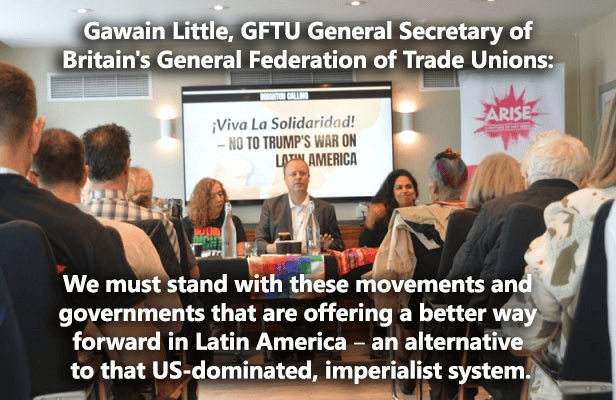
Labour Outlook: British Trade Union Leaders stand with Latin American movements and governments that are offering an alternative to that US-dominated, imperialist system Gawain Little, General Secretary of the General Federation of Trade Unions, opened with “We must stand with these movements and governments that are offering a better way forward in Latin America – an alternative to that US-dominated, imperialist system” and support all those fighting for self-determination of their nations. Sarah Woolley, General Secretary of the Bakers, Food and Allied Workers Union, outlined the links between workers internationally and how it means that “International solidarity isn’t something that sits on the edge of our trade unions, it has to be something at the heart of what we do.”
Natasha Witham, a National Education Union member who had visited Nicaragua as part of a teachers’ trade union delegation, reported how she was inspired by the participative and free-at-all-levels education system she had witnessed. Natasha also outlined how Nicaragua had prioritized achieving food sovereignty and security to ensure that children received a healthy diet, which helped them grow and learn. She also raised the threats to Nicaragua and their achievements from the actions of the US, which recently expanded its aggressive sanctions against the country.
PBS Interview: Cuban Deputy Foreign Minister Carlos Fernández de Cossío on Trump’s threats and rising tensions with the U.S. An important interview to forward to your friends. It is noteworthy that PBS, in its official transcript deleted this statement by de Cossio: “We live in a world of intimidation, in which the United States, for the first time in history, has the capacity to intimidate each and every government around the world and restrict their sovereign right to trade with whoever they want. That is a new reality. That’s new, for one country to be able to dictate to the rest of the world with who they can and cannot trade.”
Bloomberg News interview with Deputy Minister Carlos Fernansex de Cossio: He discusses the painful US war on the Cuban people, surviving without oil, electricity; the claim that Cuba is a failed state and why it is not; Venezuela; the possibility of a US invasion; the feelings of the Cuban people and their reaction to the worsening blockade.
.
Upcoming Events:
October 3: Actions to Free President Maduro and Cilia Flores
October 5, webinar: Peace & Justice Conversations: Cuban Americans for Cuba Peace Action New Hampshire hosts Danny Valdes, founder and executive director of Cuban Americans for Cuba
October 10: Global Alliance for Palestine (GAFP) Day of Action on third anniversary of the US-Israeli genocide
October 10: The People’s Tribunal on US Government Complicity in Gaza The Women’s International League for Peace and Freedom US (WILPF US), Veterans For Peace (VFP), and American Friends Service Committee (AFSC) will convene the People’s Tribunal on U.S. Government Complicity in Gaza. Taking place in Seattle, Washington, and streaming live nationwide
October 13 (webinar): World Beyond War – U.S. military spending and how to stop it
October 17: No Kings Day gives us the chance to bring signs and banners against US attempts to overthrow Latin American governments which are standing up to the Monroe Doctrine.
October 20: Stop the War on the Iran rallies at Congressional offices nationwide
Oct 25: Nicaragua Solidarity Coalition webinar on Nicaragua’s electoral reforms
October 24-31: Global Week of Action Against US Genocide in Cuba
.
2027 Casa Ben Linder Nicaragua Tours
Feb 13-19 Bird Brigade – birding in Solentiname and Rio San Juan
March 6-14 Power and Protagonism: Women in Nicaragua – meet with women in leadership roles – cooperatives, labor unions, peasant feminists, and artisans to explore gender equity in Nicaragua
April 22-30 Light and Legacy: Ben Linder Brigade – Commemorate 40 years since the assassination of U.S. solidarity worker Ben Linder by U.S.-funded contra forces
May 21-June 1 Mayo Ya – Cultural tour to the Southern Autonomous Region of the Caribbean Coast, which is the heart of Nicaragua’s Indigenous and Afrodescendant communities.
Delegations to Cuba
Witness for Peace 2026-27 delegations to Cuba
Friendly Planet delegations to Cuba
.
Nicaragua Solidarity Coalition: nicasolidarity.com
Monthly meetings of the Nicaragua Solidarity Coalition are held on Zoom on the second Monday of each month at 2:30pm Eastern/ 11:30am Pacific time. The next meeting: Monday, October 12. To request the Zoom registration link, email NicaraguaSolidarityCoalition@gmail.com.
Sign up to receive the Nicaragua Solidarity Coalition bi-weekly newsletter, action alerts, event notifications: bit.ly/NicaSubs
Listserve: nicanet@googlegroups.com join at groups.google.com/g/nicanet
Weekly NicaNotes (featured article & news briefs):https://afgj.org/signup
Facebook: Friends of Sandinista Nicaragua, Nicaragua Solidarity Coalition
Twitter: @SolidarityNica
Instagram: @NicaSolidarity
YouTube: @nicaraguasolidaritycoalition

