
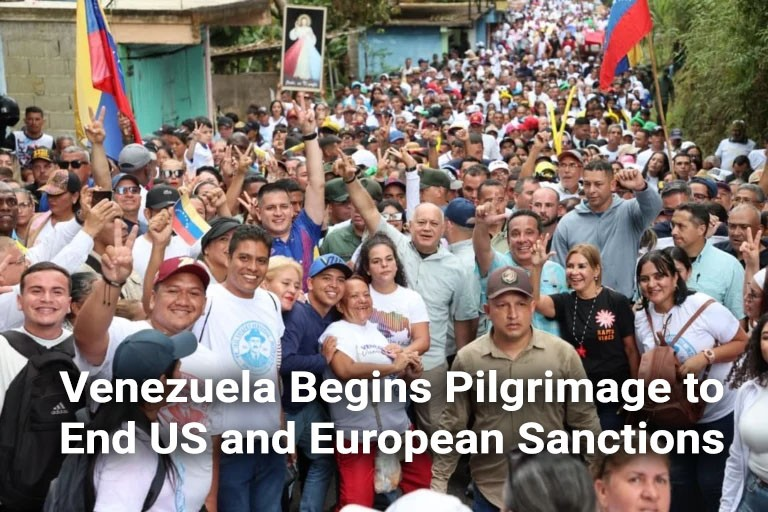
TeleSur: Venezuelan Acting President Delcy Rodriguez Joins Anti-Sanctions National Pilgrimage in Falcon State Venezuela commenced a “Great National Pilgrimage for a Venezuela Without Sanctions and in Peace” on April 19, coinciding with the 216th anniversary of Venezuela’s first cry for independence, joining citizens nationwide to demand an end to over 1,000 illegal coercive measures. During her various messages to workers and citizens, Delcy Rodríguez stressed the need to advocate for the end of sanctions to allow the country to return to peace, stability, national reunification and development with equity.
TeleSur: Diosdado Cabello Leads Venezuelan Anti-Sanctions National Pilgrimage in Trujillo State On April 21, Diosdado Cabello spearheaded a massive popular mobilization in the western Trujillo state. This event formed part of the “Grand National Pilgrimage for a Venezuela Without Sanctions and in Peace“, demanding the immediate elimination of the more than 1,000 illegal coercive U.S. measures imposed upon the country. Another powerful message conveyed by Cabello was that Venezuela has managed to achieve significant economic recovery and growth primarily due to the unwavering perseverance and dedicated efforts of its workers, who have valiantly overcome the profound challenges posed by these blockades. The national mobilization is scheduled to culminate on May 1 in Caracas.
TeleSur: Venezuelan Acting President Delcy Rodriguez Reports 100 Days Progress Acting President Delcy Rodríguez addressed Venezuela´s people after her first 100 days in office, highlighting firm steps toward national reconciliation, significant economic growth and the country’s re-entry into the international financial stage, following reforms in hydrocarbons and mining. She announced that Venezuela currently ranks among the safest countries in the region, boasting a significantly reduced homicide rate of three per 100,000 inhabitants. This improvement in public security is attributed to the successful operation of over 6,000 active peace quadrants across the territory. With the present 9% economic growth, the Bolivarian Government has directed over 70 million dollars in credits, primarily benefiting women entrepreneurs.
TeleSur: Venezuela Demands IMF Release Blocked $5 Billion Assets Acting President Delcy Rodríguez has urged the International Monetary Fund to release Venezuela’s $5 billion in frozen Special Drawing Rights, originally requested by President Maduro in 2020, crucial for vital infrastructure and economic stability. Delcy Rodrtguez confirmed this in a critical conversation with IMF Managing Director Kristalina Georgieva. The Acting President emphatically asserted that these funds are unequivocally the property of the Venezuelan nation.
Phenomenal World: Interview with Roy Daza, PSUV deputy in Venezuela’s National Assembly. Daza, and vice-chair of the National Assembly’s Foreign Policy Committee Question: What are the main pillars of Venezuela’s foreign policy today? Daza: [There are] three major objectives for the Republic at this stage: to demand the immediate release of Nicolás Maduro and Cilia Flores, to maintain peace and stability within the nation, and to continue the development of the government program known as the Plan of the Seven Transformations. We also know that the Venezuelan people must ultimately rely on their own strength. Hence the relevance of Maduro’s teaching: “In the face of adversity—calm and composure, nerves of steel, and intense popular mobilization.”
Q: The Plan of the Seven Transformations is the government’s program for the 2025-31 presidential term. Could you explain its main points? Daza: The government could only withstand ten years of economic, commercial, and financial blockade because the Bolivarian Revolution is a historical process that has created a certain degree of social and cultural consensus. The 7-T initiatives are based on a simple fact: the historical exhaustion of rentier capitalism—when [oil] rent ceased to be the driving force of the economy and became a drain on it. By 2025, sound economic policy, plus the efforts of our workers in agriculture and industry, and the active participation of the national business community which stood by Venezuela, had produced a recovery with growth nearing 9 percent. The 7-T is designed to extend these gains.
Q: MS: What is the current internal situation in Venezuela? Daza: In Venezuela, there is broad consensus on a key issue: we are now in a new political moment; it is time to overcome polarization. The fascist elements within the opposition, the sectors who only promote violence have been weakened and discredited. There is a far-reaching agreement between Chavismo and the democratic opposition. Anyone who wishes to understand the Venezuelan political process must study its radical, communal democracy and grasp that the massive popular demonstrations—from January 4 to the present—are the foundation of the current political and social stability. The people mobilized in the streets are the social force that is driving democratic coexistence forward.
Q: Could you elaborate on the country’s model of communal democracy? Daza: Communities, organized into various circuits, have the ability to propose projects, use elections to decide which ones are pursued and prioritized, and then oversee their autonomous implementation. Society can thus reclaim functions that it had previously delegated to the state. The resources for these projects are provided by a constitutional body, the Federal Council of Government, with the support of provincial and municipal governments.
Mision Verdad: Venezuela: foreign investment and sovereignty The reform of the Organic Hydrocarbons Law and the enactment of the Organic Mining Law, represent the core of a state framework that combines attracting foreign capital with protecting national resources, in line with the 2020 Anti-Blockade Law and in response to a complex scenario of US sanctions. According to the Central Bank of Venezuela, GDP grew 23% in the first quarter of 2026, marking 20 consecutive quarters of expansion. However, inflation reached 71.8% during the same period, a figure that demonstrates persistent price pressures. The official projection anticipates a 55% increase in oil investment by 2026, rising from $900 million in 2025 to $1.4 billion, driven by private sector participation. The easing of hydrocarbon laws is expected to allow crude oil production to rise to 1.5 million barrels per day by the end of 2026, a substantial increase that would alleviate currency controls. According to Conindustria, this hybrid scheme could inject up to $6 billion in liquidity into the national banking system during 2026.
Daniel Ortega Speech on National Day of Peace: The struggle for peace in these times has become more urgent, and we must begin by uniting ourselves, the people The struggle for peace in these times has become more urgent, and we must begin by uniting ourselves, the peoples, the developing countries, and seek to create a united front in favor of peace at a global level, which will put an end once and for all to the terrorist policies applied by the American rulers in the world.
Let him [Trump] put his word to the test in favor of peace, let him put an end to the war against the people of Iran; let him put an end to the blockade against Cuba; let him put an end to the sanctions he has against Venezuela, and let him bring President Nicolás Maduro back to his country. Let him start taking steps, and then he will receive the recognition of the international community and the peoples of the world.
And we managed to recover peace eight years ago, yes, because peace had been stolen from us at that time, and we managed to recover it eight years ago. Everything we have achieved in times of peace is evident: the housing for low-income people is evident, the construction of roads, the hospitals. And who is delivering these works? The Nicaraguan youth, with all their awareness, with all their courage; they are proud to be putting into practice solidarity, which is the source of love.
For Sale: Nicaragua Solidarity Coalition t-shirts
Trabajadores: Trade Unionists and Political Activists from the U.S. Travel to Cuba for May Day Among the unionists are representatives from the Teamsters, Amazon Labor Union, Service Employees International Union, International Association of Machinists, International Brotherhood of Electrical Workers, United Union of Roofers and Waterproof Workers, United Domestic Workers (California), and AFSCME. In addition, delegates from more than 20 political groups are included. Another delegation component are members of About Face, made up of veterans of the wars in Iraq and Afghanistan. They have a parallel program that allows them to attend scheduled activities and also meet with Cuban internationalists who participated in military missions in Angola, Ethiopia, and Syria.
Upcoming Events:
April 25(Toronto): Cuba Resists. With Keith Bolender, Sharmini Peries, Nicolas Ruiz
May 1, Chicago: Report on Nicaragua Today– the social and political work helping the poorest of the poor. With Sarah Woodard of the Jubilee House Community
May 11 (Monday), 2:30 pm ET: Nicaragua Solidarity Coalition monthly meeting on zoom. Email NicaraguaSolidarityCoalition@gmail.com in advance for zoom access.
Delegations to Cuba, Nicaragua:
Cuba – Video: Yes You can Travel to Cuba
Witness for Peace 2026 delegations to Cuba
Friendly Planet delegations to Cuba
Nicaragua
Casa Ben Linder Email casabenjaminlinder@gmail.com to apply:
July 2026: Solidarity in Action: Nicaragua’s Popular Revolution
October 2026: Salud & Solidaridad: Hands-On Healthcare in Nicaragua
Now offering Spanish classes! Fun and practical language classes at Casa Ben Linder – our
model teaches 1/2 day class & 1/2 day practice in a community setting.

