
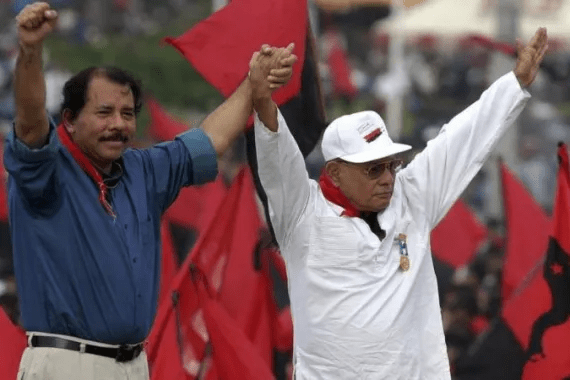
On April 30, 2014, during the tribute ceremony honoring workers and Commander Tomás Borge on the second anniversary of his passing, President Daniel Ortega offered a historical retrospective of the struggles waged—over 17 years of opposition to neoliberalism—by the workers and the FSLN in defense of the achievements of the Sandinista Popular Revolution.
Below is an excerpt from his speech:
Present at this ceremony are many labor leaders who represent a generation tasked with fighting against the Somocista tyranny within the ranks of the Sandinista Front; subsequently, following the triumph of the Revolution, they were tasked with organizing labor unions in both the cities and the countryside.
The workers defended the Revolution through extraordinary work shifts and for truly symbolic wages. It is good for the young people—the younger generation—to be somewhat aware of this: *symbolic wages!* What they received was more akin to a stipend—just enough to cover basic necessities. It wasn’t even enough to pay rent; it was simply enough to cover the bare essentials!
That period—from 1979 to 1990—was also heroic, for workers in both the cities and the countryside took up the armed defense of the Revolution… Battalions of workers! Many of you served in those combat battalions. Many brothers also fell in battle. Back then, you were just young men.
Then, beginning on April 25, 1990, we declared: “We will continue this battle by governing from below.” At that juncture, the Sandinista Front found its primary instrument of struggle—its principal instrument of battle—in the National Workers’ Front; for the need arose to organize this united front of workers who were being cast out onto the streets.
For history must not be forgotten. Not to harbor grudges, but rather to remember it for what it truly was—and for what it must never be again. From April 25, 1990, onward, a campaign of persecution against the workers began. Thousands of workers were dismissed from the healthcare system, the education system, and various state-owned enterprises. It was a scorched-earth campaign; lists of labor leaders were circulated to ensure they would be denied employment in any state institution.
This was accompanied by the destruction of works of art here in Managua—sites where numerous murals had been created, in which Nicaraguan artists and their international allies, acting in solidarity, had enshrined their art and their love for Nicaragua. And what did they do? They ordered the destruction of those works of art. It was, in short, an attitude—a behavior—of sheer barbarism. They went to the extreme of waging war against artistic creations. It felt like the Inquisition at its height.
Although thousands of workers were left unemployed, others continued to resist within the enterprises designated as the “Area of People’s Property”—enterprises they were attempting to seize. We fought a great battle there, I recall, when the government elected in 1990 attempted to return all those properties—all those enterprises—to those who had previously been subject to confiscation and expropriation, including the Somoza family. That was their intent.
Their objective, therefore, was to wrest the factories away from the workers who had defended them with such bloodshed between 1979 and 1990. To seize enterprises that had not even existed prior to 1979—enterprises that had emerged with the Revolution; state-owned enterprises—meaning, owned by the Nicaraguan people—that had been built through international solidarity, through the blood and sweat of the workers, and through the skills and dedication of the technicians and professionals committed to the Revolution.
That is where the battle lines were drawn, and that was the banner we raised in the face of such a difficult situation. At that moment, we had no intention of attempting to overthrow the government that had taken office on April 25th. We had the strength to do it, but that wasn’t what we did. Elections had already taken place, and—be that as it may—those elections had yielded results that were adverse to us; yet, the popular will had to be respected.
A Diabolical Plan
One could argue that, in the face of the plans to dismantle the achievements of the Revolution—plans that had already begun to unfold—we would have possessed every ounce of authority and legitimacy to take to the streets in peaceful struggle to overthrow the government. But we said: “No! Absolutely not! We will wage this battle by defending the gains won by the workers, by defending the social achievements of the Nicaraguan people.”
It was a battle that would not be easy, for we faced an entrenched power—one that held a majority in the National Assembly and controlled an Executive Branch with the authority to make decisions and order repression. And they did not hesitate to do so, time and again—actions that resulted in the deaths of many workers, as well as the deaths of several of our brother police officers. In essence, the diabolical plan of the Right was to engineer a confrontation between fellow Nicaraguan brothers and sisters.
And so we said—I recall us gathering at the kiosk of the Sandinista Front Secretariat—”We will wage this battle, despite our limited resources—our limited material means. We will wage this battle armed with courage and with the moral right that stands with us…” And so, we began to wage the battle.
We challenged the measures they sought to impose upon our country—measures that, first and foremost, involved stripping workers of their property, seizing land from peasants and cooperatives, and—by means of privatization—robbing the people of their fundamental rights to education and healthcare.
In short, we stood our ground. And there came a moment when the popular protest movement had gathered such immense force nationwide—when the national outcry had grown so vast—that barricades began to spring up here in Managua and across the various departments… yet, they were raised without a single rifle! It was at that very moment that the government decided to deploy the army to dismantle those barricades.
I share all this with you so that the older generation may remember, and the younger generation may learn and witness the contrast in how we have acted—from 2007 to the present day—in the face of the continuous protests that have taken place here; for here, there is freedom to protest, and people do indeed take to the streets to protest. Consider the tolerance that has been shown: not a single time have we deployed the Army. On the contrary, the Police have been the victims of those demonstrating—members of an opposition fueled by the Empire and by Somocismo. The Police have been victims, so that this would provoke the police, so that this could then be reported and turned into an international—a global—news story.
How many complaints did we file? Back then, we were the “bad guys” who wouldn’t let the government govern. Ah! But when they take to the streets to protest, they are the “good guys”—the ones who supposedly have the right to do anything, even to speak openly of overthrowing the government. And since they have lacked the capacity to win the hearts of the people—and thus win elections—they are left with no recourse other than, out of sheer desperation, to shout that the government must be overthrown.
I recall that during one of those protest periods, meetings were held regularly at the Olof Palme Convention Center. There, the leadership of the National Workers’ Front would sit at one table with government delegates, while at another table sat the Sandinista leaders alongside government delegates. Our position was this: we need you to provide a positive response; we need to reach an agreement. For their aim was to forcibly impose the dismantling of the very foundations of the Revolution. Among their objectives were the dissolution of the Army and the downsizing of the National Police, in order to pave the way for the creation of parallel forces.
They even attempted to establish a military force right here within the Managua City Hall—a force they intended to replicate across every other municipality they controlled.
Those meetings would drag on for many hours; we would often stay in session until dawn. The entire country was paralyzed. During one of those many meetings, the government delegate arrived, and I remember him saying to me: “Daniel, we cannot go on like this. We have already handed the keys of government over to you—we are going back home—so you take charge of the government.”
I replied: “We are not taking charge of the government under these conditions. Our struggle is not to assume power under duress or by force; our challenge is to regain the government through the vote and the backing of the Nicaraguan people. Therefore, you keep the keys to the Presidency and figure out how to resolve this yourselves.” And in the end, the famous Concertation Agreements (Acuerdos de Concertacion) were successfully reached between the workers and the government—with the Sandinista Front, naturally, lending its full support to that entire struggle.
Conquered Spaces
This allowed us to retain certain spaces: ensuring that some properties were allocated to rural workers, and certain enterprises to urban workers. Some of those enterprises remain in the hands of the workers to this day. Those rights had to be recognized for the workers because we declared: “If privatization is going to take place here, then privatize in favor of the workers, who are the ones who have spent their blood and sweat building them and maintaining them in times of war.”
When I see these faces—the faces of our comrades from the National Workers’ Front (specifically the older ones, for there is now a younger generation among them)—those battles immediately come to my mind; and in those battles, Tomás was always there, standing right alongside us.
Today, on this second anniversary of Tomás’s passing—standing alongside Carlos, Colonel Santos López, and Sandino—we are living through a phase of what we might call a “process,” a process designed to strengthen the country, to endow it with greater stability and security, and to ensure that this democratic process—this profoundly democratic process—continues to open up pathways for us to press on with the struggle for employment, the struggle for healthcare, the struggle for education, and the struggle on behalf of our cooperatives. It is a struggle waged in concert with all the economic forces of our nation. It seeks to strengthen that great alliance—an alliance that has been steadily advancing and consolidating itself—between business leaders, urban and rural workers, and the Nicaraguan people; all united in this grand alliance that enables us to lay our foundations with greater firmness.
When we took office in 2007, we found a State designed entirely to serve the interests of those who had assumed power in 1990. They were able to do this because they possessed the votes necessary to enact amendments to the laws and to the Constitution. They—not we—were the first to set the precedent that the Constitution could, in fact, be amended.
We had left the Constitution intact—the very Constitution born of the Revolution following the 1984 elections, forged in a Constituent Assembly alongside the People throughout 1985, and finally promulgated in January 1987. That is the Constitution we left behind.
The very first thing they did was to move against that Constitution—and they amended it. We, for our part, were not going to resort to force to prevent them from amending the Constitution. We were not going to encourage the formation of armed groups to prevent that reform—or to prevent all the measures they implemented—but rather, on the contrary, what we did was to keep battling, to keep fighting.
Amidst that struggle, they were putting their framework in place, installing their model; they had the time, they had the conditions—because after those major upheavals, immediately following April 25th, there was a period of calm, of extensive dialogue, of much exchange, and of meetings held to determine how the agreements were being fulfilled—or to voice our complaints that they were not being fulfilled; they were stalling the agreements—as we all know.
In the end, they had all the time in the world: they had 17 years to install their model, to establish a State in accordance with their vision and their interests—a State in which, logically, the people become a completely secondary factor.
We came to power in 2007 through the ballot box, and we have barely traveled a fraction of the distance they covered to establish their own models. We have currently been in office for seven years. They were there for seventeen years—and who told them to step down just because they had already served seventeen years? They wanted to continue—and that is fine; they have every right to do so. Ultimately, it is the people who decide. Likewise, we wish to continue; we have every right to do so, and ultimately, it is the people who decide. That is the reality.
A New Model
We have been implementing a new model—one that is attuned to current global circumstances. It was no longer feasible to simply attempt to replicate the model of 1980. That era is now a part of history; it left behind its legacy in terms of consciousness and values. We now had to focus our efforts on this new model—one in which citizen participation serves as the central axis, the very heart, and the soul. It entails the participation of the people in every undertaking: the fight against crime, against drug trafficking, and against organized crime; the defense of the environment and our natural resources; and citizen involvement in healthcare and educational initiatives.
In other words, it is not merely a matter of institutions acting alone, but rather of institutions working in conjunction with the youth, the general public, families, communities, and municipalities to develop and implement all these programs. Even the planning of roads and highways is discussed with the population—keeping the people informed—to ensure that the necessary coordination is established so that, when construction begins, there are no disruptions to traffic flow in the area.
And central to all these endeavors is the participation of the youth. Just as the youth played a decisive role in every undertaking during the period from 1979 to 1990, they are doing so once again in this new era—from 2007 to the present day. Youth participation has grown; it has multiplied exponentially. This serves as a true test of the youth’s commitment to their families, their people, their country, and the Revolution. We are now waging the Revolution peacefully. We are waging the Revolution by building alliances. We are achieving the Revolution by attending to the poorest families. Yes!—with that little food package—yes! You say that’s paternalism…? So what?! Would you rather they starve to death? Because we are talking about families living in extreme poverty—families still mired in destitution; families whose homes are still roofed with scraps of zinc and plastic, and to whom we must bring the “Roof Plan.” Can that be called paternalism? That isn’t paternalism… that is called Christianity; that is called Solidarity; that is called Socialism!


3 thoughts on “The Sandinista Struggle During the Neoliberal Years, 1990-2007: Daniel Ortega: The Heroic Years of the 1990s”