
Sanctions Kill: Response Statement to US Government “Solidarity is not a Crime!” The State Department report – Cuba: the Capital of 21st Century Communism – inverts reality by blaming the victim. Washington has waged a hybrid war against Cuba for 64 years, including the 1961 Bay of Pigs invasion and current threats of military intervention. The report is a double-edged sword, threatening solidarity activists at home while providing further regime-change propaganda against Cuba. We commend the subpoenaed groups for their noncompliance with the Congressional committee’s orders: The People’s Forum, BreakThrough News, and Tricontinental: Institute for Social Research.
Over 43 organizations are explicitly named in the State Department report. This encompasses many tens of thousands of individuals and projects. The Trump administration lumps genuine leftists, legal defense organizations, environmental groups and even the Democratic Party under the rubric of a communist threat.
Francisco Dominguez: Latin America Faces Growing US Aggression Recently, the US has scored substantial political victories through the election of right-wing administrations in several Latin American countries, including Ecuador, Argentina, Honduras, Bolivia, Chile, Peru, Colombia, Costa Rica, El Salvador, Panama, Paraguay, the Dominican Republic, Trinidad and Tobago, and Guyana. This represents a dramatic reversal of the political trajectory of a region that experienced the Pink Tide (1999–2016), when most governments were either revolutionary or progressive. By 2026, the region’s progressive governments are Brazil, Mexico, Nicaragua, Uruguay, Venezuela, and Cuba – a remarkable shift.
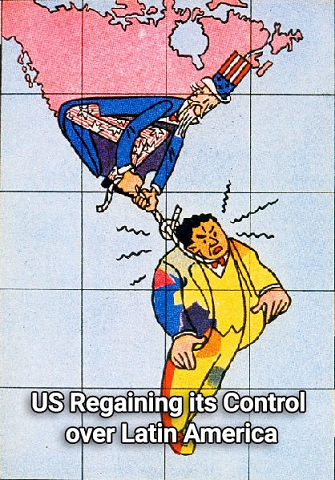
Trump’s military attack on Venezuela and the kidnapping of President Nicolás Maduro and Cilia Flores, First Lady and National Assembly member, on 3 January 2026 represents a dramatic escalation of the US aim to subordinate the entire Western Hemisphere to its political hegemony. This offensive has been broadened by a highly threatening and intimidating naval blockade against Cuba, which has prevented the supply of oil to the country for the past five months. The explicit aim of the US is to bring about its economic collapse.
Mexico and Brazil, especially the latter, are also in the US crosshairs. A principal reason for the aggression against Brazil is its status as a founding member of BRICS – a body that is not only growing in significance, influence, and membership, but which represents an objective challenge to Washington’s hegemony and its ability to weaponize its relations with the Global South.
Venezuela: Chavistas Reject ‘Treason’ Claims Against President Delcy Rodriguez Venezuelan journalist Andreína Chávez Alava and sociologist María Páez Victor rejected allegations that Acting President Delcy Rodríguez and the Chavista leadership betrayed President Nicolás Maduro. Chávez said any analysis must begin with US military encirclement, control over Venezuelan oil exports and revenues, and the standing threat of renewed bombing. She cited a Financial Times calculation that Washington had collected more than $13 billion from Venezuelan oil sales, while Venezuela initially confirmed receiving only $300 million through the US-controlled arrangement. Páez Victor rejected the word “cooperation” for this relationship. “This is extortion,” she said, noting that Washington holds Venezuela’s oil income while keeping President Maduro and First Lady and Congresswoman Cilia Flores hostage.
Orinoco Tribune: Venezuela: Grassroots Groups Condemn Government’s Rapprochement With Genocidal Zionist Entity Venezuelan grassroots and Palestine solidarity organizations have condemned the Venezuelan government’s controversial decision to initiate consular ties with the Zionist entity of “Israel,” warning that the measure contradicts the Bolivarian Revolution’s historic anti-imperialist principles and solidarity with the Palestinian people. The latest condemnations from the Brigada 13 de Abril and the Venezuelan Movement in Solidarity with Palestine Al Awda add to an earlier condemnation by the Canaan Palestinian People’s Relief Association, which described the rapprochement as a painful blow to the Bolivarian revolutionary struggle.
The complete collection of Selected Works of Fidel Castro is now available for download in Spanish.
Orinoco Tribune: Evo Morales Accuses Bolivia’s President of Planning His Assassination Former Bolivian President Evo Morales informed the Bolivian people and the international community about a police and military operation in the Cochabamba Tropics ordered by President Rodrigo Paz to assassinate him. Morales resides in the region, which is also home to the headquarters of the Coordinating Committee of the Six Federations of the Cochabamba Tropics—the country’s main union and coca growers’ organization—where he serves as executive secretary. Plots to assassinate Evo Morales continue because, despite the political persecution that he has faced since the time of Luis Arce’s administration, he remains the country’s most prominent opposition leader and the main unifying force for social majorities. Rodrigo Paz’s government seems to have realized that the Bolivia it is governing is not the neoliberal-era Bolivia.
Earthquake in Venezuela The double earthquake that struck the north-central region of Venezuela on Wednesday, June 24, 2026, has left a deep wound on a country already reeling from an illegal US blockade and sanctions, alongside the seizure of billions of dollars in Venezuelan assets abroad. Beyond the tragic loss of thousands of lives, the structural damage in the affected areas—primarily in Caracas and La Guaira state—is massive. This reality continues to weigh heavily on millions of Venezuelans, making ongoing donations vital. We hope the following list assists those wondering where to send their contributions:
• CODEPINK Emergency Solidarity Fund
• People’s Forum Earthquake Relief for Venezuela!
• Fundalatin/Presbyterian Church of Venezuela
• Venezuelan government and the Andean Development Bank (CAF)
• DSA Venezuela Relief Fund
The Sandinistas’ Work During the 16 Years of Governing from Below Enabled them to Regain Power Don’t miss a 5-part webinar series. Many revolutions or socialist governments existed the 1970s besides Nicaragua that later lost power or abandoned their socialist ideology by the 1990s. These include Mozambique, Angola, Zimbabwe, Guinea Bissau, Guinea, Tanzania, Congo (Stanleyville), Afghanistan, Grenada, almost in El Salvador, Portugal, Spain, and Ethiopia. In addition, the Communist Soviet Union collapsed (now 15 countries), along with East Germany, Poland, Czechoslovakia, Hungary, Romania, Bulgaria, Yugoslavia, and Albania.
When the Sandinistas lost the 1990 election these other socialist leaderships were already disintegrating or had already been overturned. Only the Sandinistas continued the struggle and once again arose to retake power and implement their original program. What revolutionary lessons does this experience provide? What abilities did they possess, what practices did they employ, that make them unique among the socialist movements of these 23 countries? These questions were discussed by the Nicaragua Co-Foreign Minister in an August 23 webinar to introduce a four-part webinar series in September, “Governing From Below, Lessons from Nicaragua’s Neoliberal Years, 1990-2006.” After losing the 1990 election, Nicaragua’s Frente Sandinista de Liberación Nacional (FSLN) vowed to “govern from below.” The series will delve into how the FSLN during these years worked closely with its grassroots base in unions, student groups, and women’s, peasants, and communal movements to pressure the neoliberal governments and eventually return to power.
The New Hampshire Gazette: Daniel Ortega, Elections, and the Context Western Media Won’t Print First, the elections. During his July 19th address commemorating the Sandinista Revolution, Ortega declared that the era of parties “installed by the Yankees” returning to government was over: “There will be no more elections, there will be no more [elections] through which they can try to seize the government, seize power.” He immediately called for laws erecting a “wall” or “block” against golpistas and vendepatrias—coup plotters and traitors—adding that “no matter how much money the Yankees give them, they will not succeed.” Western headlines performed emergency surgery and emerged clutching: “There will be no elections.”
Nicaragua has good reason to take American meddling seriously. During the Banana Wars, U.S. Marines occupied the country for much of 1912–33 in what historian Greg Grandin called the United States’ “first Third World quagmire,” until resistance leader Augusto Sandino won a war of attrition, sending occupation forces packing.
.
Coming Events:
September 2 (Wash DC): Moral and Legal Issues Related to the United States’ Blockade of Cuba Congresswoman Delia Ramírez, Congresswoman Ilhan Omar
September 2 (Wash DC): Solidarity is not a Crime! Code Pink
September 3: The Communes Will Not Kneel: Popular Power and the Unyielding Bolivarian Revolution
September 3, 10, 17, 23: Governing from Below: Nicaragua During the Neoliberal Years A course comprising four 2-hour classes on Thursday evenings, to probe more deeply into the FSLN’s work following the loss of the elections in 1990. Nicaragua’s Frente Sandinista de Liberación Nacional (FSLN) vowed to “govern from below.” Over the next 16 years the FSLN worked closely with its grassroots base through unions, student groups, and social movements to influence the national government and eventually return to power. The FSLN’s experiences in opposition to neoliberal governance provide important lessons for activists around the world working to effect change.
September 6: Fueling Genocide: Cuba & Palestine Webinar Report Back Nida Liftawiya is a Palestinian refugee living in California. She shares experiences and analysis from recent trips to Palestine and Cuba where she witnessed how U.S. tax dollar are fueling genocide and how the people are resisting.
September 13 (Britain), No to Trump’s War on Latin America Francisco Dominguez, Venezuela Solidarity; Maria Perez Ramos, MORENA supporter, Mexico; Claudia Turbet-Delof, Wiphalas Across the World, Bolivia; Natasha Witham, NEU member of UK teachers’ delegation to Nicaragua; Colombian & Cuban speakers invited.
September 27 (Britain), No to Trump’s War on Latin America Gabriel Becerra, Pacto Histórico Party MP, Colombia; Francisco Dominguez, Venezuela Solidarity; Marcos Lagier, Argentinian anti-fascist campaigner; Julia Felmanas, Brazilian Workers’ Party; Conor Murphy, Sinn Fein Senator & Colombian election observer; Richard Burgon MP; Kim Johnson MP; John McDonnell MP; Cuban speakers invited..
.
Delegations to Cuba, Nicaragua:
Upcoming Delegations to Nicaragua: 2027 Casa Ben Linder Nicaragua Tours
Feb 13-19 Bird Brigade – birding in Solentiname and Rio San Juan
March 6-14 Power and Protagonism: Women in Nicaragua – meet with women in leadership roles – cooperatives, labor unions, peasant feminists, and artisans to explore gender equity in Nicaragua
April 22-30 Light and Legacy: Ben Linder Brigade – Commemorate 40 years since the assassination of U.S. solidarity worker Ben Linder by U.S.-funded contra forces
May 21-June 1 Mayo Ya – Cultural tour to the Southern Autonomous Region of the Caribbean Coast, which is the heart of Nicaragua’s Indigenous and Afrodescendant communities.
Cuba – Video: Yes You can Travel to Cuba

