
Michelle Ellner: Alex Saab And The Fragility Of The Solidarity Movement The recent deportation of Alex Saab from Caracas to the U.S. on May 18, 2026, has generated shock, confusion, anger, and intense debate across sectors of the international solidarity movement and many Venezuelans themselves. The Venezuelan revolution did not survive the last decade of US economic warfare without contradictions. It survived through improvisation, exhaustion, loyalty, fear, sanctions, migration, stubbornness, and an almost unbearable national fatigue that few outside the country truly understand. And it is easy to demand uncompromising heroism from a country under attack when you are not the one responsible for preventing millions of people from falling into even greater catastrophe. But I think there is something dangerous about how quickly so many people are rushing toward absolute conclusions while fragments of information, accusations, leaks, and political narratives are still colliding in real time. If we are serious about ending U.S. aggression towards Venezuela, we cannot allow our solidarity with the Venezuelan people to be deterred. They have shown us how to sustain a revolution amidst contradictions, and that is what we must do.
Stansfield Smith: About the Extradition of Alex Saab What some may find as unjustifiable compromises by the Venezuelan government pales in comparison to what is incumbent on us: to defend both Venezuela and Cuba from the cruel policies of our own government. The US imposes increasingly onerous blockades and military threats of attack against these two revolutionary examples. The US also propagates continual disinformation campaigns against them, as it is presently engaged in against the Chavista leaders and against Raul Castro. Both Fidel Castro and Hugo Chavez considered US imperialism the enemy of humanity. We must clearly focus our work on combating our own government’s aggressions and not become sidetracked into criticizing what other governments do or don’t do.
Celina della Croce: The Politics of Purity and the War on Venezuela The idea that Venezuelans have given up or are not “real” revolutionaries is easy to profess from an armchair in the imperial core (as Vijay Prashad, Roxanne Dunbar Ortíz, and others reminded us in “A letter to intellectuals who deride revolutions in the name of purity,” published in the aftermath of the 2019 coup in Bolivia). Yet for this group of people, the focal point, seemingly exclusively, is whether Venezuela (or Cuba, for that matter) is “doing it right.” Trump has been clear that a decision from the Venezuelan government to refuse to make concessions would undoubtedly lead to mass destruction, stating for instance, that “we are ready to stage a second and much larger attack if we need to do so… a much bigger wave, actually” and that “All political and military figures in Venezuela should understand what happened to Maduro can happen to them”. Faced with the threat of continued bombings and bloodshed, the Venezuelan people are left with a difficult, if not impossible, set of choices and their own internal contradictions to struggle through.
Is there a Venezuela Model of Trumpist Imperialism? Maria Paez Victor and Francisco Dominguez The assumption is that Trump successfully effected regime change, installed a pliant government in the country, practically a viceroy taking orders from the White House, has made Venezuelan oil and other minerals open to investment by US oil majors who are now set to control Venezuelan oil and even controls Venezuelan oil revenues. How much of this is true? Discussion with Maria Páez Victor and Francisco Dominguez.
At BRICS Meeting Cuba denounces the threat of direct US military aggression and the effects of a brutal blockade At the BRICS Foreign Ministers’ Meeting, held between May 14 and 15, Foreign Minister Bruno Rodríguez stated, “the current exclusionary international order has been practically destroyed by the US attempt to make it unipolar again, through an imperialist agenda based on military force, supremacism and fascist neoconservatism… “Cuba is under the threat of direct military aggression from the U.S. and suffers the effects of a brutal blockade on fuel supplies, which constitutes a growing threat to international peace and security and a breach of international law and the universally accepted rules of international trade and freedom of navigation.”
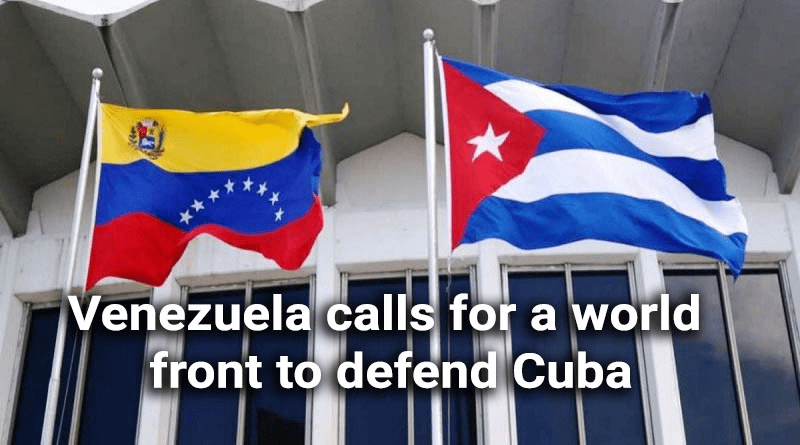
PSUV Calls for a World Front to Defend Cuba The United Socialist Party of Venezuela (PSUV) issued an urgent call for the unity of parties, social movements, unions, student federations, and popular organizations worldwide, to form a political and diplomatic front in defense of Cuba, in light of the threats of invasion made by US President Donald Trump. In this regard, PSUV alerted governments, political parties, and movements in Latin America, the Caribbean, and the world about the consequences of the recent oil blockade and other coercive measures imposed by the US against Cuba, especially following the Executive Order issued on May 1, 2026. Full statement included.
Jill Clark-Gollub: Growing Calls To End Unilateral Coercive Measures This spring constituents and grassroots organizations have been raising awareness in Congress and in public forums of the harms caused by Unilateral Coercive Measures (UCMs or “sanctions”). Sanctions have become the “go-to” foreign policy tool of the US government, now impacting a quarter of the global economy and one-third of the world’s population. These measures cause an average of 564,000 deaths around the world annually.
On April 22, Congresswoman Delia Ramírez (D-IL) hosted a Congressional briefing on “Humanitarian Impacts of Economic Sanctions, Cuba as a Case Study,” with three outside experts: Mark Weisbrot of the Center for Economic Policy, co-author of the largest study ever conducted on the impacts of sanctions on mortality; David Paul, co-founder of the Sanctions Kill campaign, retired nurse practitioner, and co-author of a letter from health workers to Congress about child deaths from sanctions; and Danny Valdes, co-founder of Cuban Americans for Cuba, who shared the perspective of bi-national families impacted by the longstanding and escalating US blockade of Cuba.
TeleSur: Venezuela Launches 2nd Phase of National Pilgrimage Against Sanctions Venezuelan Acting President Delcy Rodriguez launched the second phase of “The Great National Pilgrimage for a Venezuela Without Sanctions and in Peace.” “May violence never prevail in our country! We are moving toward peace and development. We are moving toward a Venezuela free of sanctions!” she stressed at an event. She reaffirmed that her administration has set two strategic objectives: achieving Venezuela’s right to development and reducing social gaps generated by the economic blockade.
TeleSur: 1,040 Arbitrary Sanctions Against Venezuela Remain Active Vice MInister for Anti-Blockade Policy William Castillo confirmed that 1,040 out of 1,088 unilateral coercive measures imposed against Venezuela remain active today. “This form of suffocation… caused many professionals to migrate, divided families and generated a severe economic decline with hyperinflation,” he recalled. “Venezuela has the right to fully recover all its economic rights, its freedom to import and export, to sell and buy from whomever it wants. There are only 31 countries in the world that have unilateral coercive measures, and that is illegal.”
Kendall Myers Dies in Prison—Agent 202, Who Conducted Intelligence Operations for Cuba from the State Department Kendall Myers, a high-profile State Department official who worked as a volunteer for Cuban intelligence for 30 years, died on March 12 at a prison medical facility in Springfield, Missouri, where he was serving a life sentence. Starting in 1982, the Myers passed sensitive intelligence regarding the island’s security to their Cuban contacts during trips abroad via shortwave radio messages and by using package deliveries in shopping carts. The quality and scope of the information they both provided to the Cubans improved as he rose through the ranks as a State Dept official. Within the State Dept Bureau of Intelligence and Research, he became a senior intelligence analyst for European countries between 2001 and 2007.
CNN: As the US starves it of oil, Cuba is pulling off one of the fastest solar revolutions on the planet — with China’s help The speed of the solar surge has been startling. China exported around $3 million of solar panels to Cuba in 2023; that figure rocketed to $117 million in 2025. A big part of the country’s clean energy push is an agreement with China to open 92 solar parks across the country by 2028, projected to bring a total of 2 gigawatts of solar power online, enough to power more than 1.5 million homes. Cuban President Miguel Diaz-Canel opened the first in February 2025 and there are now around 50 online, dotted across the island. Cuba has installed around 1 gigawatt of solar in the last 12 months alone. Renewable energy now makes up roughly 10% of Cuba’s electricity, up from around 3% in 2024. The country has pledged that figure will rise to at least 24% by 2030. It would cost $8 billion for Cuba to generate around 93% of its electricity from renewables.
.
Upcoming Events:
June 1 webinar: U.S. Policy of Regime Change in Cuba with William LeoGrande and Peter Kornbluh
June 3 (NYC); Rally to Free President Nicolas Maduro and Cilia Flores
June 7: Marx, Marti & The Cuban Revolution
June 8 (Monday), 2:30 pm ET: Nicaragua Solidarity Coalition monthly meeting on zoom. Register here for the June meeting.
June 12, Chicago: End the Blockade of Cuba with representatives of Cuban Embassy
.
Delegations to Cuba, Nicaragua:
Cuba – Video: Yes You can Travel to Cuba
Witness for Peace 2026 delegations to Cuba
Friendly Planet delegations to Cuba
Nicaragua Casa Ben Linder Email casabenjaminlinder@gmail.com to apply:
July 2026: Solidarity in Action: Nicaragua’s Popular Revolution
October 2026: Salud & Solidaridad: Hands-On Healthcare in Nicaragua
Now offering Spanish classes! Fun and practical language classes at Casa Ben Linder – our
model teaches 1/2 day class & 1/2 day practice in a community setting.

