
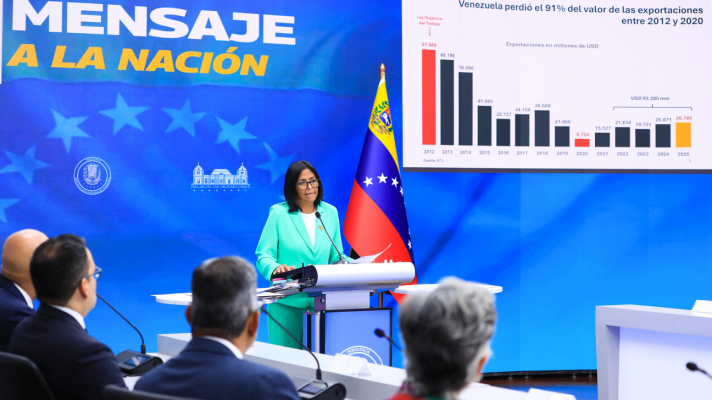
On April 8, the acting president Delcy Rodríguez expressed to the country a series of statements, data, and announcements of an essentially economic nature.
The speech focused on a sincere and forceful assessment of the economic and political dynamics of recent years, and emphasized key accountability statements regarding the effects of sanctions on national income, social security financing, the status of public wages and pensions, among other issues.
Similarly, she expressed a series of decisions that indicated the need to avoid repeating past mistakes and to establish a change of perspective in the management of the State, economic policy, and the approach to economic sectors beyond the government.
LOSS OF THE RESOURCE BASE
The President revealed a hard fact that illustrates the dimensions of the real Gross Domestic Product (GDP), with respect to 2012.
It is necessary to clarify that, although the annualized nominal GDP has registered a much greater growth in percentage terms, the calculation of this base of real GDP is done according to the size of the economy in 2012.
She indicated that, by the end of 2025, real GDP would be only 35.7% of the size it was in 2012, which suggests that the Venezuelan economy, in real terms, is 64.3% smaller than in 2012, therefore, it is an economy that generates less real net income.
The downward trend in real GDP is clearly noticeable since 2016, the year in which the legal bases for sanctions from 2014 and 2015 took shape and when the US government published its first laws and executive orders, which have been the legal pillars of a list of more than 1,000 sanctions against Venezuela.
According to an image released by the president, the year of the peak decline in real GDP was 2020, at 24.9%. Since then, there has been moderate growth in this indicator, suggesting that the economy continues to recover, although it remains far from reaching its historical peak and point of greatest prosperity.
Real GDP.jpg
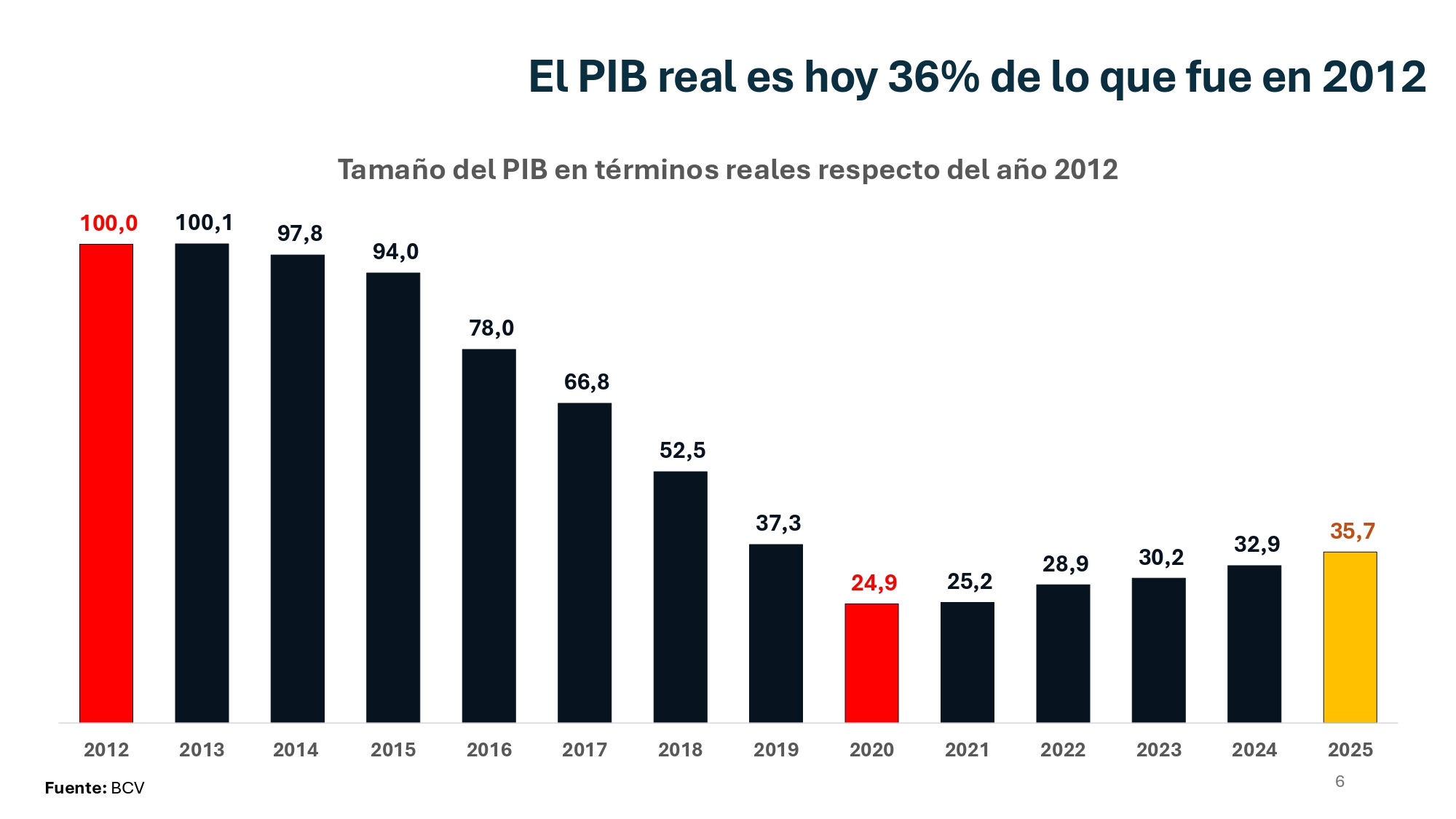
The country’s real GDP, although it has recovered, remains far from 2012 levels
(Photo: Presidency of the Bolivarian Republic of Venezuela)
Rodríguez emphasized that the decline in real GDP is directly linked to the drop in the value of national exports. She noted that this decline has been 91% between 2012 and 2020. In other words, in 2020, the country received only 9% of what it received in 2012, a situation clearly associated with the boycott of hydrocarbon activities through sanctions and blockades.
An image presented in the speech suggests that, from 2022 to 2025, total exports for those four years barely exceeded $93 billion, a figure that is still lower than the revenues of 2012 alone.
Value Exponent.jpg
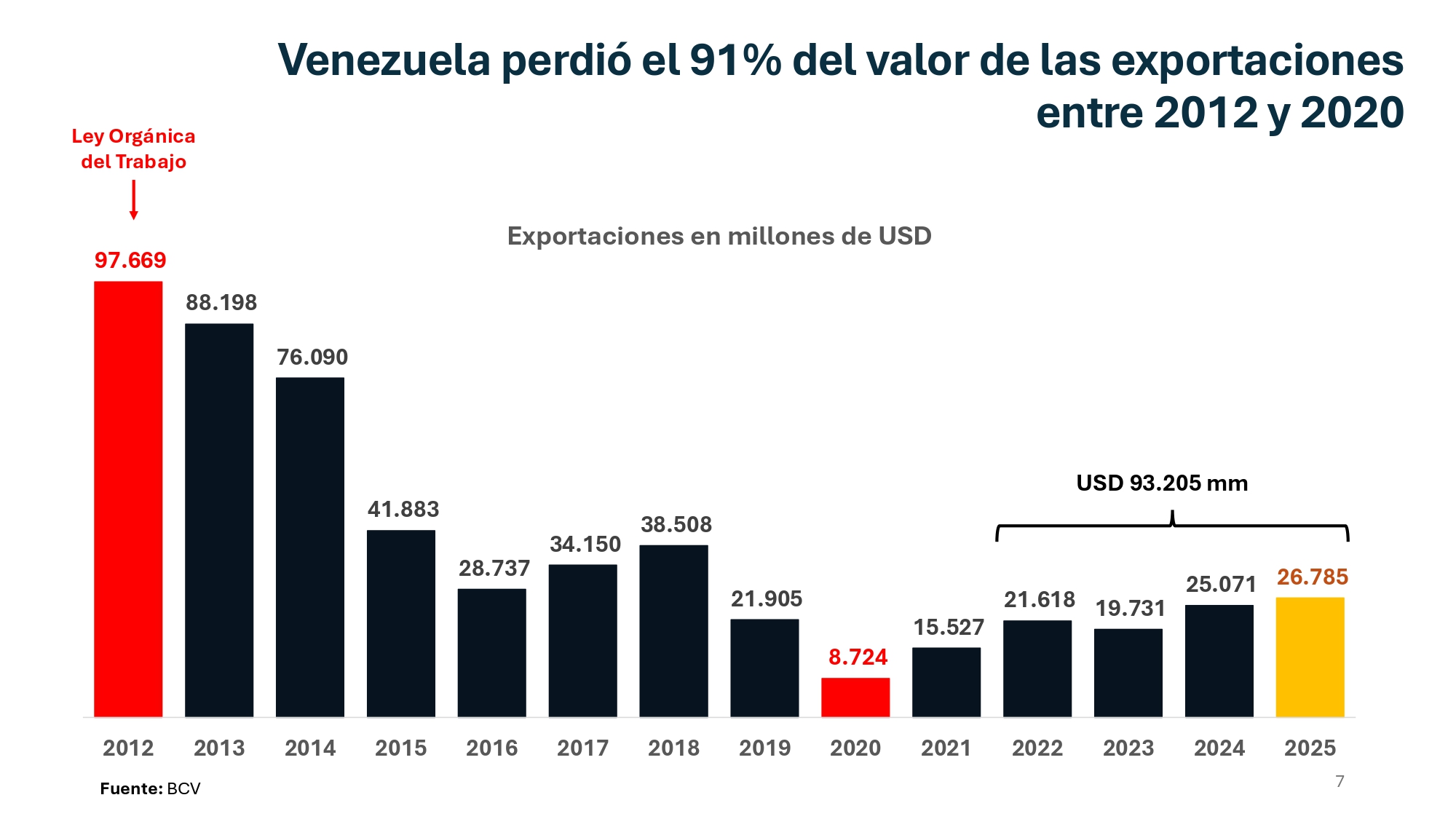
The decline in the value of Venezuelan exports is directly related to the sanctions on hydrocarbon activities
(Photo: Presidency of the Bolivarian Republic of Venezuela)
The image shows that income from oil and derivative exports, which are the fundamental basis of the national budget, although it has recovered in recent years, is overwhelmingly lower than in 2012, the year when the current Organic Labor Law (LOTTT) was approved.
INFLATION AND LOSS OF PURCHASING POWER OF WAGES
Delcy Rodríguez pointed out, with necessary bluntness, a paradox regarding the minimum wage for the working class. On the one hand, the national minimum wage has recovered its nominal value, rising from $30 in October 2021 to its current value of $190. However, at the same time, the purchasing power of the minimum wage has deteriorated significantly.
A graph presented by the president illustrates in an exemplary way that in June 2018 there was an increase in the comprehensive income of workers and, subsequently, inflation pulverized the real purchasing power achieved in that adjustment, to a dramatic 0.1% in less than a year, until April 2019.
Salaries.jpg
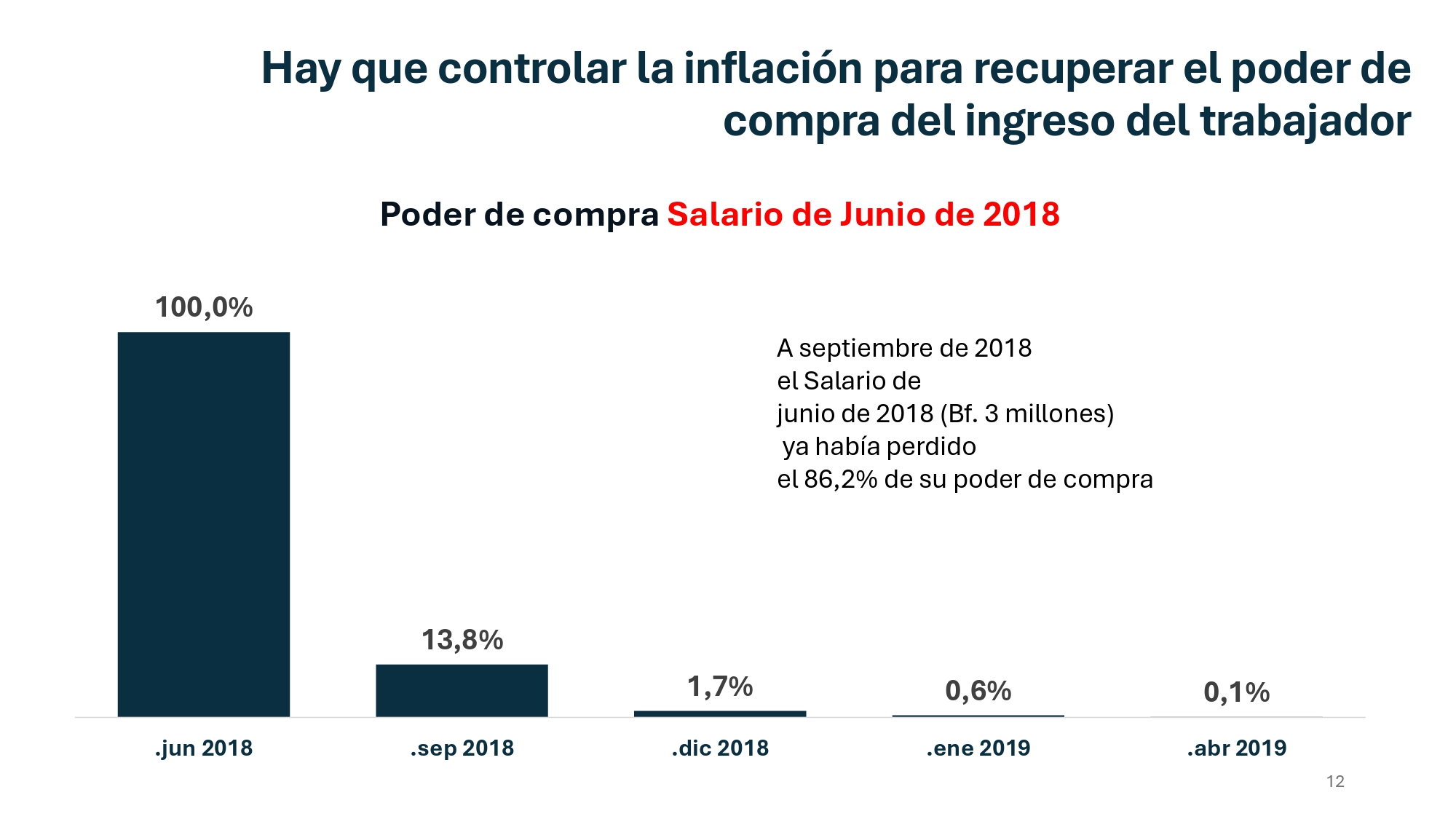
Example illustrating the loss of purchasing power of wages, when increases are financed through the issuance of bolivars
(Photo: Presidency of the Bolivarian Republic of Venezuela)
She also pointed out that in 2022 another salary adjustment was made “without backing”, which triggered monthly inflation.
Nominal salary.jpg
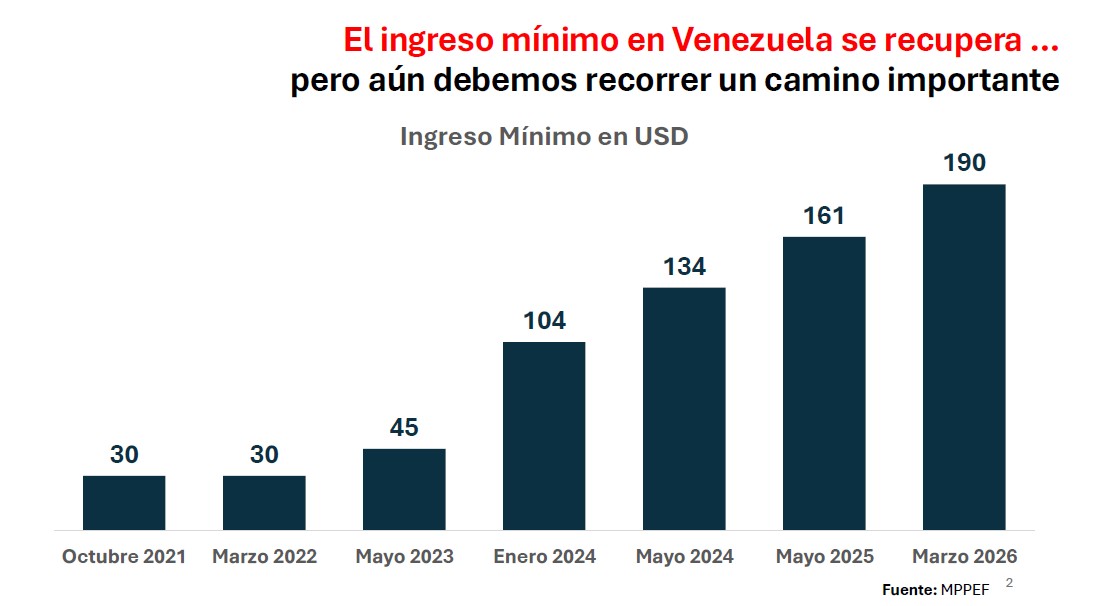
Nominal income has increased, but the paradox lies in inflation and the erosion of that income as it loses purchasing power
(Photo: Presidency of the Bolivarian Republic of Venezuela)
The premise is very simple: in the public sector, salary increases should not be implemented without strengthening the state’s revenue base. Otherwise, the government resorts to issuing bolivars as a mechanism for financing the fiscal deficit. This implies an increase in the money supply in national currency, which accelerates inflation.
On the other hand, even if private sector workers’ wages are substantial, the real purchasing power of those wages will also be diminished if monetary expansion to finance public sector salaries intensifies. According to the highest-ranking official, this was evident in 2018 and 2022. There are lessons learned and practices that should not be repeated.
She also stressed the need to break the trend and act in favor of a structural correction.
ABOUT THE PENSION SYSTEM
The Acting President revealed data on pressing issues within the pension system. Since the implementation of the Pension Protection Law, the private sector has increased its contributions, but these represent only 9% of the system’s funding base.
Meanwhile, the Venezuelan state pays 91% of pension payments.
One particularly worrying statistic is the ratio of contributors to pensioners. In the country, there are 5.3 million active workers contributing to the system and 6.2 million retirees and pensioners.
Pensions.jpg
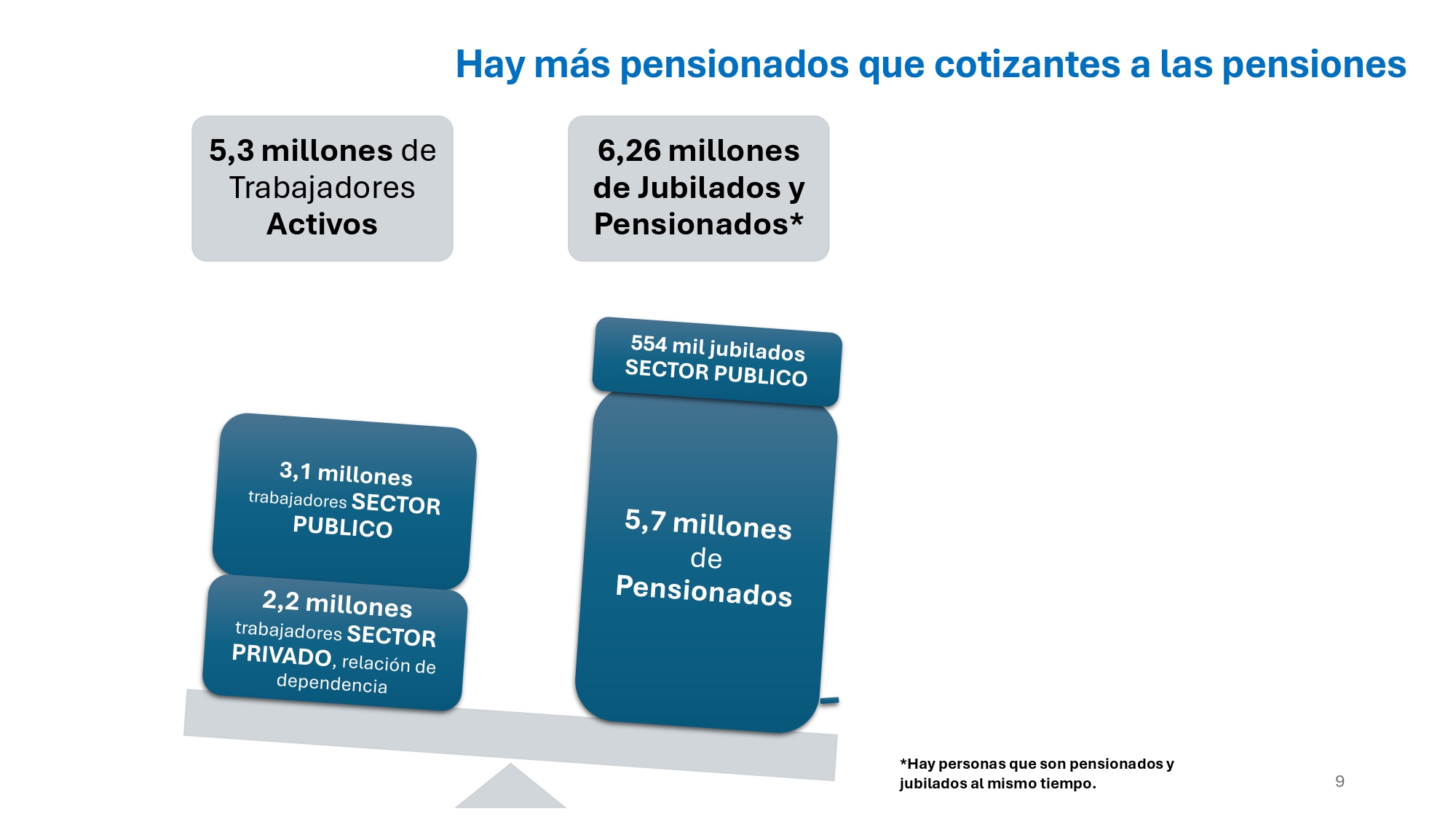
Current relationship of the pension system: contributors and beneficiaries
(Photo: Presidency of the Bolivarian Republic of Venezuela)
The significance of these figures can be gleaned in several ways: firstly, the current system is unsustainable because there are more people dependent on the system than contributors to support it. Secondly, there is a clear gap left by the demographic loss—due to migration—of the economically active population. Thirdly, there is a significant working population not reflected in these figures, which remains in the informal sector and, therefore, does not contribute to social security.
ANNOUNCEMENTS AND MEASURES
Acting President Rodríguez indicated that on May 1st she will announce a “responsible” increase in the minimum wage for workers.
Considering the data and reflections presented, this suggests that it will be a realistic increase, in accordance with the modest recovery of national income, without being leveraged through the issuance of bolivars.
On the other hand, she stated that the current pension model “is not sustainable,” suggesting a future restructuring of the social protection system.
In that vein, she announced the establishment of the Commission for Labor Dialogue, which will encompass the ongoing Labor and Social Security Constituent Assembly, with the participation of the State, the private sector, workers, and pensioners. The purpose of this commission would be to move toward the development of a new labor convention and a social security system tailored to national realities.
In other news, she signed the Organic Law for the Acceleration and Optimization of Administrative Procedures and Processes. The signing of this legal instrument marks a milestone in the simplification of bureaucracy in the country. During her address, she explained that the new legislation provides the Executive Branch with direct legal tools to eliminate critical bottlenecks in public administration, seeking greater efficiency for the State.
Regarding tax reform, she stated: “I hereby order the immediate establishment of the National Economic Council to receive proposals for a new tax model for Venezuela.”
In this regard, she asked that this model be more efficient and also that it promote technological platforms that allow Venezuela to move to a “higher level”.
It is expected that a reform of the tax system will contribute to its modernization, reduction of evasion, targeting of taxes in sectors that do not compromise growth and employment, and a greater efficiency of public finances.
The president stated that the recovery of blocked resources, which belong to the people of Venezuela, will be immediately allocated to rehabilitating our basic infrastructure —electricity, water, roads, schools, hospitals— and to productive investment, “which guarantees sufficient income for better pensions and workers’ wages,” she noted.
She also indicated that there are 500,000 homes “frozen” or off the market in the country. The goal is to bring these homes back into the real estate market to facilitate access to rental housing, especially for young people and new families who cannot immediately afford to buy.
In this way, she requested the National Assembly to reform the laws relating to the real estate market, which would build new guarantees to incentivize activities with support for both landlords and tenants.
SANCTIONS IN THE CENTER
A recurring theme in the presidential address was the issue of sanctions against the national economy. Once again, she addressed the United States government and the country, emphasizing the seriousness and impact of these illegal measures.
Rodríguez announced the development of a nationwide social mobilization agenda, in the form of a “pilgrimage,” which gives a political dimension to referring to sanctions as an inertia that compromises the stabilization and improvement of major socioeconomic variables.
The mobilization is scheduled to begin on April 19, Venezuela’s Declaration of Independence Day, and conclude on May 1, International Workers’ Day.
The significance of this mobilization is clearly symbolic. The pilgrimage is expected to travel through various parts of Venezuela before ending in Caracas.
From the perspective of the National Executive, the total withdrawal of sanctions could mean an increase in the resource base to sustain the commitments of the Venezuelan State and leverage the new reforms that could arise in the labor convention and the pension system of the country.


One thought on “Venezuela Acting President Delcy Rodriguez on the economy and sanctions: Announcements and measures”