
Stansfield Smith, ChicagoALBASolidarity.org
The left has not become marginalized because of exhaustion or infighting. Its decline was caused by the US government’s more than century long police state operations, purging the left from its home in the working class movement, leaving it with tenuous connection among the organized working class. The national security state – the actual US government – has constantly worked to neutralize anti-imperialist and class conscious working class voices, and instead promoted a “compatible left” in their long-term strategy to divide and control the left.
The working class, particularly those in industrial production, had significance for the left not because workers are more progressive in their thinking, but because they possess the power no other social forces have: they can bring the rule of capital to its knees by halting production, shutting off the capitalists’ ability to generate surplus value, the life blood of their system. The entire economy halts if these workers, those engaged in manufacturing, construction, electric power and utility workers, miners, dockworkers, truck drivers, warehouse workers – amounting to 20% of the US working class – stop working. That is why Marx, Engels and Lenin regarded the working class as the revolutionary force in this phase of human history, and the paramount task of the left is to fight to win its leadership.
In the US, the trade unions are the only mass self-defense organizations of the working class, built through painful and bloody class struggles against the bosses and their government. Gains for human rights result from struggles by the exploited and oppressed – organizing unions, the fight for decent living standards, greater rights for Blacks and women – often won through strike battles that were a class vs class civil war.
The Working Class Left Wing
There has always existed a militant layer of workers who have resisted, committed to destroying the main cause of their torments, the capitalist class. Most of these fearless organizers of the workers movement found their guide to action in Marxism, which clarified the proletariat’s pivotal role in transforming society.
These activists exemplified the class struggle left wing of the workers movement 75-130 years ago, in the Industrial Workers of the World, the Socialist Party, Communist Party, and others.
Today’s left has long been separated from leading working class struggles against the bosses. While imposed on us through US government purges, the isolation continues today seemingly almost by choice.
Before, leftist leaders were working class activists: Big Bill Haywood, Gene Debs, Mother Jones, Lucy Parsons, Elizabeth Gurley Finn, William Foster, Joe Hill. They risked everything to help organize and lead workers battles, including the Colorado, Lawrence and Paterson strikes, and the 1919 steel strike. The “Red Scare” repression of 1917-1920 and the Palmer Raids crushed the movement, with some 6,000 deported or imprisoned.
A generation later, in 1934, four strikes shook the country: longshore and maritime workers on the west coast, the textile workers in the southeast, the Toledo Auto-Lite workers, and the Minneapolis Teamsters. Those labor battles were virtual civil wars, pitting the workers against the bosses and their government, and led in part by working class left wing organizations — the Communist Party, Muste’s American Workers Party, and the Trotskyist Communist League of America. Soon came the labor struggles creating the CIO, which relied heavily on the exemplary work of Communist organizers. (Whose class character is seen in the first part of Seeing Red).
These working class leftists formed the backbone of the new stewards organizations of industrial unions, shared information and analysis across union and industry lines, and collectively pushed for broader mobilizations. All through these periods, the left meant the left wing leadership element in the working class movement.
The Ruling Class Purges the Trade Union Left Wing
With the end of World War II came a massive strike wave: 3.5 million trade unionists in 1945, then 4.6 million in 1946, the most in US history (in the recent big strike year of 2023, there were 492,000). US capitalist rulers responded with a ferocious counterattack against the working class and peasant upsurge around the world and at home.
In 1947 the US government imposed the Taft-Hartley Act, preventing solidarity strikes or secondary boycotts (crucial in forging the unions), denied federal employees the right to strike, and outlawed Communists and their defenders from the labor unions. The trade union leadership as a whole did not challenge this witch hunt.
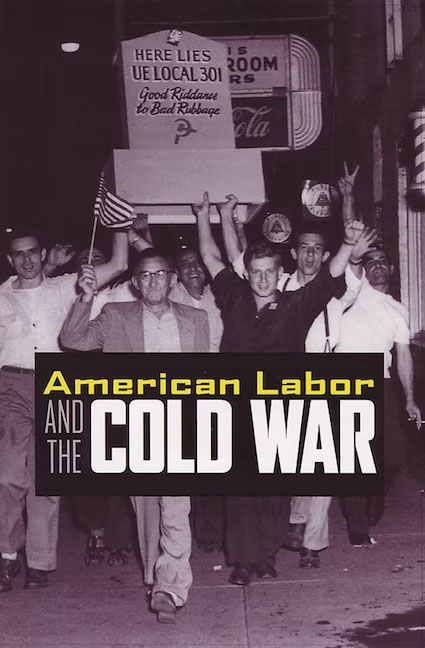
Then in 1949, shortly after the people’s victory in China, the CIO leadership launched its own purge of the working class left wing, expelling eleven unions, including its third largest, the United Electrical Workers, totaling one million members. This soon brought a halt to the growth of the trade union movement. The trade unions, by condoning and participating in this purge, were making themselves irrelevant as the force to remake society.
What is called the McCarthyite Red Scare went far beyond targeting Communists. The Chamber of Commerce “said that the real danger came from non-Communists, ‘those who engage in pro-Communist activities’ such as fighting for higher wages, housing, or the repeal of the thought-control Smith Act” (Labor’s Untold Story, p. 349fn). All those who struggled for social and economic justice and civil liberties could be targets.
Herman Benson, a Workers Party union activist at the time, noted “In those days [the 1930s-40s], radical intellectuals and radical workers were bound in a fraternity…They shared more than common ideals; they often shared membership in the same party or group.” But because of the witch hunt, “around 1950, intellectuals and union dissidents went rocketing off in opposite directions.” (The World of the Blue-Collar Worker, p. 221)
Not only government destruction of the trade union left wing undermined the workers struggle against capitalist assaults. Prosperity also acted as a pacifying force. The US, the only industrialized nation not destroyed in World War II, dominated world markets, enabling the bosses to grant continual wage increases to placate the working class. The average yearly increase (now almost unheard of) was 3.4% in real wages for unionized industrial workers, combined with ever better health coverage and vacation time. The trade union movement grew increasingly bureaucratized and went into political retreat, ruled over by pro-imperialist layer. This business unionism takes capitalism for granted, sees collective bargaining as a form of junior partnership in the administration of the company.
As Kim Scipes pointed out: “Labor’s foreign policy leadership is wedded to the idea of Empire…it undercuts opposition to the imperial project from within the United States, and especially limits the power of the most organized section of American society, organized workers…the AFL-CIO’s foreign policy program neutralizes arguably the key leadership in our society that has the ability to mobilize American workers against the imperial project.” (p. 113, 119)
The unions were blunted as fighting instruments for the 99%. “In the McCarthy era, most of the labor movement decided to give up the fight over controlling conditions on the shop floor,” explained UE President Carl Rosen.
Workers control over production (control over job conditions on the floor, the pace of work, and safety conditions) was rolled back. Companies much prefer to grant workers more money than to acceed them any control and power in the workplace. The needs of unorganized workers, women, Blacks, immigrants, the fight to win broad social programs such as health care for all, and opposition to US overthrow of foreign governments were neglected. The trade unions often no longer led important social and political struggles.
Popular Movements Detour Around the Tamed Trade Unions
With the left wing purged from the unions, fighters in the 1950s–60s Black rights struggles, against the US war on Vietnam, the environmental, Chicano, gay and women’s movements lost their most powerful ally and had to detour around these working class mass organizations. The trade union officialdom generally opposed participating in these struggles, sometimes even attacked them.
As a result, these political movements won significant concessions from the ruling class without mobilizations by organized labor. To new generations arising since the 1960s it seemed that the working class and its trade unions were not the foundation for building a left wing leadership, nor even necessary to advance social struggles. For generations of youth, including industrial workers, the AFL-CIO did not appear as the fundamental class enemy of the capitalist class, but as part of the Establishment.
Some politicized youth from the 60s did recognize its revolutionary power and sought jobs in industry, becoming activists in the trade union movement. However, even during the 1970s labor upsurge, Labor Notes’ Kim Moody points out,
“there were no nationally recognized leaders or organizations that straddled the movement as a whole. Nor was there the sort of radical core of organized leftists that has provided so much of the indispensable grassroots leadership, at the shop-floor level and across the movement as a whole, as there had been in earlier labor upheavals. Socialists and other radicals played important roles in some rank-and-file organizations [Teamsters for a Democratic Union (TDU), Miners for Democracy (MFD), United National Caucus (UNC) in the UAW, Steelworkers Fightback] but their numbers were few, and none of their organizations were strong enough to provide anything like national leadership and direction to the movement as whole….Nor did the leading rank-and-file organizations of the era, like TDU, MFD, UNC, or Steelworkers Fightback, make serious attempts to relate to one another, let alone organize umbrella organizations that might help them to provide mutual support.” (Understanding the Rank-and-File Rebellion in the Long 1970s, in Rebel Rank and File, p. 144)
No organized working class left wing coalesced, providing national grassroots leadership during the 1970s labor upsurge. Since then we refer not to the working class left wing, but to a disembodied “left,” with no substantial connection with the industrial working class.
Era of Trade Union Defeats and Concessions Began in the 1980s
Two major ruling class assaults on the workers movement put an end to the labor upsurge of the 1970s, commencing an era of significant setbacks. The UAW leadership swallowed the Carter administration’s Chrysler “bailout,” and settled for a contract that broke the Big Three pattern agreement covering workers at GM, Ford and Chrysler.
Reagan’s firing of all 13,000 striking PATCO workers in 1981 followed. This evoked only a tepid response from AFL-CIO heads, leading to a devastating setback for the workers movement. Soon to follow were defeats such as the Greyhound strikes, Phelps-Dodge (1983-86), Hormel and UFCW P-9 (1985), Eastern Airlines (1989), and the Bridgestone-Firestone, Caterpillar, and Staley strikes (1992-95).
The AFL-CIO leadership led no serious fight against the worsening economic conditions inflicted on the working class since the mid-1970s. It focused on spending tens of millions of dollars to elect Democratic politicians. The working class struggle was paying a heavy price for the lack of organized left wing leadership, in contrast to the first half of the 20th century.
Yet some battles were successful, such as the UPS (1997) and Verizon strikes (2016), and A Day Without Immigrants (May 1, 2006). While the 2011 Madison, Wisconsin labor occupation of the State Capitol inspired working people around the country, it was derailed, and the state’s public sector unionization plunged from 50% in 2011 to 22% by 2021. The 2012 Chicago teachers strike won by championing issues benefiting both its members and the communities they serve, igniting a series of teacher strikes elsewhere.
These labor battles could not have succeeded without some class struggle left wing presence pushing them forward. But the different struggles produced no way to coordinate their fights, nor recognized national leaders. There was no organized connection between this current in the labor movement and the left today.
The Myth of US Deindustrialization
The view that the US empire is declining is partly based on alleged US deindustrialization. Yet, as Moody pointed out, while manufacturing employment decreased 40% just between 1979-2014, labor productivity dramatically increased, meaning a higher rate of the capitalists’ surplus value extraction. The workforce in steel production fell 65% from 1980-2017, yet work-hours to produce a ton of steel fell more, 85%. The US still produces 75% of its own steel. The overall national industrial production index grew from 52 in 1979 to 105 now, with the 2017 level being the reference point of 100. The US is actually manufacturing more than ever, even though its world share has dropped from 22% in 2004 to 15.9% in 2024, now half the share of China. As of February 2024, there was nearly $223 billion in inflation-adjusted annual U.S. manufacturing construction investment, with manufacturing workers numbering 15 million, though still only 10% of the private sector.
What has dramatically declined is not the US industrial base, but the number of unionized private sector workers: 6% today, down from almost 35% in 1953.
The Quandary the US Left Faces
Now, long after the left wing’s purge from the trade union movement, there has been no effective organized campaign to rebuild it. Today’s left exists in a separate domain from the industrial working class, more oriented to the university than to the shop floor, further enfeebling it. Kim Moody notes, “since the 1940s, the left has been middle class. The socialist, communist left has been removed from the working class… they are not even oriented that way.” This contrasts with what Marxists historically advocated; as Lenin said the task of the party was “to organize the class struggle of the proletariat and to lead this struggle” When leftists are not part of the class struggle left wing of the labor movement, they abdicate the essential task of Marxists.
Protests today, against police brutality, against mass murder in Palestine, for women’s rights, involve working people. Their strength, however, was not felt as such. The struggles are in the street, but there is no clear connection to the workplace and the strength that arises out of organizing the ranks of the working class. For the vast majority of those who protest, involving unions is not on their horizon.
Ruling Class Control over the Movement
While there is widespread sentiment for a party that represents the 99%, the corporate elite, their national security state and their Democratic and Republican machines control US society.. The corporate rulers do not intend to allow a working peoples party and possess many tools to prevent it. They control the state apparatus of rule: the legal system, the electoral system, the open and secret police agencies, the military, the mass media, most of the country’s wealth, and the national security state — the actual government. (1)
The rulers are ingenious at neutralizing movements independent of their two parties, and can control the left through selective repression and corporate foundation funding of a “compatible left.”
Activists in movements that threaten the status quo learn they are not free but live under a police state. People recognize at some level that building a progressive party and a new leadership means the more effective you are, the more police state methods will be used to stop you.
Consequently, we often opt for something safer and seemingly more feasible: working for any social changes that we feel possible under the present system – or being diverted into peripheral issues such as identity politics. This may be why most leftists have not committed ourselves to pressing issues that exist to unite left forces and the working class in a collective fight. Our whole class would be immensely benefit from a successful fight for national health care or for a livable minimum wage. The left today has not focused on these basic needs, yet what could more galvanize working people than gaining health care for all?
Exercising your First Amendment rights – never actually upheld* – means you give up your somewhat comfortable and safe life for one of combating government operations out to destroy you. Bernie Sanders clearly recognized this, given his capitulation from his previous views calling for a new, progressive political party.
Reconstructing a Working Class Left Wing
The trade unions have the tools to fund and build a working people’s party. In 2020, organized labor spent more than $1.8 billion to help elect candidates of the two corporate parties, besides mobilizing many thousands of foot soldiers to campaign. The unions possess $29 billion in net assets. UE President Carl Rosen said, “Our unions are the most powerful and democratic organizations we have, and we have a responsibility to use them to fight not only for a decent life for ourselves and our co-workers, but also for a world of peace and justice for all.”
Moreover, the Bernie Sanders pro-socialist presidential campaigns did attract hundreds of thousands at his events around the country, and millions were organized to vote for him. This was a base to build a mass popular party opposed to oligarchic rule. But he stayed loyal to the Democratic National Committee, did not use his huge supporter lists to launch a new party, instead turned it over to the party bosses.
Therefore, we know the consciousness is there, the willingness, and the funding, where we fail is in the struggle reconstruct a working class left wing.
(1) Ruling Class Police State Unconstitutional Repression In Democracy for the Few (The Repression of Dissident), Parenti notes the “boundless” resources of the “law” to derail mass protest movements. Activists can be spied on, victimized by grand jury witch hunt investigations, by serious beatings and death threats, arrested on trumped up charges, faced with exorbitant bail and long jail time (Obama used against whistleblowers, Leonard Peltier), by confiscation or freezing of their funds ($64 million imposed UMWA because of a 1989 strike), by offices being raided and destroyed (Black Panthers), by government run media smear campaigns (Russiagate against Trump, or against Gary Webb), by constant police harassment (Malcolm X), by government murder (Martin Luther King), by police death squad murders (as with 34 Black Panthers), or by FBI front groups (KKK killing four anti-Klan activists in Greensboro), by bannings from internet media (many of our alternative media groups and writers today), jailed for constitutional free speech (Julian Assange, Eugene Debs), by bans from using the mails (Margaret Sanger’s Woman Rebel), denied any speaking engagements (Paul Robeson), by revoking passports (Robeson), by being banned from entering the United States (Charlie Chaplin, Arnold August), by mass deportations (IWW, Palmer Raids), death sentence frame-ups (Mumia Abu Jamal, Sacco and Vanzetti, Joe Hill, Haymarket martyrs), with blacklisting (Hollywood Ten), and jailings (Communist Party members), funding “compatible” leftists to smear you, FBI infiltration and disruption (such as Cointelpro, now under a different name), denial of ballot status (Green Party), exclusion from election campaign debates (all non-corporate candidates), drug frame-ups, by freezing of bank accounts (Ottawa protest leaders), time-consuming trials that paralyze their organizations, exhaust their funds, consume their energies, destroy their leadership (Socialist Workers Party, 1940; Communist Party 1949). Or being publicly threatened with mass execution: The Los Angeles Times wrote in September 1917, “The IWW conspire against the government of the United States and…every day commit actual treason…and ought to be shot as actual traitors to the country which has given them life and liberty.” These are but a sampling of ruling class police state methods to crush working class opposition.
* We can think of endless examples of how much the First Amendment has been dismantled, given it states: “Congress shall make no law respecting an establishment of religion, or prohibiting the free exercise thereof; or abridging the freedom of speech, or of the press; or the right of the people peaceably to assemble, and to petition the Government for a redress of grievances.”
 Chicago ALBA Solidarity
_and_Manufacturing_Employment.png)
4 thoughts on “ Part 2: Behind the Decline of the US Left”