
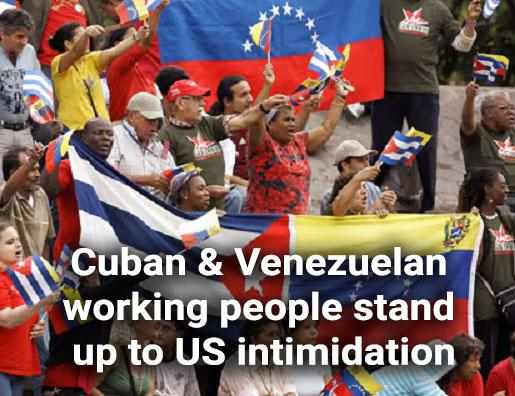
Monthly Review (Cira Pascual Marquina): The Commune and Popular Sovereignty in Times of Imperialist Siege The revolution’s leadership has been forced to make difficult decisions; it is a tactical concession affecting our national sovereignty how the US now oversees and controls our oil sales. The immediate alternative to this concession was not maintaining sovereignty—an idea often invoked by “leftists” in the global North as they hastily declare the end of our revolution—but rather an all-out bloody war under extremely unfavorable conditions.
In Venezuela, there exists another equally important dimension to national sovereignty: organized popular sovereignty. The commune is a political form capable of embodying collective emancipation. Communal production, collective management of services, and collective decision-making become concrete mechanisms both of resistance and of building new social relations that point toward emancipation.
The recent National Popular Consultation, held on March 8, International Working Women’s Day, expresses this dynamic. Every time a community collectively decides how to organize its material life, it exercises a concrete form of sovereignty. This popular sovereignty acquires strategic value when a country faces unilateral coercive measures and military aggression. The objective of such attacks is not only to pressure a government: it is to disorganize social life and fracture the collective fabric that allows a society to reproduce itself with dignity.
Communal organization operates as a form of social resilience. it is politically significant that, just two months after the January 3 attack, the national government chose to center these popular consultations. At a moment when imperialism presses for the dismantling of popular power, the decision has been the opposite: to maintain communal democracy as the backbone of the revolutionary process. This reflects a strategic understanding: in the midst of siege, the principal strength of the Bolivarian Revolution does not lie solely in state institutions, but in the territorial organization of the working class.
Diana Block: Cuba is Not Alone! Cuba Will Not Yield! An interview with Adrián Heredia, Second Secretary of the Cuban Embassy in Washington DB: How should we respond to those in the U.S. who think that “it’s all over for Cuba?” AH: That narrative has been repeated many times over the decades—and it has consistently been proven wrong. Cuba has faced sustained pressure, yet it has not relinquished its sovereignty or its social project. The current situation is challenging, but it is not unprecedented. The Cuban people have demonstrated resilience, dignity, and a strong sense of national identity. Measures are being taken every day to confront these challenges and protect the most vulnerable. Cuba will not yield! It will continue to defend its independence and its vision of a more just society, regardless of external pressure—even from a country as powerful as the United States.
OrinocoTribune: President Maduro’s Trial Will Not Bring Justice, but It Can Weaken US Imperialism US District Judge Alvin Hellerstein rejected the motion to dismiss the case, but will soon decide whether to order Washington to allow Caracas to pay the legal fees. A trial date has not yet been set. What is happening in the Manhattan courthouse is the illegal abduction of a sovereign head of state.
Since President Maduro and Flores were abducted, Trump has effectively seized control of Venezuela’s oil exports and revenue, the result of demands made at gunpoint. Following the bombings on January 3, Trump threatened further strikes and the killing of the remaining Chavista leadership while maintaining a naval blockade to prevent any Venezuelan oil shipments from leaving, unless Acting President Delcy Rodríguez complied. Once these demands were met, Trump recognized Rodríguez, vice president under President Maduro, despite having previously alleged that the government was illegitimate.
Venezuela’s response has been resistance through diplomacy and compromising on less-than-ideal oil sales to guarantee peace and fight for the return of President Maduro and Flores. Delcy Rodríguez has to make concessions to the US that she otherwise wouldn’t do because she’s dealing with an opponent that has openly kicked international law and has shown its willingness to use its vast military power to cause grave harm to Venezuela.
The corporate media has claimed the recent changes in the Venezuelan government by Delcy are a way of removing key figures from the Maduro era to positions with less political or judicial power. Those being appointed had already held positions under the President Maduro government, so they are not newcomers or US sympathizers. Some of them have a long history of militancy in the Chavista movement. The intention behind this is to create division and distrust among grassroots Chavistas towards government leaders. The grassroots Chavista movement has not been defeated. It is fighting against US control in the hope of achieving better conditions, albeit under different circumstances.
Granma: Russia to send second oil ship to Cuba Russian Energy Minister Sergey Tsiviliov said Thursday that Russia is preparing to send a second oil ship to Cuba amid the island’s severe energy crisis caused by the U.S. embargo. “A Russian vessel broke the blockade. Now the second one is being loaded. We will not leave the Cubans in dire straits,” Tsiviliov said.
Ultimas Noticias: The US removes Delcy Rodríguez from the OFAC sanctions list The Office of Foreign Assets Control (OFAC) officially removed Delcy Rodríguez from the List of Designated Nationals and Blocked Persons. By removing her from this list, the prohibitions on US citizens and entities conducting financial transactions with the official are eliminated, in addition to unlocking any assets that may have been under US jurisdiction.
Medea Benjamin: How U.S. Sanctions Are Fueling Hunger in Cuba In Cuba today, food is rotting in the fields while families go hungry. I spoke with farmers who are watching their livelihoods slip away—not because they lack skill or dedication, but because they lack fuel, parts, and basic inputs. One farmer described fields ready to harvest but no diesel to bring the crops in. Others showed broken machinery they have no way to repair. These are not isolated stories; they reflect a system under siege. The U.S. fuel embargo, together with tightened sanctions under Trump, is strangling Cuba’s agricultural system from seed to table—making it harder and harder for Cubans to feed themselves.
There is not enough fuel to transport fresh produce from rural farms to urban markets. Trucks sit idle. Distribution chains break down. Food that could nourish communities never makes it to the people who need it most. Processing food becomes impossible. Without reliable electricity, processing factories cannot operate.
The government has set up soup kitchens to support the most vulnerable. But portions had grown smaller and less varied, and staff were forced to scavenge for wood to cook with due to gas shortages and unreliable electricity. Lift the blockade. Allow Cuba to import fuel without threats of sanctioning the countries that provide it. Stop punishing farmers for trying to grow food—and the Cuban people simply trying to feed their families.
.
Upcoming Events
Some screenings of Earth’s Greatest Enemy
April 13 (Monday), 2:30 pm ET: Nicaragua Solidarity Coalition monthly meeting on zoom. Email NicaraguaSolidarityCoalition@gmail.com in advance for zoom access.
April 19 Nicaragua Solidarity Coalition webinar: The impact of economic coercive measures, especially on children, with focus on Cuba and Venezuela. Sponsored by our coalition’s lobbying/ advocacy team and Americas Without Sanctions. Register: bit.ly/NicaApril19
May 1, Chicago: Report on Nicaragua Today– the social and political work helping the poorest of the poor. With Sarah Woodard of the Jubilee House Community
.
Delegations to Cuba, Nicaragua:
Cuba – Video: Yes You can Travel to Cuba
Building Relations with Cuban Labor May Day Delegation
NNOC 19th International May Day Brigade
May Day in Santiago de Cuba 2026 (download info doc)
Witness for Peace 2026 delegations to Cuba
Friendly Planet delegations to Cuba
Ernesto ‘Che’ Guevara Volunteer Work Brigade
Nicaragua
Casa Ben Linder Email casabenjaminlinder@gmail.com to apply:
July 2026: Solidarity in Action: Nicaragua’s Popular Revolution
October 2026: Salud & Solidaridad: Hands-On Healthcare in Nicaragua
Now offering Spanish classes! Fun and practical language classes at Casa Ben Linder – our
model teaches 1/2 day class & 1/2 day practice in a community setting.
Share this:
 Chicago ALBA Solidarity