
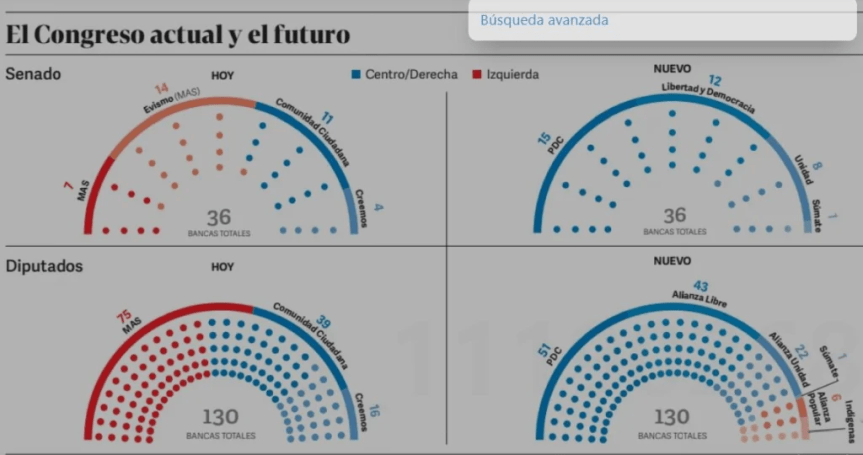
The image accompanying this article illustrates the profound changes experienced by the Plurinational State Assembly and the catastrophic nature of the MAS defeat in Bolivia. This ended a cycle that began with Evo Morales’ victory in the December 2005 presidential election and his entry into the Palacio Quemado in La Paz on January 22, 2006. It should be emphasized that in this period saw the MAS electoral hegemony was overwhelming, winning a succession of six elections with percentages that, except in one case, soared well above 50% of the vote.
This supremacy at the polls reflected MAS political hegemony and the leadership capacity of the undisputed leader of the popular movement, Evo Morales. In the nearly fourteen years of his administration, interrupted by the fascist coup d’état of November 10, 2019, Evo’s administration radically and positively changed the face of Bolivia, leading many observers and media outlets to speak of the “Bolivian economic miracle.” Not only economically but also socially and culturally, areas where progress was perhaps even more spectacular than in the economic sphere. But this is not the place to examine this fascinating emancipatory process, its great achievements, as well as some of the most deficient aspects of those years. The urgency of the situation compels us to look toward what is imminent.
It is more productive, therefore, to ask ourselves what can be expected from a collapse as spectacular as the one that occurred last Sunday at the polls, but which was brewing almost from the moment Luis Arce assumed the presidency of the Plurinational State of Bolivia on November 8, 2020. This thesis, however, is questioned by Javier Larraín, director of the magazine Correo del Alba, when he offers a more pessimistic, and probably more realistic, view. Larraín places the origin of this decline much earlier. This is what he told Gustavo Veiga in an interview for Página/12: “The process of decomposition of the MAS began in 2013, 2014, and if we remember that in 2019 it obtained the lowest vote ever under Evo, 47%, and (before that) it had lost a referendum whose result it ignored, then what we have been seeing is this decline.” [1]
Since then, an internal struggle for popular leadership and the direction of the process of change has gained momentum. As Sacha Lorenti points out in an article aptly titled “Preliminary Autopsy of the Elections in Bolivia” (because unfortunately the MAS, that great Bolivian popular movement, has died), “the government of Luis Arce did everything in its power to try to destroy the leadership of Evo Morales: the theft of the MAS-IPSP name, the cancellation of any possibility of participation with another name, the violent takeover of social organizations, the disqualification of Evo Morales, the attempt on his life, the persecution and imprisonment of more than one hundred people who protested against the proscription and, as reported by Diario Red, payments to judges and members of the Supreme Electoral Tribunal to remove him from the electoral board.” [2] This is true, but it cannot be overlooked that Evo, who not by chance during his presidential term was popularly known as “the boss”, never finished digesting the legal impossibility he had to be a presidential candidate in 2020 and that he always considered Arce – his star minister in the years of economic splendor, let’s not forget that – as a usurper, which is why he did not spare harsh criticism of the person who then occupied the presidency.
A more intermediate interpretation of this lamentable conflict, which began as a fierce personal struggle for power and only later developed into a broader political and ideological divergence, is offered by an article published by Álvaro García Linera on the eve of the Bolivian elections, in which he described this fracture in the harshest terms: “On the one hand, a mediocre economist who happens to be president and who believed he could displace the charismatic indigenous leader (Evo) by banning him from office. On the other, the leader who, in his twilight, can no longer win elections, but without whose support no one wins either, and who has taken revenge by helping to destroy the economy without understanding that in this immolation, he is also demolishing his own work. The final result of this miserable fratricide is the temporary defeat of a historic project and, as always, the suffering of the humble who were never taken into account by the two brothers intoxicated by personal strategies.” [3]
Taking this background into account, and especially the idea of a “miserable fratricide” that puts an end – or just a pause? – to a revolution in progress, Carlos Figueroa Ibarra is right in his analysis of the Bolivian elections. He asserts that both Rodrigo Paz Pereira – son of former President Jaime Paz Zamora (1989-1993) – and his opponents, Jorge “Tuto” Quiroga, who he will face off in the runoff if the latter decides not to participate at the last minute due to his slim chances of winning, and Samuel Doria Medina, who came in third in the first round, share the main lines that will define the course of the next government, almost certainly headed by Paz Pereira. [4] This new neoliberal consensus contemplates the “elimination of the plurinational republic, agribusiness as the heart of the Bolivian economy, legalization of GMOs, repression of social protest, privatization of state-owned companies, opening to transnational capital, elimination of fuel subsidies, elimination of community ownership of land.” But, in addition, on the political level, the pardon of the coup plotters Jeanine Añez and of one of the leaders of the racist extreme right and former governor of Santa Cruz, Luis Fernando Camacho, in addition to the persecution of Evo Morales and Álvaro García Linera. In other words, a political nightmare.
In this lamentable scenario, given a very painful defeat not only for the working classes of Bolivia but for all the peoples of Our America, Evo Morales’s triumphalist declarations extolling the 19.2% spoiled vote are surprising. According to him, this projects him as the leader of the opposition to the new reactionary regime. But this euphoria, which is undeniably based on the loyalty of a significant portion of the popular camp to Evo’s directives, obscures the ineffectiveness of the spoiled vote, its practical sterility, except when it is the prelude to an insurrectionary moment capable of challenging established power, something that this writer does not recognize at this moment in Bolivia.
This possibility should not be ruled out, considering the long experience of struggle and the extraordinary combativeness of the Bolivian plebeian masses. Perhaps this confrontation between institutionalized power and the creative power of the street will occur. But to this day, these signs of popular insurgency are not seen in the present political climate. And much less do the existing balance of forces in the economic, political, cultural, and military spheres offer any indication that something underground is moving toward a popular uprising.
Meanwhile, the existence of a National Assembly in whose Senate the MAS has completely disappeared and barely retains a tiny minority in the Chamber of Deputies demonstrates that the null vote has only served to facilitate the right’s construction of the two-thirds of the votes needed for the National Assembly to reform the State’s Political Constitution, nullifying the great advances embodied in that luminous constitutional piece that emerged from the rise of the MAS. And we know that, unlike the left, when the right has an opportunity, it doesn’t waste time in philosophical debates or discursive bidding. It acts swiftly and lethally. For those who doubt this assertion, I advise them to examine the Argentine case. Hopefully, the outcome of the current Bolivian situation will be different and better.
[1] See Gustavo Veiga, interview with Javier Larraín, “The process of decomposition of the MAS has been going on since 2013”, Página/12, 16.8.2025 https://www.pagina12.com.ar/850001-javier-larrain-el-proceso-de-descomposicion-del-mas-viene-de
[2] “Preliminary autopsy of the elections in Bolivia”, Diario Red , 18.8.2025, https://www.diario-red.com/opinion/sacha-llorenti/autopsia-preliminar-utopsia-preliminar-elecciones-bolivia/20250818092812052736.html
[3] “Why do progressivism and the left lose elections?”, in Resumen Latinoamericano , August 17, 2025, https://www.resumenlatinoamericano.org/2025/08/17/pensamiento-critico-por-que-el-progresismo-y-la-izquierda-pierden-elecciones/ . I cannot help but point out one nuance: Arce did not become president by chance. There was no other candidate, that is the truth.
[4] . https://www.e-consulta.com/opinion/2025-08-19/bolivia-quien-gano-y-quien-perdio
 Chicago ALBA Solidarity
One thought on “Atilio Boron: Notes on the Bolivian political tragedy”