
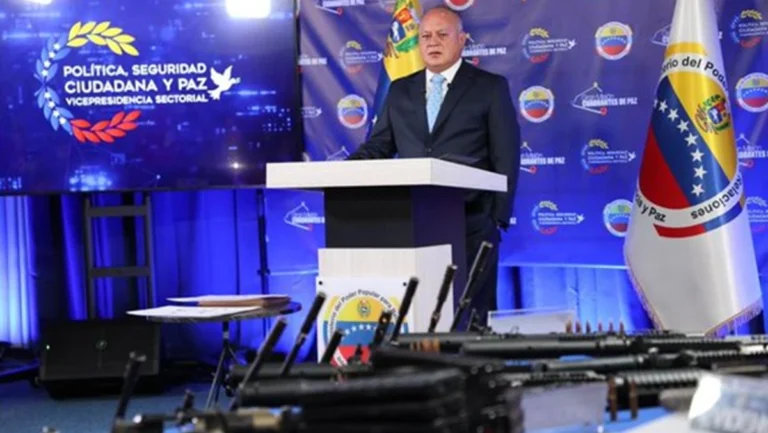
On Monday, May 19 , the Vice President of the Policy, Citizen Security, and Peace Sector, Diosdado Cabello, denounced a new conspiracy and terrorism plot in Venezuela, resulting in the arrest of 38 people, 17 of them foreigners, linked to plans to sabotage the regional elections.
These actions reportedly included explosive attacks on embassies, hospitals, police transportation units, and electrical substations. They also sought to target high-ranking government officials, social leaders of the Chavista movement, and even opposition members who will participate in the regional and legislative elections on May 25.
The objective was to create a climate of terror to portray to the international community that Venezuela is in no condition for elections and, in doing so, to sow fear among the population so they won’t go out and vote. For this reason, the government decided to suspend air connections with Colombia.
Among those arrested is a Colombian citizen of Albanian origin, wanted as an international drug trafficker. Investigations reveal that this individual had a hotel reservation in Caracas paid for from the United States and had ties to the Albanian mafia operating in Ecuador.
It’s known that drug trafficking and corruption networks have been operating in the Andean country since 2009, involving Danilo Carrera, brother-in-law of former President Guillermo Lasso; Rubén Cherres, Carrera’s close friend and oil businessman; and high-ranking law enforcement officials. The case was revealed by the digital media outlet La Posta , whose journalists were forced to leave Ecuador under threat.
Cabello also denounced the existence of paramilitary training camps in Ecuador run by American mercenary Erik Prince, who visited the country last April to “advise” the government on security matters.
Furthermore, he blamed the coordinator of the Vente Venezuela movement, María Corina Machado, for these plans and indicated that seven of those arrested are implicated in criminal activities linked to a cryptocurrency organization that is allegedly “related to a network of narco-mayors” in the state of Zulia.
During the early hours of Friday, May 23, two days before the elections, the remaining terrorist group led by opposition extremist Juan Pablo Guanipa Villalobos, which had been in hiding since last January, was dismantled. As a result of the police operation, electrical detonators, C4 explosives, cell phones, computers, and various explosives equipment were seized.
Cabello reported that “drug trafficking is the main source of financing for these operations” and that among those captured days earlier are Albanian and Bulgarian citizens, as well as four Pakistani mercenaries with false documentation. He also indicated that the day before, a meeting had taken place with former Venezuelan police commissioner Iván Simonovis in which the installation of explosives was agreed upon, starting Friday. So far, the following have been arrested: José Ledezma, Carlos Marcano, Isidro León, Luis Gutierres, Carlos Gómez, Naomi Arnáudez, Yraida Ruiz, Enrique Gómez, Jhonnel Narváez, and Yalida Mendoza. All linked to the terrorist plot.
The violent threat that has become permanent
Machado announced on May 9 that “a very complex plan is underway to further weaken” the Venezuelan government. Furthermore, last Wednesday she urged the population to stay home on election day. For its part, the Democratic Unitary Platform (PUD), led by Machado, maintains its rejection of vote participation and considers the call for a “hasty, unfair, and rigged” election by “a severely questioned referee.”
While maintaining a politicized discourse, this extremist sector of the opposition has been openly involved in acts of criminal violence; this agenda has not diminished, although it has undergone transformations. Its mechanisms have been different and, at times, have favored street violence, as in 2014 and 2017, but recently this agenda has focused more on paramilitary violence.
Since July 28, several schemes have been dismantled, notable for their constant threats, the instrumentalization of criminal gangs such as Tren del Llano, among others, and the infiltration of Venezuelan and foreign mercenaries.
Regarding the threats, the propaganda surrounding the “Ya Casi Venezuela” campaign, which involved Prince, was led by Iván Simonovis, whom Cabello accuses of being behind the plot dismantled in recent days. Last October, a shipment of weapons linked to a violent plot similar to the case in question was seized.
The most notorious case of mercenary infiltration was Operation Gideón in 2020; however, Spanish intelligence agents were arrested in September 2024, and other mercenaries were captured in January of this year, prior to President Nicolás Maduro’s inauguration. By that date, more than 150 mercenaries of 25 nationalities had been detained in Venezuela.
It’s worth remembering that, stripped of ideas and political proposals, the extremist opposition has lost any ability to rally people and has offered its followers solutions described as “magical” by other militants in that sector, which only demonstrates strength when supported by foreign sponsors.
The sponsor of the “weakening” plan being attempted is US Secretary of State Marco Rubio, who also operates on a broader international spectrum.
Guyana as bait for a war scenario
Specifically, this US foreign policy chief has sought to inflame differences with the Cooperative Republic of Guyana to provoke a war scenario. His visit to the neighboring country last March sought to consolidate it as a satellite state against Venezuela and a subsidiary of the oil company ExxonMobil, within the framework of the territorial dispute over the Essequibo.
Venezuela has included the state of Guayana Esequiba in its electoral call, in line with the majority vote approved in the referendum held in December 2023. Therefore, on May 25, a governor, seven deputies to the Legislative Council, and representatives to the National Assembly (AN) will be elected for the first time.
Guyana has reported two alleged attacks from Venezuelan territory, seeking to reuse the trusted resource of the false flag operation, a trademark of the United States. After the first, which occurred during the Caribbean Community (CARICOM) summit, the perpetrators were captured by Venezuelan authorities, and President Nicolás Maduro reported that they confessed to having been hired to “assassinate or kidnap” security agents from the neighboring country.
Furthermore, on April 5, Venezuela reported that a simulated attack was being planned against an ExxonMobil platform in the still-undemarcated Essequibo waters to hold the Venezuelan state responsible. Prince was also implicated in the attack.
Misión Verdad has identified a pattern accompanied by a narrative offensive from Georgetown intended to delegitimize the upcoming electoral process. During his visit, Rubio declared from Guyana that his country would not hesitate to intervene militarily if Venezuela decided to act to defend its territory in the dispute over Guayana Essequiba, a differential factor for the profits of the oil company ExxonMobil.
Defend the right to choose and move forward
For those calling for a boycott of the May 25 elections, creating fear and anxiety is a useful strategy; it would be the card needed to generate abstention and reinforce their narrative. Although they aren’t mobilizing people, the leaders around Machado are trying to extract a payback from the demobilization that terrorist-type violence would generate.
On the other hand, renewing and/or ratifying both regional authorities and parliamentarians is essential for Venezuelan political life; it is a right of the general public. However, the supposed defenders of democracy are trying to prevent this.
The Bolivarian National Armed Forces (FANB) have deployed Operation Republic, and the Head of State has reaffirmed the activation of a “special peace and security defense plan” for the elections. In particular, he ordered the reinforcement of the National Electricity System’s defense plans against the newly detected threats.
The goal is for the population to express itself safely and freely, for differences or disagreements to be resolved through voting and debated in eminently political spaces like the National Assembly. Furthermore, citizen participation in the electoral process will be another step toward continuing the plans for economic recovery and national stability. These are fundamental keys to sovereignty.
After this was written, TeleSur reported: Venezuela Neutralizes Nearly 60 Attacks on Its Oil Facilities: Cabello Venezuelan Minister Diosdado Cabello said that his country’s forces had thwarted more than 60 attacks on oil facilities over the past 10 days. This happened amid the parliamentary and regional election process, which was successfully held on Sunday, May 25. During a press conference, the Bolivarian official said investigations revealed that the attack plan was orchestrated by a right-wing terrorist organization.
 Chicago ALBA Solidarity
One thought on “Venezuela: The Chavistas Foiled the Rightwing Attempt at Election Terrorism and Sabotage”