
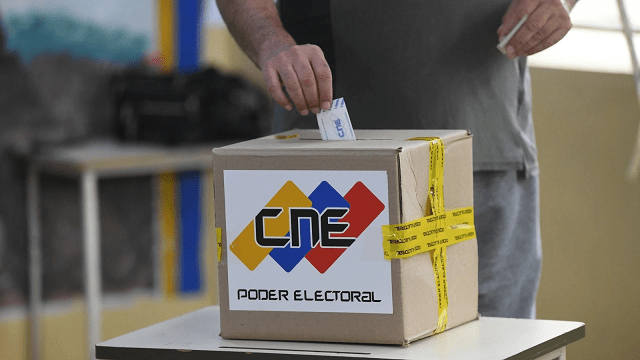
Cyberattacks to disrupt a country’s democratic elections where the US government knows its candidates cannot win through a free vote has become a new US coup attempt tool. It succeeded in Bolivia in 2019, but Venezuela has been able to fend off these US coup operations.
A video is circulating on social media that reveals that Venezuelan far-right politician María Corina Machado paid $50,000 to hackers to sabotage the transmission system of the National Electoral Council (CNE) and the CANTV network during the vote counting of the presidential elections of July 28, 2024. According to a video posted on TikTok by the user @Carlos_Chavez1995, the cyberattack let Machado make the CNE system dysfunctional for three hours, thus being able to display the infamous fake “voting records” that declared Edmundo González Urrutia as the winner. In the video, Chávez explains that it was an intervention with a T2 system, which collapsed the network with many bots making simultaneous calls to CANTV.
A man identifying himself as the Chilean hacker ASTRA recently claimed responsibility for the cyberattack that targeted Venezuela’s National Electoral Council (CNE) during the presidential elections held in July of last year.
In those elections, the Venezuelan electoral body declared President Nicolás Maduro the winner for a new presidential term after obtaining 51.95% of the vote, while his closest rival, Edmundo González, only achieved 43.18%. After the results were announced, the Venezuelan president celebrated the country’s democratic victory and denounced the cyberattack that targeted the National Electoral Council.
In response to these statements, Victor Theoktisto, Ph.D. in computer science, professor at Simón Bolívar University and former auditor of the National Electoral Council, explained in a conversation with Sputnik how the cyberattack was developed, the technologies involved, and the challenges Venezuela faces in terms of electoral cybersecurity .
A massive denial of service
According to the expert, the attack developed on two main fronts. “The first was actually a distributed denial of service (DDoS) attack targeting the transmission of election results from polling stations to the telephone company CANTV,” Theoktisto explains.
The method involved overloading the routers and servers that processed the electoral data, which delayed its arrival at the CNE’s digital collection center. “The transmitted information was secure. What was happening was that the information wasn’t reaching the National Electoral Council’s digital collection center,” the expert points out.
The second attack targeted the CNE website , which displays the results in real time. “That attack was also a distributed denial of service attack, which prevented communication with the website. Basically, what it ended up doing was that the website kept crashing precisely because it couldn’t handle the traffic,” he explains.
Despite the initial shock, the CNE and CANTV technical teams managed to mitigate the attack, allowing the results to be broadcast about six or seven hours later than planned. “It was repeated over and over again until eventually, within six or seven hours, all the results that should have been received had been transmitted,” Theoktisto notes.
The cyberattack industry
“It’s well known that there are services on the internet, actors offering hundreds, thousands of bots running on different computers, a complete service to launch these attacks,” said the expert consulted by this outlet.
These “bot farms,” the specialist explained, can be made up of previously compromised computers, turned into “zombies” without their owners’ knowledge. “Even IoT devices that don’t have appropriate security protocols can be used as a bridge to attack the target,” he warns.
The expert emphasized that, although there are measures to mitigate DDoS attacks, no organization is completely safe from them.
Even large platforms like X have suffered outages due to similar attacks . The internet infrastructure is designed to handle an average volume of traffic, so a flood of requests can overwhelm its capacity and cause service outages.
Theoktisto believes that these attacks are financed by large interests. “Someone needs to pay for them, and therefore, there was a significant investment of money here,” he emphasized, referring to the cyberattack against the National Electoral Council (CNE).
“Any country with significant digital infrastructure can both develop these attacks and organize a defense against them,” he explains.
Free software and network protection
In response to these types of threats, Venezuela has promoted the use of free software for its critical systems. “The Linux system allows any individual or organization to free themselves from these types of impositions from large corporations ,” explains Theoktisto. However, widespread use of Linux also entails risks. “Linux vulnerabilities, which do exist, once exploited, can affect a huge number of computers,” he warns.
To mitigate these risks, the free software community is constantly working to identify and address them.
With new elections on the horizon, the alleged hacker’s statements highlight the challenge of ensuring secure and transparent election days in the face of any potential digital attack.
In this regard, the specialist emphasizes that the Venezuelan government must study the attacks in detail and implement additional measures to strengthen its cybersecurity.
“On election day, not allowing requests from IP addresses outside the country is a simple measure,” Theoktisto adds. He also emphasizes the need to establish constant network monitoring and decentralize data transmission points to avoid a collapse similar to that of July 28.
However, he acknowledges that while it is possible to mitigate the impact of these attacks, it is difficult to guarantee complete protection due to the nature and sophistication of today’s cyber threats.
“In any case, the ultimate goal of these types of attacks isn’t to hack the election data, because that’s not possible; it’s all encrypted. But it is to delay the transmission of the results by several hours in order to generate a narrative of suspicion in the media and social networks about the election results and pave the way for social and political chaos,” he concludes.
For more on the US and rightwing cyber attack on the July 28 presidential election see:
Renowned Hacker Claims Responsibility for Cyber-Attack Against Venezuela and CNE
Venezuela: New Wave of Cyberattacks Against CNE Website
Expert: Attack on CNE’s Website Was of Unprecedented Magnitude
 Chicago ALBA Solidarity
One thought on “Cyberattack against the CNE [Venezuela’s electoral body] in the July 28 Presidential election required “a significant investment of money””