

Since the Donald Trump administration decided to close the offices of the United States Agency for International Development (USAID) with the aim of, according to reports , reforming, restructuring and subsuming it into the operational organization of the State Department, American legislators and numerous political, media, educational, etc. organizations around the world have cried out because they would lose the cash flow from their projects.
This was admitted, for example, by the executive director of Reporters Without Borders, United States chapter: “The freezing of US aid funds is sowing chaos throughout the world, including in journalism,” and he made a general call to the international corporate sector to “commit to the sustainability of independent media.”
The NGO mentions, citing a USAID report, that “in 2023 the agency funded training and support for 6,200 journalists, assisted 707 non-state media outlets, and supported 279 civil society organizations dedicated to strengthening independent media. The 2025 foreign aid budget included $268,376,000 allocated by Congress to support ‘independent media and the free flow of information.'”
Perhaps a considerable portion of the information was allocated to the opposition media network in Venezuela, which is known for reporting uncritically on US foreign policy in our country. Contemporary history has shown this.
The role of USAID in Venezuela —and in other global scenarios— especially in the attempts at regime change in the last five years, has been reported and analyzed by Misión Verdad , so it is not new to learn of the leaks about the agency’s financial channeling in programs and projects with objectives of destabilization or strengthening Washington’s influence throughout the planet.
Its operations in our country date back, basically, to when John F. Kennedy created USAID by executive order in 1961, but with different stages, defined in time by the degree of foreign intervention in Venezuelan affairs.
USAID Office for Transition Initiatives [OTI] begins operations
A declassified State Department document dated July 2002 reveals that the George W. Bush administration maintained close relations with opposition groups that participated in the April 11, 2002 coup against President Hugo Chávez, although the report denies that Washington or its embassy in Caracas had any direct or active participation in the events.
But he does not deny that between November 2001 and April 2002 “Embassy and Department officials met frequently with individuals and groups opposed to President Chavez (…) These meetings took place at all levels of the Department and the Embassy. These meetings are consistent with the normal practice of embassies and departments around the world.”
He also admits that “it is clear that the NED [National Endowment for Democracy], the Department of Defense, and other U.S. assistance programs provided training, capacity building, and other support to individuals and organizations believed to have been actively involved in the brief overthrow of the Chávez government.”
According to the document, NED was already involved in activities related to coup groups during President Chavez’s first term in office. This US organization usually operates in tandem with USAID. The report mentions on page 27 that, until the first quarter of 2002, “USAID’s assistance programs in Venezuela [had] been minimal.”
To immediately report that, since March – a month before the coup – the Office of Transition Initiatives (OTI) of USAID had been installed in Caracas with the objective of “studying the current political and social environment in Venezuela and identifying other possible program opportunities for the United States to support the democratic processes, institutions and elements of civil society that sustain Venezuelan democratic traditions. The OTI team spent two weeks in Venezuela meeting with interlocutors from the government, the business sector, the media, non-governmental organizations and the Roman Catholic Church.”
That is to say, the first steps taken by the OTI included building a map of agents for funding programs. But what kind?
A CBS News review of the AP investigation — published in April 2014 — into Zunzuneo, the so-called “Cuban Twitter” funded by USAID during the Obama administration, comments that the OTI is “a division that was created after the fall of the Soviet Union to promote U.S. interests in rapidly changing political environments, without the usual bureaucracy,” and continues:
“In 2009, a report by congressional investigators warned that OTI’s work ‘often lends itself to political entanglements that can have diplomatic implications.’ Members of oversight committees complained that USAID carried out secret programs and failed to provide details.”
The fact is that, as the document reveals, the OTI began its operations in Venezuela with “the creation of a flexible, fast-disbursing, $1 million small grants fund capable of responding to the rapidly evolving political situation in Venezuela. The OTI expects the fund to be operational by August 2002.”
So it is possible that, at least according to official reports from the State Department, this office began to carry out financing activities for individuals and non-governmental organizations – of different types – starting in the second half of 2002.
However, on page 32 of the unclassified document, it contains a statement by the then president of the International Republican Institute (IRI), George A. Folsom, dated April 12, 2002, in which he welcomes the coup and:
“IRI applauds the courage of civil society leaders—members of the media, the church, the nation’s educators and school administrators, political party leaders, labor unions, and the business sector—who have risked their lives in their struggle to restore genuine democracy to their country. IRI will remain engaged over the long term with political parties and our civil society partners to help rebuild Venezuela’s fractured political system and restore elected democracy to the country.”
It is worth noting that the IRI operates with government money from the NED and USAID. It funded individuals and organizations that signed the Carmona Decree for several years, and continued to support them after the coup failed, as stated by Folsom. On its own website it clarifies that it continued its support for the Venezuelan opposition during the 2010s onwards. In this case, there is little room for speculation: confession by one party relieves proof.
But the efforts of IRI and other organizations— specifically the National Democratic Institute (NDI), Freedom House, and the Pan American Development Foundation—under the financial umbrella of NED and USAID, were centered around OTI, an office that hired the consulting firm Development Alternatives, Inc. (DAI) to establish programs to “support democratic institutions and processes […] to alleviate social tensions and maintain democratic equilibrium.” This company opened a headquarters in El Rosal, Caracas, in October 2002.
A Los Angeles Times report published in August 2006 states that “OTI says it has overseen more than $26 million for programs in Venezuela since 2002 […] Much of it has gone to more than 220 small grants as part of USAID’s ‘Venezuela Confidence-Building Initiative,’ a campaign carried out by DAI.”
An analysis of the contract , written by former CIA agent Philip Agee in 2004 and signed between OTI and DAI and obtained through the Freedom of Information Act (FOIA), cites the consulting firm’s obligation to work with “union, business, political, government and civil society organizations to strengthen democratic institutions and processes,” as well as with “media institutions through journalism training” and NGOs.
The chain of command established by the contract was as follows: State Department-USAID/OTI-Embassy-DAI, with the disbursements going into the hands of individuals and opposition organizations. Agee, after reviewing the contract and analyzing the role of USAID and the CIA in covert operations, concludes: “In reality, it is a key office [DAI] of the American embassy disguised as a private company.”
According to documents obtained by FOIA, Agee notes that “DAI focused its projects on the August 2004 referendum, and among its main beneficiaries was Súmate, the main NGO that promoted the referendum against Chávez [founded and operated by María Corina Machado, it should be noted]. In parallel to these activities, DAI has financed the development of the political program of the opposition against the Bolivarian Revolution known as Plan Consenso,” a project that was presented to the country by the Democratic Coordinator at the time.
Numerous declassified documents on USAID funding in Venezuela in the 2000s can be read on the official FOIA website , in order to facilitate more detailed investigations.
Five-point strategy
Following the leaks in 2011 by former US Army soldier and intelligence analyst Chelsea Manning, published by Wikipedia, we have been able to learn in some depth about the US embassy’s planning in the organization and financing of the Venezuelan opposition, its activities and operations on the ground.
Of note is the cable, dated November 9, 2006 , from the then ambassador in Caracas, William Brownfield, in which he describes the five-point strategy or guidelines that he had been carrying out since 2004, a long-term plan summarized by the Texan politician as follows (textual quote):
- Strengthen democratic institutions;
- Penetrate the political base of [Hugo] Chávez;
- Divide Chavismo;
- Protecting vital U.S. businesses; and
- Isolate Chavez internationally.
Brownfield reports that for several years a number of Venezuelan organizations received financial and technical support from USAID/OTI. In total, nearly 15 million dollars were distributed among more than 300 organizations, including training and technical assistance. The Republican diplomat clarifies that this support was essential because:
“Organized civil society is an increasingly important pillar of democracy, over which President Chavez has not yet been able to exercise full control.”
Among the beneficiaries are the Venezuelan Prison Observatory and the Network of Human Rights Lawyers of Bolívar State, both linked to the Freedom House program and partially funded by DAI. These entities focused on documenting alleged human rights violations with the stated goal of bringing the Venezuelan government before international bodies such as the International Court of Justice (ICJ). Their work sought to erode President Chávez’s image in the global arena.
One of the achievements attributed to the Venezuelan Prison Observatory was obtaining a court ruling ordering special measures to address alleged violations in La Pica prison. For its part, the Lawyers Network brought a case before the ICJ related to an alleged massacre of miners in Bolívar state, attributed to the army.
Brownfield highlights the role of the DAI, having channeled resources for tens of thousands of dollars. The contractor is said to have contributed to the establishment of the Human Rights Center of the Central University of Venezuela, among other assistance and logistics tasks.
The strategy also involved engaging Venezuelan and foreign figures—such as academics, activists, and politicians—to promote the interests of the Venezuelan opposition internationally:
“DAI has brought dozens of international leaders to Venezuela—university professors, members of some NGOs, and political leaders—to participate in workshops and seminars, who then return to their countries with a better understanding of the Venezuelan reality and as stronger defenders of the Venezuelan opposition.”
This confirms that USAID, via OTI, planned the “activities to support the strategy.”
But it also played a key role in actions on the ground, for example, in the color protests of student groups in 2009. A diplomatic cable from August of the same year , during the regency of then ambassador Patrick Duddy, reveals that Eduardo Fernández, representative of USAID/OTI in Venezuela and contractor of DAI, confirmed that all the organizers of the demonstrations that year benefited from resources from the agency: “All of these people [those who organized the protests] are our beneficiaries,” says Fernández, quoted in the report.
This support included not only financial support but also training to strengthen their mobilization and organizational capacities.
Cuban journalist Rosa Miriam Elizalde was able to confirm in 2007 , through researcher Jeremy Bigwood of the National Security Archive at George Washington University, that “new declassified documents reveal that the young people have received a total of $213,000 since 2003, a very small part of the $26 million that the OTI has spent in Venezuela between 2002 and 2006.”
However, Elizalde adds, “the declassified documents do not reflect the total amount of money that has reached students and universities because USAID is not the only US agency that distributes money for political activity in Venezuela.”
The thousands of cables from the US embassy in Caracas, revealed by Wikileaks, also show close communication and coordination between US diplomats and Venezuelan opposition leaders, as well as with various NGOs, businessmen, trade unionists, etc. Of course, the NGO Súmate stands out, led at the time by María Corina Machado. The leaked documents show a Machado who over the years has adopted more extremist positions compared to other opposition leaders. In private, the embassy even questioned the strategy promoted by Súmate to delegitimize the Venezuelan electoral system, an approach that, according to the cables , ended up harming the opposition at the polls, particularly in 2005, when the opposition electoral boycott took place that allowed Chavismo to consolidate itself in the National Assembly.
USAID’s involvement in subversive activities is extensive, as Brownfield himself comments when describing the case of the NGO Cecavid in Barquisimeto, capital of Lara state, which organised a blockade of the city (“shut down the city”) for two days. He concludes: “This project is being replicated in another area of Venezuela.”
In 2009, Wikileaks reported in 2011 , the embassy in Caracas had requested increased resources for the OTI, whose programs “are vital to preserving and strengthening the democratic institutions and practices that persist in Venezuela,” according to then-chargé d’affaires John Caufield.
Money has always flowed into the opposition’s coffers, and they have always asked for more.
Non-presence phase and color revolution waves
President Hugo Chávez ordered the expulsion of the OTI in September 2010, accusing it of financing activities aimed at destabilizing his administration, a decision that was made in February 2011. This was before the cables cited above in this investigation were revealed. It should be recalled that at the end of that year the Law for the Defense of Political Sovereignty and National Self-Determination was approved, which prohibited external financing for political purposes in the country.
At the end of 2012, USAID had informed the State Department, at that time managed by Hillary Clinton, that it was beginning a phase of non-presence in Venezuela, according to an email leaked by Wikileaks. This did not mean that their operations would cease, but rather that they would relocate their efforts elsewhere. The email says:
“On the program side, USAID is looking at ways to better focus its development funding and is reviewing the criteria that govern such decisions, such as the size of a program, setting limits on the number of sectors in a given country or region in which we work, etc.”
The cash flow to the opposition has continued since then, as confirmed by the agency’s own reports, as outlined in a paper by the University of Pittsburgh published in 2018. Unfortunately, the information cannot be accessed at present, since the Trump administration took down the institution’s website.
But a complementary investigation to this article by Misión Verdad analyst , Éder Peña, shows how the funds disbursed by USAID were distributed proportionally, according to the implementation of its programs between 2014 and 2022.
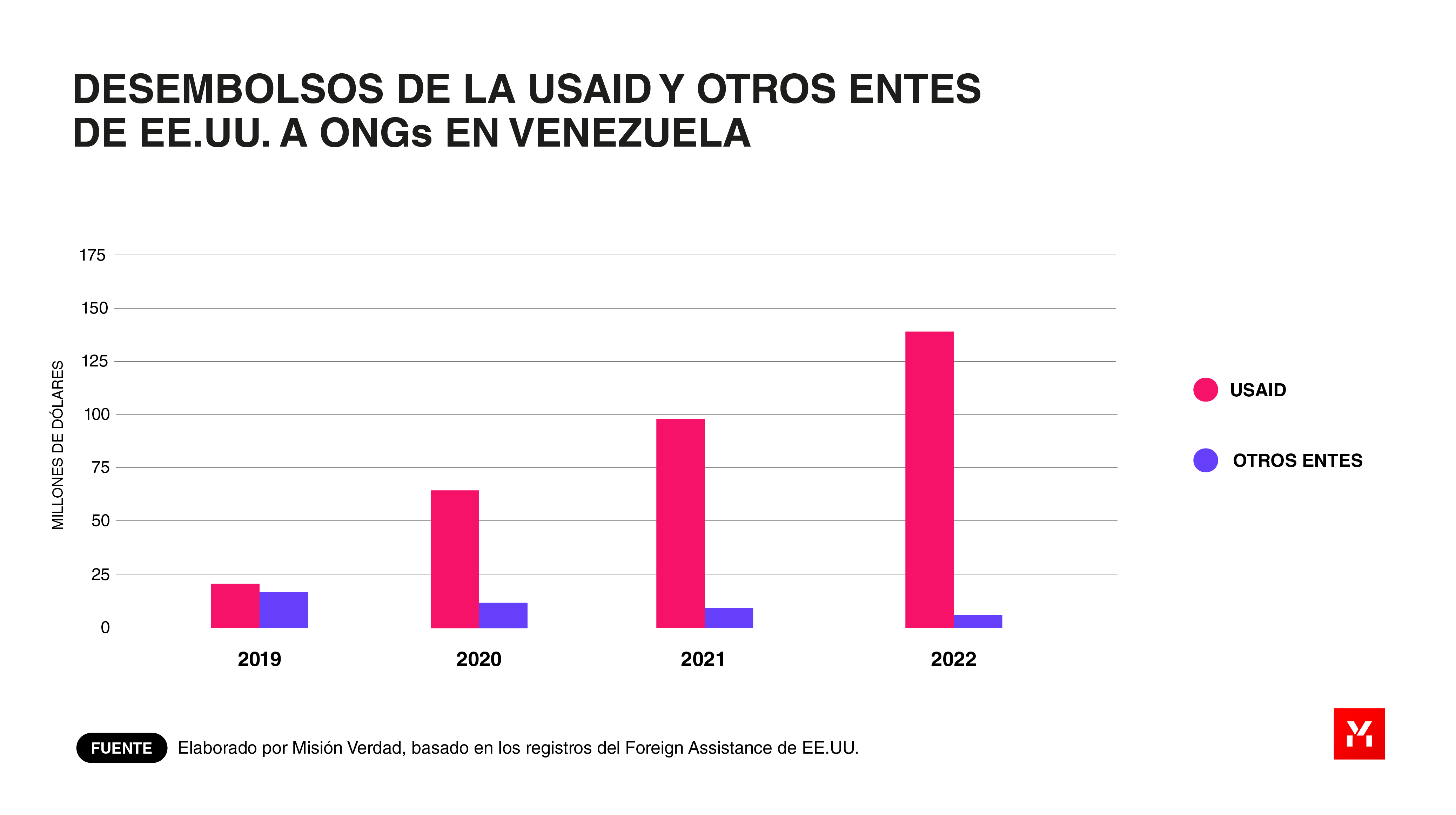
The variation in disbursements from this agency to Venezuela, compared to those of other agencies between 2019 and 2022, can be seen in the graph below. In the case of USAID, the amount reported for 2022 is $142.9 million, 633% higher than that of 2019, which was $13.9 million. While the amount corresponding to other departments and agencies decreased from $13.09 million $6,734,395, 51%.
Disbursements by USAID and Other US Entities to NGOs in Venezuela
(Photo: Mission Truth)
We can see in the following graph that the disbursements for “Democracy, Human Rights and Governance” are significantly more generous than in areas such as “Humanitarian Assistance” or “Health”, this agency being supposedly an institution that claims to be humanitarian.
USAID-Venezuela.png
Distributions of Funds from the US to NGOs in Venezuela

(Photo: Mission Truth)
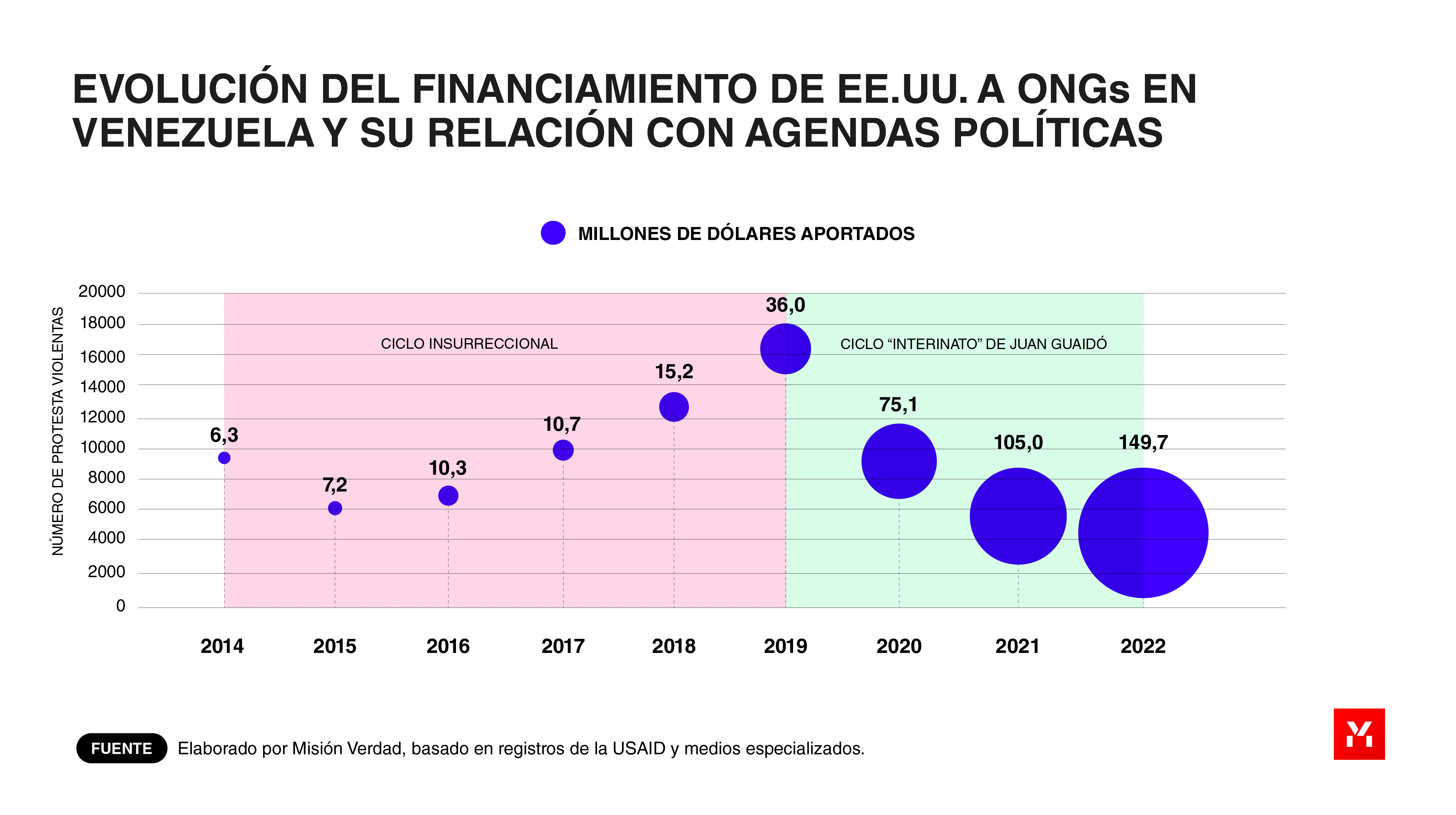
The graph also highlights the correlation between USAID/NED funding and the social protests recorded between 2014 and 2019. There is a joint increase in mobilizations and disbursements (bubble width) until 2019 and, later, although the increase in funding continues, the number of protests declines. The graph clearly shows that, as the financial flow of the intervention agencies increases, so does the political conflict on the ground through an evident insurrectional cycle that has its peaks in 2014, 2017 and 2019, the year when Operation Guaidó begins and gives rise to another financial relationship with the opposition.
Correlation between NGO funding and conflicts in Venezuela.png
(Photo: Mission Truth)
The notable increase in funding for the Venezuelan opposition since 2017 is such that, since then, the figures have almost doubled year-on-year. These disbursements finance programs that support opposition political activity within the national territory with NGOs as connecting vessels.
The color revolution waves, in reference to the insurrectional street actions, also known as guarimbas, were a fundamental part of the 2014-2019 cycle, when NGOs and private media received hundreds of millions of dollars – as we will see below – with the component of unilateral, criminal and illegal sanctions under International Law, issued since 2015 – with the Obama Decree as a turning point -undermining the response capacity of the Venezuelan State to the political, economic and social situations that became a breeding ground for the continued coup.
Partly financed by USAID, and triangulated by its regional offices, with Uribe’s Colombia as a channel for funds and a beachhead for insurrectional incursions.
Guaidó plan embezzlement
The current scandals surrounding the agency in relation to Venezuela have pointed to Operation Guaidó, including an FBI investigation into the former congressman and self-proclaimed interim president in 2019, a political adventure fully supported by the first Trump administration.
Attorney General Tarek William Saab called for bilateral cooperation with the United States to clarify criminal charges against Juan Guaidó and Carlos Vecchio in the corruption investigation involving funds received through USAID.
Files revealed by various media indicate that Carlos Vecchio would have received $116 million through USAID.
The amount of money handled by the coup clique is believed to exceed $700 million, according to leaked documents and figures calculated by the government of President Nicolás Maduro.
Officially, USAID “multiplied by 26 times its funds allocated to Venezuela between 2014 and 2024,” reports Voice of America: “It went from providing $8.09 million to Venezuela in 2014 to allocating $211.02 million last year. It was the sixth country in America with the most resources allocated by the agency.”
It also notes that “US contributions to various causes in Venezuela have increased significantly since 2018, a year when various federal agencies, including USAID and the State Department, allocated a total of 25 million dollars.
“Before, between 2001 and 2017, amounts ranging from a minimum of $4.2 million (2011) to $19 million (2008) were disbursed to Venezuela through different agencies and dependencies of the US government. “That aid rose to $73 million in 2019, the year when the US disavowed Maduro as a legitimate president and backed opposition parliamentary leader Juan Guaidó as such. “A year later, in 2020, contributions from various US federal agencies, but mainly from USAID, increased to $163.3 million. In 2021, they rose to $197.6 million; and in 2022, they rose to $209.4 million.”
What was reported or censored by the US agency shows that, in any case, the amount of money destined for the Venezuelan opposition is counted in the hundreds of millions, during a period (2014-2024) characterized by attempts at color and military coups, mercenary and paramilitary incursions, with components of organized criminal gangs inside and outside the country, a media and NGO network well filtered between the narrative purposes of all the destituent operations and a parallel government that, even today, navigates in profits that have made the country lose, according to President Maduro , $630 billion.
This phase could also be characterized as the decline of the USAID agenda against Venezuela, if we even take the words of Inspector General Thomas Yatsco in his report published in April 2021 , when he reveals that the “humanitarian aid” that was attempted to enter Venezuela in February 2019 “was motivated by the US attempt to provoke a regime change rather than by a technical analysis of the needs and how best to help the Venezuelans who needed it.” It was a public relations disaster for the agency that already prefigured the multidimensional scandal that is still raging today.
The balance of USAID’s contribution to the attempts to politically undermine and overthrow the governments of Hugo Chávez and Nicolás Maduro concludes in human, property and political damages of immeasurable magnitude. It is certainly good news for Venezuela – and the rest of the world – that the agency is currently closed, but this does not mean that the regime change operations will not continue.
Quite the contrary: in the United States, foreign interference is not the central problem of USAID activities, but rather waste and corruption in agendas that no longer interest the current White House administration.
The graphs presented were developed under the concept, research and methodology of Éder Peña. Thank you to him for complementing this article.
 Chicago ALBA Solidarity
One thought on “Two decades of USAID in Venezuela: a review of a criminal agenda”