
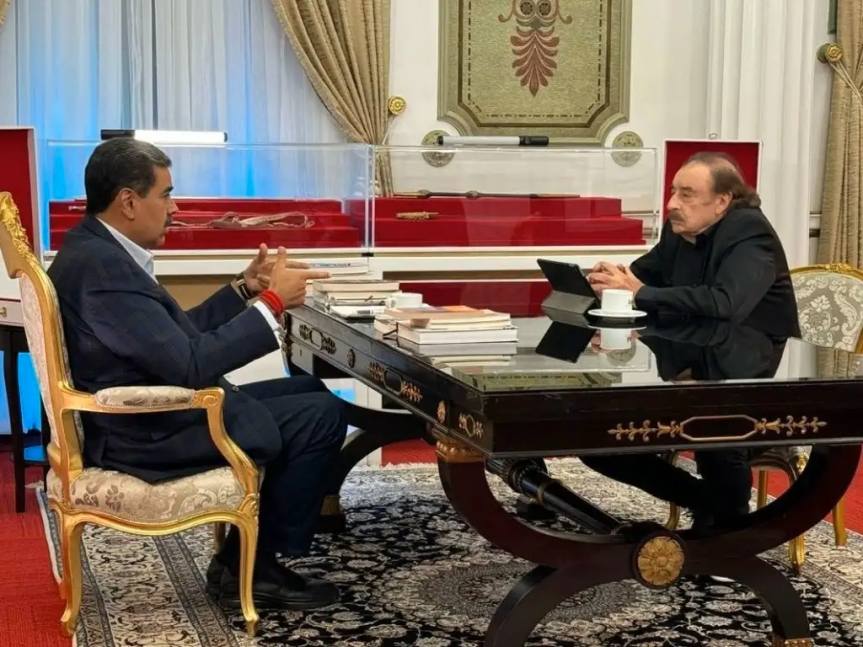
Ignacio Ramonet: Mr. President, let me first wish you a happy new year.
President of the Bolivarian Republic of Venezuela, Nicolás Maduro: Thank you.
Ignacio Ramonet: And, on the other hand, thank him that you have accepted you to do this interview, which is the interview number 10, since we’ve started these encounters of the first of the year, which are already a classic. This past week there was an article in France, for example, in a weekly newspaper, doing an article against me, and, in particular, focused on the fact that I am the journalist that does the interview every first of the year.
Nicolas Maduro: They are afraid of the interview, then, those people.
Ignacio Ramonet: Yes, because this is a conversation, isn’t it, and very frank.
Nicolas Maduro: To tell the truth that covers them. And then, you can check these 10 interviews, 10 continuous years, what we said in the past year and projections for the coming year.
Ignacio Ramonet: What has been done also, every time, These interviews have also a character of which allow you to make a balance sheet for the year ended and open perspectives on the new year.
Nicolas Maduro: not like that you open the discussion, as we open a debate. We like a lot of the debate, the debate of ideas, the battle of truth against so much manipulation, and for that I am who I thank you for this window of opportunity, when we started these interviews, they were published in writing. It was another century, another world.
Ignacio Ramonet: It was another world.
Nicolas Maduro: Now these interviews are by the so-called social networks and platforms.
Ignacio Ramonet: President, the interview is going to be like every year, divided, this time into four parts. Let’s talk about domestic policy, there is a lot of important themes, the economy is a key issue. Let’s talk about technology and society, precisely because of this, you just say, of the social networks. And we end up talking about international politics.
Nicolas Maduro: Correct.
Ignacio Ramonet: So, I wanted to start with the following question, which has to do with the question of democracy in Venezuela.
In Venezuela, the 24th year, the year that just ended, it has been a year of elections. There has been the presidential elections, on 28 July; there was the referendum on the Guayana Essequibo; there was also the popular consultation of August 25 on the participatory budgeting; there was the election of justices of the peace; and also this year is going to be elections at local and regional levels, there’s going to be a whole series of elections, also in parliament. Now Venezuela, from 25 years ago which started the Bolivarian Revolution, is characterized by the high intensity of elections. But recently you said that you are thinking about a possible constitutional reform to inject more democracy in Venezuela. Then, I consider that there is already quite a lot of democracy, what is it that you think that it is necessary to add to Venezuelan democracy?
Nicolas Maduro: Well, are several issues. In the first place, the balance that we have now that the Constitution was 25 years old, on the 15th of December last, is very auspicious, very positive, because despite so many plots, so many attempts of coups d’état, the coup that we were able to roll back in April of 2002, of the economic war in different phases, from the war’s psychological, cognitive, war, politics, national, international aspects, we have been able to see the reviving of the main proposal of the Constituent assembly in 1999, the construction of a participatory and protagonistic democracy. It was said at the time, the end of the 1990s, Commander Chávez began to present the idea of overcoming the old, exhausted party democracy, representative democracy. Because, supposedly to remain a democracy, well, it’s a big limitation that is truly who is the owner of sovereignty, the power, and who is the real sovereign – the people. And we can say that the ideas and proposals of the past 25 years were fulfilled, widely and fully.
We have had 31 constitutional elections, 31 elections, periodic elections, permanent ones, on impeccable schedules, presidential elections when it was due despite all the wars and blockades, there has never been an excuse to postpone any presidential election, elections for governorships and legislative councils, which is the state power, elections for mayorships and municipal councils, the municipal power. We have had 7 referendums, including the referendum on the Essequibo region, to settle key, fundamental issues. We must remember a very important referendum in 2007 for a constitutional reform that we lost by 20,000 votes, and we immediately recognized the result. We must remember the February 2009 referendum to amend the Constitution, because in Venezuela, no comma, period, or word of the Constitution can be changed without a referendum. That is a constituent mandate and a constitutional right of the people.
Now, beyond that, Commander Chávez began in 2006-2007 the construction of a direct popular democracy, with the founding of the first communal councils, then the development of the concept of commune, which is the aggregation of communal councils, and giving the neighbors, the community members, the power of self-government.
We have strongly resumed the idea of direct democracy, of neighborhood, community democracy. In this case, the construction of what our people say about a new communal state, a new modern state, within the concept of 21st Century Bolivarian Socialist modernity, not within the concept of the failed modernity of the Western world, nor of postmodernity, which was a critique of modernity. In this case, we are trying to build a new concept, based on the 1999 Constitution. And the results have been, and are, extraordinary. This year, the year 2024, we held three direct consultations with the communities. Two consultations for projects, for budget allocation, for community projects, decided, defined, planned, voted on, and approved by popular vote, direct, secret, broad, of the majority. This involved the approval of thousands, thousands of community projects, to solve problems that are often urgent, which the bureaucracy of the old State does not address, does not resolve. I witnessed, in a region called Guatire, Araira, here in the state of Miranda, a project, a retaining wall for a main access road to a productive area, on the Ruta de la Mandarina. And how they had been asking the mayor there, for years, for the retaining wall, because the entire access road was going to collapse, and they never got a response. And we, and the community, in one of the consultations, the first, approved the project, a direct resource was allocated, something like $10,000, the equivalent of $10,000, and the community, in four months, built the wall in a fantastic, complete, safe way, and had money left over to restore a health center and a school, which shows you that direct democracy, neighborhood democracy, with participation, the people’s eye, is infinitely superior, much more efficient than the old and worn-out bourgeois State, which we still have around, which is like a strange coexistence between that old State that doesn’t quite solve local problems, and that electric force of a new State is emerging from the grassroots.
We also conducted a beautiful experiment at the end of the year, on December 15, because the National Assembly approved the Organic Law of Communal Justice of the Peace, and in Venezuela, with direct popular vote, 15,000 judges from the territories, from the neighbors, 15,000 principal judges, 15,000 alternate judges, were elected. This is not mentioned in the world, because what interests the world is repeating that there is a dictatorship in Venezuela, that there is no democracy, and that the only democracy that exists is their democracy, from the North, from the West, from this degraded, decomposed, and already in the final stage of decadence collective empire, and not mentioning that here in the South, in the Global South, in South America, there is a beautiful experience of popular democracy, direct democracy, the democracy of the neighbors, that is being born.
So we have had a wonderful time proving that it is possible to build another way of doing politics, that it is possible, necessary, and urgent for humanity to consider new models. And from there, from that debate, a very powerful proposal emerged, which has been very well received by all of Venezuelan society, that starting in January 2025, we advance towards a constitutional reform that democratizes the entire State, that democratizes the entire society, and that moves towards a process of strengthening a new way of doing politics, a new democracy. That’s where it’s headed, and moreover in a dialogical, inclusive method.
I am forming a special team of, we could say, experts, advisors, counselors. I am keeping an eye on the forms of consultation with the popular power that we apply permanently, and also a group of international advisors, counselors who have offered to support us, and very soon, perhaps in the next…
Ignacio Ramonet: Translate this into law, to some extent?
Nicolás Maduro: Yes, because the constitutional reform, to be enforced, has to be a project first. The reform has to go to the National Assembly, the Legislative Power of Venezuela, the Parliament, the only one that exists in Venezuela, the Parliament elected by the people in 2020. Once the Parliament approves a project, that project has to go to the streets, to the people, to the debate, to the referendum, and the one who has the final word in Venezuela to approve a reform, to change the Constitution, is the sovereign, it is direct democracy, it is the people.
Ignacio Ramonet: Mr. President, the whole world is currently anticipating two inaugurations that will take place in the coming days. On the one hand, the inauguration of the elected President of the United States, Donald Trump, in Washington, which will be on January 20, and yours, which will be in a few days, on January 10. The question is, how do you explain that for so many international observers there is the same interest between the inauguration in the world’s leading power and the change of command, which in this case does not occur because you have been re-elected, in Venezuela? What is so special about Venezuela that it is the center of world attention?
Nicolás Maduro: Because there is a dispute over the control and dominance of Venezuela. Venezuela was the center of the anti-colonial and independence struggles exactly 200 years ago. Here we have, well, the sword, the liberating saber of Carabobo, with which the Liberator Simón Bolívar led the victorious battle on June 24, 1821, that drove the Spanish imperial army out of the lands of what is now Venezuela. Here with us is the sword given to him by the people of Lima, the poor of Lima, the indigenous people, the artisans, to declare Bolívar their Liberator, their savior. They are two swords of great symbolic importance in our history, of great significance. And here we also have a dagger that belonged to the Grand Marshal of Ayacucho, victor 200 years ago in Ayacucho, who finally drove out the imperial armies of Europe, of Spain, from this territory, from South America. All these symbols, the pistol of the liberator Antonio José de Sucre, well, forcefully mark the struggles that we are carrying out today.
Ignacio Ramonet: We must say, President, that we are in the presidential office.
Nicolás Maduro: Yes, this is Office number one of the Miraflores Palace, which is a house, the house of the people. And precisely these symbols accompany us daily, permanently. And it is a permanent reminder, Ramonet, of where we come from, what our project is, where all our strength and energy for the 21st century comes from.
So, you see, the empire believed that in 2024 it could deliver a definitive blow in Venezuela, they played a double game. On one hand, what I have called the diplomacy of deception, which empires practice a lot, and the American empire in the world, with its different modalities, the diplomacy of deception with false attraction, false offers, to try to then, after gaining space, stab you in the back; or they also apply at other times the diplomacy of deception based on blackmail, the threat of invasion, of economic wars.
We are familiar with all those methods of action by the American empire and its allies. They believed that 2024 was the definitive year and applied the diplomacy of deception, based on negotiations we developed with the outgoing Joe Biden government, which they completely violated.
Ignacio Ramonet: That were called the Barbados talks, right?
Nicolás Maduro: And from Qatar.
Ignacio Ramonet: And from Qatar.
Nicolás Maduro: Correct. And the signing of the documents. There are the documents that they violated in a vulgar, shameless manner. And behind the scenes, they favored, financed, supported, and promoted the resurgence of a fascist far-right outbreak that would control a large part of the Venezuelan opposition, steering it once again towards a grand conspiracy, the Trojan horse they need to destroy countries. And they believed, once again, as they did in the 2002 coup, underestimating us, underestimating the people of Venezuela, they thought they had the perfect plan. But a small detail, they did not account for the immense power of the historical block of the Bolivarian Revolution. They didn’t account for the fact that in Venezuela there is a powerful historical bloc that has a perfect fusion between popular power, military power, and police power. It is what we call the union and fusion of civic-military-police, which I have been calling the popular-military-police fusion of the great historical bloc, taking Gramsci’s concept, developed by Chávez, of the Bolivarian Revolution.
So, this year we have thwarted the imperialist plan to try to destroy the Bolivarian Revolution. And they persist in their efforts, blinded, obsessed, to destabilize Venezuela. And so they try to turn, just as they turned the presidential elections on July 28 into a worldwide election, and now with social media even more so, the manipulation of social media. How many elections were there in the world in 2024? Hundreds of elections.
Ignacio Ramonet: Dozens at least, it is one of the most electoral years in history.
Nicolás Maduro: But there were only two elections, the one in Venezuela on July 28…
Ignacio Ramonet: And the United States.
Nicolás Maduro: And the United States in November. They turned it into a worldwide election. Now they want January 10th to be a worldwide inauguration. Trying to do what they have not achieved and will not achieve, which is to destabilize our homeland, destabilize our democracy, derail Venezuela and try to lead it down the paths of chaos, division, confrontation, and with chaos, division, and violence, call for a foreign military intervention, which is the ultimate dream of this reckless idea of Venezuelan fascism, of the extreme right, trying to apply a method of maximum pressure, violence, and destruction of the revolutionary forces of Chavismo.
Simply put, Venezuela is at peace, calm, tranquil, and confident in its destiny, confident in its path. And just as we have been able to tear apart, dismantle, and dismantle internal conspiracies, internal fascist Trojan horses, external pressures, conspiracies, mercenaries, terrorists, during these 25 years, we have already gained the knowledge and capacity to guarantee the people of Venezuela and the peoples of the world who support us, who love us, who love the people of Venezuela, that Venezuela will continue on its path of independence, peace, and revolution. Rest assured of that.
Ignacio Ramonet: As you are saying, Mr. President, the media campaign against Venezuela has been going on for 25 years, and we have seen how this campaign intensified following your electoral victory on July 28th. In particular, international conservative media have shamelessly altered the narrative of what happened the day after the elections, what occurred on July 29. That is, when organized armed groups attacked a series of official institutions and caused around thirty deaths. The version given in the international media, which has been spread by social networks, is that those victims were caused by the authorities. So, a bit like turning the world upside down, as Eduardo Galeano used to say. You have reacted against those lies and have launched, not only relaunching the revolutionary movement, particularly with the historical bloc, but also with a great antifascist offensive. You have organized, you have organized in Caracas a series of antifascist congresses, of antifascist movements. International antifascism has now gathered in Caracas, in support of the Bolivarian Revolution.
And I wanted to ask you, on the one hand, your opinion on this new international campaign, although you have just somewhat mentioned it, and what assessment you make of these antifascist congresses that have been taking place in Caracas in recent months.
Nicolás Maduro: The antifascist congresses of Venezuela have highlighted the immense support we have in all global movements, anti-colonial, antifascist, progressive, leftist, revolutionary, in all humanist movements. Here in Venezuela, people from immense civilizational diversity, from all continents, from all countries, have come together, looking for what? An alternative, an alternative so that the unipolar world does not return, so that hegemonism ends, and also telling the owners, the private companies, owners of social networks, portals, and major media outlets in the world, there is another possible world. And the world of reality in Venezuela, we support it, first and foremost. Secondly, the immense support of the people of Venezuela for the antifascist congresses. I witnessed several experiences where, let’s say, visitors, delegates from social movements, intellectuals, politicians from around the world, from Asia, Africa, Europe, the United States, Latin America, and the Caribbean, went to visit the communities of different states in the country, were able to walk through the streets of various cities and towns, and could see on the streets the Venezuelan people’s desire for tranquility, stability, peace, for us to be respected, for no one to meddle in Venezuela’s internal affairs, for the empires to leave Venezuela alone, for this to be the homeland of Bolívar.
So, secondly, the immense support and admiration of the people of Venezuela for the antifascist congresses could be observed.
Thirdly, I can tell you, in Venezuela, the future of progressive movements in the world, of revolutionary movements in the world, is being decided, and I am convinced that this message, this awareness, and this vigilance, are in the minds of millions of men and women from all continents, all countries, all religions, all cultures, because they know that Venezuela has a very powerful voice to denounce global crimes, a very powerful voice to denounce the decline of the Western world, a very powerful voice to make proposals that allow the rapprochement of peoples, of civilizations, based on new models of development that are more egalitarian and promote greater social happiness, as was the plan of the Liberator Simón Bolívar. So people were watching. Just as there is manipulation of social media, by mercenary hitmen who write articles here and there, on portals, in the media, rest assured, because I am seeing it and we have verified it, that just as there is immense manipulation, there is also an immense operation to defend the truth of our country. And the people know that the conspiracy meant to use the elections of July 28 to fill the country with violence, to stage a coup with foreign intervention. The people are aware of the immense value of the Venezuelan people’s effort to, in 48 hours, restore tranquility and peace, to deliver justice.
The justice bodies in Venezuela, the Public Ministry, the Judicial System, you know they have conducted a thorough, professional investigation, in accordance with domestic law, even in line with international standards, to identify those responsible for the acts of violence, the hate crimes that were committed. All the people murdered in the violent events of the fascist outbreak on July 29 and 30, all were victims of these groups called the “comanditos,” these groups of paid criminals, these groups that took to the streets to burn, to break, because they intended, once again, it’s not the first time, they intended with this 2024 version of guarimba, to provoke a commotion of such magnitude that would give justification to the gringos and their allies to try to insert military force into Venezuela, and turn Venezuela into a combat area, a conflict zone.
.
But there is strength, there is awareness, there is capability, and in 48 hours constitutional peace was restored, justice has been served, justice will continue to be served, and I can tell you with absolute conviction that if you go out into the streets of any community, anywhere in the country, and you ask the Venezuelans, “Do you want the guarimbas to return?” Do you want violence to return? Do you want hate crimes, attacks, and intolerance to return? More than 90% of this country will answer you in one voice, we do not want intolerance, we do not want hatred, we do not want division, we do not want violence. We are on the path of peace, and I can assure you that this man here, whom you know very well, Nicolás Maduro Moros, re-elected president, is the greatest guarantee, along with our people, of peace, stability, and independence for Venezuela.
And the antifascist congresses will continue in a few days, from January 7-12, an immense Antifascist Congress of World Youth will be held. And the second chapter of the Antifascist Congress of Social and Political Movements will take place. So we are expecting the arrival, between January 7 and 12, of more than 2,000 leaders of social and political movements from all continents, who come together with Venezuela to celebrate the victories of antifascism. Because in Venezuela, the future of the struggle against that macabre model that is trying to resurface, which is fascism, is being decided.
Ignacio Ramonet: Mr. President, we are going to talk about the economy, which is an extremely important topic. And I wanted to mention to you, a few days ago the Executive Vice President, Delcy Rodríguez, announced that you had decided to change the name of the Ministry of Popular Power for Oil, which will now be called the Ministry of Popular Power for Hydrocarbons. And Delcy Rodríguez said that this modification represented a strategic shift in the way the energy issue is approached. I would like you to explain to us what this strategic shift consists of.
Nicolás Maduro: We defined 18 engines in the year 2016. Then came all the criminal sanctions, all the economic, commercial, and financial persecution against Venezuela. And we have been patiently carrying out the entire development of the 18 engines, right? One of those engines is the Hydrocarbons Engine. Viewed comprehensively, Venezuela is a powerhouse in terms of energy. We have the largest oil reserve on planet Earth. We have the fourth largest gas reserve. We have a powerful petrochemical industry. So we are addressing the Hydrocarbons Engine as a very important driver in its development. Yes, with a vision of not becoming dependent again, or breaking the dependence on the Hydrocarbons Engine. Let it be a powerful support engine for the development of the country’s economy. A powerful lever, but without going back to dependence, because we have already made the decision to build a productive economy that is sustained far beyond oil. And I believe we have made good progress.
Ignacio Ramonet: A more diversified economy.
Nicolás Maduro: Correct. With various properties or, let’s say, various potential development capacities to guarantee and meet internal needs and to develop the export-oriented and import-substitution vocation that the country must have.
Ignacio Ramonet: Mr. President, for the past few years, Venezuela has been experiencing what analysts call an economic miracle. According to figures from independent and reliable international organizations, Venezuela experienced a growth of 12% in 2022. Last year, 2023, the year before last, the growth was 5%. And probably, when the figures are published, the growth for the year 24 that has just ended will be 6%. And all of that in a besieged country, a country subjected to dozens of criminal unilateral coercive measures. Analysts are wondering how you do it. What is your recipe?
Nicolás Maduro: First of all, we have a plan. Here I have, look, the summary. This is my working document. This is my document. Here, we are permanently following the economic strategy. The first thing was to clearly establish, in 2016, the real engines for national development. The second was to establish the need to build macroeconomic balances characteristic of a productive effort. And the third was to build a development strategy that would allow, in a self-sustaining manner, with our own effort, I always quote Artigas, the great liberator of the Banda Oriental of Uruguay, when I say let us not expect anything, but ourselves. That, look, I have it here, ping, ping, ping, in the development strategy of each sector of the national economy. We set ourselves great goals. Here we are ratifying them. A fundamental objective was to produce food. I reengineered the Great AgroVenezuela Mission created by Commander Chávez, and we reengineered it in debate with the national peasant movement and took practical actions that allowed us to unleash the productive forces of the countryside. And Venezuela went from an 80% dependence on food products from abroad. We had been buying all our food from abroad for 120 years. Why? Because, look, the oil checkbook. We went from 80% dependence. We went from 80% shortage on the streets to 100% supply of agroecological products, organic products, seeking answers with the productive movement of the countryside, with the peasant movement, with the rural entrepreneurship.
The development of the countryside, the land, and food is fundamental. And we have been recovering the capacity of the Venezuelan industry, which had reached as low as 8%. Venezuela has an important industry in all sectors, with a good level. Commander Chávez made a good industrial investment in the country through credit systems,etc. We managed to have the Venezuelan industrial system at 8%. This year, overall, we are closing at 45%. Next year, I have proposed to the Vice President, the head of the economy, Delcy Rodríguez, that we need to reach 70% to complete the import substitution cycle, which is a necessary cycle to break the negative cycle of imports, of things we can produce here; produce everything here and strengthen the new export-oriented cycle that allows, look, money, convertible currencies to strengthen the exchange system of Venezuela, to have money for many other things.
Here I have the plan. I’m going to go through all of this… I have already proposed the Seven Transformations. The first of all, the great economic transformation of Venezuela. Continue advancing in the development of a strong economy. Notice that we have developed a strong internal market. Right now, we had an 81% growth in national internal trade in the last quarter. It is what I have qualified as an overheating of internal consumption, which shows you the great purchasing and consumption capacity of the population and demonstrates a high level of supply through internal production, but also through imports. So, we need to find a balance there so that we don’t import so much, and that everything is produced here, that’s a fundamental element.
So we have good economic figures, you were talking about the year 2022.
Ignacio Ramonet: 12% growth.
Nicolás Maduro: I’ll correct you, if you’ll allow me.
Ignacio Ramonet: Yes. Please.
Nicolás Maduro: It was a 15% growth in 2022, it was the first year of growth after the missiles, the criminal economic sanctions, the missiles fell, we endured, we resisted, and the first year of growth for the real economy was 2022, 15%.
The second year was 2023, in 2023 we had 5.5%, in 2024, according to all scientific, statistical, and technical data, it will exceed 9% growth in the Gross Domestic Product with a very high level of growth in the real economy, and also in the hydrocarbon economy, as we are recovering, Ramonet, with our own investment, with our own technology, and with the immense effort, wisdom, preparation, and training of the Venezuelan hydrocarbon working class, with their knowledge; because you should know that we are still suffering from economic persecution against our oil industry, our gas industry.
So there are good elements, we are having the lowest inflation in the last 20 years in 2024; we are having in 2024, we have closed with 14 quarters of growth. So everything is auspicious for taking on six years, as we are going to take on, of building a self-sustaining, productive economic model that supplies the country, develops its export vocation, and generates wealth to recover all the social and labor rights of our working class and our people.
Ignacio Ramonet: Mr. President, following up on what you just said, now that the economic situation is improving significantly, what good measures can you announce during this holiday season to improve the daily lives of Venezuelans in 2025?
Nicolás Maduro: Well, here I have the plan. First of all, consolidate the country’s food and comprehensive self-sufficiency, which is vital, and its export-oriented vocation. We are obtaining significant investments in the Venezuelan countryside to advance that objective. Secondly, consolidating the stability of the Venezuelan exchange system and the fight against inflation. That is vital to have the best conditions for the country’s socio-economic development. Here is a set of elements that are well articulated, well activated. Continuing to guarantee investments and proprietary technology with our allies around the world, to stabilize the electrical service and continue stabilizing fuels in domestic consumption, the recovery of the entire Venezuelan refining system, are fundamental elements in the plan. At the social level, in 2023, I created the formula for indexing the comprehensive income of workers. In 2024, we deepened it and took it beyond what we could, because the income depends on the country’s income; I could tell you that we have barely recovered 10% of the income that the country had, and with that, we have to invest and recover everything. But this year 2025 we are going to advance in strengthening the concept of indexing and recovering real income to grow in the same measure as the generation of national wealth grows. Also, the plan for this year 2025 is to complete the recovery of 100% of the country’s health establishments, with full operational guarantees. We have made progress with the Military Community Brigades, which has been a miracle; and also this year 2025, we are going to recover 100% of schools and high schools across the country with this wonderful formula, the Bricomiles.
Working in all directions, as I was saying, is of great importance to me and I prioritize it. This year we are going to hold six consultations to deliver direct resources to the communities, four of those consultations for general community projects, one of those consultations, the fifth, for projects specifically for the youth and for the youth; and another for projects of the artists, and everything related to the great cultural mission, the Gran Misión Viva Venezuela Mi Patria Querida [Great Mission Live Venezuela My Dear Homeland].
And the implementation of the new communal budget, which has a modality that people are going to start getting to know, I created the Budget Fund for Community Projects and we estimate, we project that it will have the equivalent of $600 million extra, it is the national budget put directly into the communities and they deciding their priorities, that will have an immense impact on the quality of life in the land, in the communities.
And well, we are also going to advance as we started in 2024, in the development of the new generation great missions, the new generation great missions taking the original concept from Commander Chávez, of the missions, great missions; the new generation great missions are designed from a structural strategic point of view towards sectors that were the most affected in the economic war, with the criminal sanctions from the gringos; the Great Mission Venezuela Woman, continuing to advance in the comprehensive care vertices for women in a specific, particular way, in the construction of that immense movement of women in the country; the Great Mission Venezuela Youth, continuing to strengthen the right of young people to study, to work, to culture, to education; the Great Mission Grandparents of the Homeland, that is my great mission because I am a grandfather too.
Ignacio Ramonet: Me too [laughs].
Nicolás Maduro: We are the grandparents of the homeland, of the human homeland: the Great Mission Live Venezuela My Dear Homeland, the identity, the culture, the independence of the spirit, the soul, the minds; the Great Mission of Equality; and alongside this, well, what has to do with housing and habitat, which is the revitalization and unification in a single effort of the Great Mission Housing Venezuela and the Great Mission New Neighborhood, Tricolor Neighborhood.
Ignacio Ramonet: Very beautiful the New Tricolor Neighborhood.
Nicolás Maduro: That is already beautiful, well-crafted, and I believe we are going to move forward with new methods that the people want, new methods to build housing, fix housing, fix. We have our priorities very clear, we have the plan, we have the will, we have the support of the people, and I believe that the year 2025 and the years to come will be truly exceptional, wonderful.
Ignacio Ramonet: President, let’s move on now to this topic of technology and society.
Nicolás Maduro: Correct.
Ignacio Ramonet: I know that you are very interested…
Nicolás Maduro: Will you accept a little tea? Lemon verbena with lemon and ginger. Yes?
Ignacio Ramonet: Yes, with great pleasure.
Nicolás Maduro: Very good for health.
Ignacio Ramonet: Well. Absolutely.
I would like to address a topic that I know you are very interested in, which is the issue of social media and its influence on our societies. Recently, several governments have taken measures to limit access to social media. For example, Albania decided to ban TikTok for a year. For example, Brazil decided to prohibit access to electronic devices, smartphones in schools. And Australia has decided to ban social media for all minors under 16. So I would like to ask you if here in Venezuela, if your government is considering adopting any of these precautionary measures.
Nicolás Maduro: The first thing is to understand the global phenomenon of social media and how some private companies own the immense power of communication, which no one has ever had in the history of humanity. To reach millions, billions of men and women on planet Earth through the phone. And the ability they have created, first for commercial economic reasons, to influence people’s minds. Ability that they have already developed with the marketing we knew. You studied it very well in this book, the capabilities, this is your book from 2007, where you study the capabilities of manipulation and influence in radio, press, and television, at the time.
Ignacio Ramonet: And cinema.
Nicolás Maduro: And cinema, correct. So now they have taken this to a level never before imagined. And they know your personalized taste, Ramonet, and mine, and yours too, what you like, if you like kittens, puppies, or if you like a certain soda, a certain food, they know all personal tastes. But it doesn’t stop there; it has already been taken to the level of political power, for the manipulation of electoral processes, for the manipulation of political processes, for the destabilization of countries. In fact, the great powers of the world have control over the social networks of their countries: the People’s Republic of China, India, Russia, and, well, the United States, which controls the large private companies of billionaires who own Facebook, WhatsApp.
Ignacio Ramonet: Instagram.
Nicolás Maduro: Instagram, YouTube, and now TikTok. But in the end, TikTok has ended up succumbing to the blackmail and control of the powerful in the United States. First, you have to understand, I have started studying the topic a lot, because it is not easy. Moreover, I have seen people who understand it theoretically, but who are victims of the influence of social networks, because there are many people who know quite a bit about social networks, but they are also just another victim.
I started reading this book, this book was brought to me by Juan Carlos Monedero during the days of the fascist outbreak in Caracas. I recommend it to you, I recommend these books to everyone. I was reading them this year and I’m reviewing them. Mainstream Fascism, by Carles Senso, Journalism, Conspiracies, Algorithms, and Bots in the Service of the Far Right. You read this book and you think it was written to interpret what happened in Venezuela on July 27, 28, 29, and 30. What the book says was applied in Venezuela for a fascist coup d’état. We know the book by heart, but in its practice. The book is very valuable.
Here’s a book that also fell into my hands, they gave it to me, by Jonathan Haidt, an American, I don’t know him. Very good book, New York Times bestseller, The Anxious Generation. Why are social media causing an epidemic of mental illness among our youth? It is written by an American intellectual. I recommend it.
Ignacio Ramonet: The word of the year, this year, has been brain rot.
Nicolás Maduro: Brain rot. What social media creates. They rot emotions, the brain, the ability to react. Here I have another book by Marta Peirano, a Spanish author: The enemy knows the system: Manipulation of ideas, people, and influences after the attention economy. They are books, look, by people, this is a group of Venezuelans, two officers, a frigate captain, Francisco Felipe López Crespo, Major José Gregorio Silva Fernández: The Information War in the 21st Century, an extraordinary book, extraordinary, especially about this phenomenon of Venezuelan military.
I have a book that fell into my hands early on, by Michel Desmurget: More books and fewer screens: How to Deal with Digital Idiots.
Ignacio Ramonet: Excellent [laughter].
Nicolás Maduro: There is indeed a lot of research material, and we are obliged to understand it.
Ignacio Ramonet: Absolutely.
Nicolás Maduro: Because we are obligated to protect the mental health of our countries. But especially, we are very obligated to protect the mental health of children, girls, and the youth who are growing up. Because that concept they call brain rot is already being studied, it is even severely affecting the cognitive development of brain functions in our children dedicated to screens. Here in Venezuela, these days, the Constitutional Chamber of the Supreme Court of Justice that handles this issue, a group of parents from schools and high schools filed a protective measure, due to the fact that because of one of TikTok’s viral challenges, two children, a girl and a boy, lost their lives. One of those viral challenges. Recently, another person was burned and suffered 70% destruction of their body while fulfilling a viral TikTok challenge live, broadcast live. The Venezuelan state acted through the competent authority Conatel, which is the National Telecommunications Council. This group of parents acted before the Constitutional Chamber. The Constitutional Chamber convened a series of hearings, judicial events, and issued a first, clear, and forceful ruling to compel TikTok to open an office in Venezuela and to comply with Venezuelan laws.
Secondly, it has imposed a fine equivalent to 10 million dollars. And thirdly, he has said that if this is not complied with, he will take more severe protective measures within Venezuelan territory. All I can say is that I am at the service of those in humanity who want to defend the right to mental health, and of the Constitutional Chamber of Venezuela, to do whatever it takes to protect our children, young people, and the entire society. We already saw the fascist outbreak, TikTok was the main campaign tool for the fascist outbreak in Venezuela, July 27, 28, 29, and 30. I can tell you that I was in this very office, sitting right here, on July 29 and 30, and I logged into my TikTok account. I have a TikTok account, you’ve seen it, right?
Ignacio Ramonet: Yes, of course.
Nicolás Maduro: I logged into my TikTok account and opened it, look, I’m going to open it, so you can see, here I’m going to open it, here I get a really nice video from Gualberto Ibarreto. Well, here on the TikTok account, out of every 10 videos that came to me, 8 were promoting violence in the streets, are you going to tell me that TikTok didn’t know, huh? You’re going to tell me, they use what is called selective censorship, they censor whoever they want, they take down accounts, they take down videos, but when it was violence against Venezuela, they promoted it, and now they are promoting these viral challenges, which have led to a one-year suspension in Albania, and radical measures being taken in Australia as well, and I am sure that by the year 2025 we will see how laws and decisions proliferate around the world to protect citizens from the infection of anti-values and mental unhealthiness that is promoted, not only by TikTok, but by many social networks.
Ignacio Ramonet: Mr. President, in the same perspective, it’s not exactly the topic, but it develops…
Nicolás Maduro: Here is the tea, enjoy!
Ignacio Ramonet: Thank you very much. I would like to hear your thoughts, as I see you work quite extensively on the topic, on the issue of artificial intelligence, particularly regarding the type of international framework, in light of what you mentioned at the end of your intervention. What international framework should be defined to, on one hand, not hinder the ongoing technological and scientific reflection on artificial intelligence, which can greatly benefit society, but, on the other hand, to limit the harmful effects of artificial intelligence and the threats it may pose in the future; many scientists are warning against this.
Nicolás Maduro: Artificial intelligence, without a doubt, is a technological advancement that astonishes humanity. They say there are four sources of artificial intelligence in the world, two are in the United States, China has another, and the other is in Europe, that’s what is known so far. I have studied the topic quite a bit; here I also have some books that I recommend. This one was given to me by Héctor Rodríguez on my birthday, no, for Christmas, I’m already reading it, The Age of Artificial Intelligence and Our Human Future, it has several authors, Henry Kissinger wrote it before he died, Eric Schmidt, and Daniel Huttenlocher. I’m working on it, and here it explains how artificial intelligence started, what the first supercomputers were, and how they were fed.
There’s also a book here that was given to me, I’m reading it from the Debate publishing house, it’s called Artificial the new intelligence and the outline of the human, by Mariano Sigman and Santiago Bilinkins.
Ignacio Ramonet: Yes, I know Mariano Sigman well.
Nicolás Maduro: Oh, really?
Ignacio Ramonet: Yes, yes, he’s an Argentine boy, a very brilliant scientist.
Nicolás Maduro: Correct. And here is a descendant of Japanese people, Michio Kaku, Quantum Supremacy, the technological revolution that will change everything.
Ignacio Ramonet: Of course, quantum computers can perform billions of operations that used to take centuries, now it takes seconds.
Nicolás Maduro: It’s what they are already calling super artificial intelligence. And our countries have the obligation to understand this technology, to understand it very well, now it is even combined, Ramonet, I have said it quite a bit, but you know they cover up many things that one says. They combine artificial intelligence, beyond Big Data, beyond what Big Data was, to understand countries, and social networks are already directed by artificial intelligence, for the influence of segments.
Ignacio Ramonet: Algorithms are already artificial intelligence.
Nicolás Maduro: And the bots.
Ignacio Ramonet: And the bots.
Nicolás Maduro: For example, they know your social networks and have complete knowledge of your history, your life. And now, everything you post, fundamentally, when you receive comments, they are already personalized comments.
I was telling a young man, an artist, about this the other day, a
n artist that the far-right started attacking from Miami. Well, because he spoke nicely about Venezuela, a famous artist from Venezuela. He spoke nicely about Venezuela, he came to Venezuela. And then afterwards he complained. I received a thousand messages. And I told him, the messages you received, you received them through bots. But bots, robots, are no longer a warehouse where a few people with phones send messages, no. They’ve already saved themselves that. Now it’s artificial intelligence applied to social media. And they know your history and know where to hit you. So, they threaten your daughter, they threaten a loved one, they say something that can offend you. So, when you read the messages they send you, it’s a cognitive war. It’s a psychological massacre they’re trying to carry out. Artificial intelligence, we are working on it. I recently inaugurated the University of the Sciences Humberto Fernández Morán. It has a 4-year degree in artificial intelligence, engineering, and artificial intelligence technology. We are also offering diplomas there. We are training the national staff and also collaborating with Cuba, China, Iran, and Russia. Because we have to prepare ourselves. We are in the world of artificial intelligence. And what President Xi Jinping says, which I have read from him, a leader as enlightened as President Xi Jinping, even he considers it a threat, and he is… Let’s be careful.
Ignacio Ramonet: It’s an opportunity.
Nicolás Maduro: It is also an opportunity. So it’s a big topic for the years to come.
Ignacio Ramonet: President, let’s move on to the final segment of our conversation about international politics. You have traveled quite a bit to the Middle East, you know the Arab world well. On the other hand, here in Venezuela there is an important Arab community, in particular there is a community of Syrian origin, which is also important. And I wanted to ask you, were you surprised by what happened on December 8th when insurgent forces entered Damascus almost without resistance? And the Ba’ath state collapsed, what is your analysis of this event?
Nicolás Maduro: Well, I think we are still evaluating. I believe that neither those who came to power know how they got there, nor why they got there. One looks at permanent statements and actions. Let’s hope the waters calm down so we can know the truth of what happened. It is known that very powerful forces acted with the most advanced technology. I was in communication with our ambassador all those days.
Ignacio Ramonet: In Damascus.
Nicolás Maduro: A great ambassador, a great companion. He was there until just a few days ago when he left Damascus due to the threats of assassination against diplomats that still exist there. And I was aware of all the events. I was very struck by how they took over social media and how the Syrian state had no means to prevent it. And how they managed to impose digital terrorism, social media terrorism, and paralyze the entire society. There would be many ways to explain what happened, we will see in due time. All of that leaves lessons for those of us who fight for freedom, for independence, for a world for us, the men and women of the south; it leaves very important lessons about the consolidation of democratic states, deep ones, with the people, with unity; the consolidation of well-trained, well-prepared military forces. It leaves lessons in terms of managing social networks. Syrian society is a complex society. In Venezuela, we have a large community, with which we have deep friendship and great respect. The Syrian people are one of the peoples that have one of the original civilizations; civilization was born there, between the Tigris and the Euphrates, in that wonderful land, between what is today Iraq, what is today Syria, Egypt. The wonders of the world. And next to all of them, Persian culture, and the holy lands of Palestine, Lebanon, where our Lord Jesus Christ was. It has a wonderful history from a human, civilizational, cultural, and religious point of view, that entire region. What we aspire to is for that region to find its own path and consolidate its own model; sooner rather than later, I am sure that will happen, and those who today are counting on Pyrrhic victories will regret it, because that Syrian people is a people we know and they are wonderful, and they have a deep, ancient, and powerful force, and they will not be able to subjugate or dominate them, you will see.
Ignacio Ramonet: Mr. President, a few weeks ago in Baku, Azerbaijan, not far from the Middle East, COP-29, the World Climate Summit, was concluded. I remember that you attended a Climate Summit in Copenhagen. One of the conclusions of the Climate Summit is that greenhouse gas emissions must be reduced, particularly those emitted by carbon-based energies, oil, gas, and coal. And the question is, how does Venezuela, which is a major producer of hydrocarbons, as you just mentioned, plan to contribute to this collective effort to try to reduce the possibility of climate change?
Here, those who have to contribute are the countries that consume the most. The United States, the European countries, well, they have destroyed the climate and they intended from Copenhagen to create a kind of carbon credits, which was a misleading, false offer, the diplomacy of deception. They offered to create a carbon credit fund for them to pay for the pollution they were creating up north to the countries that we don’t pollute. Venezuela is not a country that has significant emissions of greenhouse gases. On the contrary, the entire Amazon rainforest is an oxygen producer.
Nicolás Maduro: Correct. And well, humanity has to start moving forward, without a doubt, towards non-polluting forms of energy. In that, we are fully committed. We have a group of scientists at the highest level of government advancing as a country towards decarbonized forms and producing all our electrical energy. Now we produce 75% of our electrical energy from hydrological sources, and that percentage will grow in the coming years. We are also investing in solar energy, which they call photovoltaic and give it a bit of a name so that people don’t understand. Energy caused and produced by the sun, which is an ultra-clean energy. The solar pane is advancing so much now and the solar panel that produces electricity for you.
I believe that humanity is currently in a position to make giant strides towards alternative, non-polluting forms of energy production. You can see it, recently our Vice President Delcy Rodríguez was in China, in several cities, and they showed her technologies, Ramonet, that will leave you amazed.
Ignacio Ramonet: Energy production
Nicolás Maduro: Yes. And China has made progress, for example, in vehicles. It has made progress in vehicles that are powered by direct solar energy. You don’t even have to plug them in for them to charge. We are already negotiating with one of the Chinese electric vehicle manufacturing companies to assemble in Venezuela, producing electric vehicles with solar energy.
There are wonderful things that technology allows. And it is also very important, I was explaining to a group of young people these days, matters that have to do with regenerative agriculture, which is being applied in some places in Africa, to recover totally desert areas, totally arid areas, in the same measure that we recover forested areas, defending them, like the Amazon, in the same measure that we regenerate areas that are already desertified, in the same measure that we strengthen microhabitats through a green regenerative process, I believe that the burdens of the immense damage that predatory capitalism has done to rivers, forests, seas, and the entire environment in general over 150 years can be balanced. It is one of our priority lines of action.
Ignacio Ramonet: Mr. President, on November 24th in Uruguay, the candidate Yamandú Orsi from the Broad Front won the second round of the elections and consequently, the left is returning to power in that country. With the left in power in Uruguay, there are now 11 countries in Latin America governed by leftist parties. On the other hand, a few days ago marked the twentieth anniversary of ALBA, this mechanism of regional integration founded by Commander Chávez and Fidel Castro. How do you see the issue of regional integration today? Do you think that with more leftist governments in Latin America than in a long time, the issue of regional integration can advance more quickly?
Nicolás Maduro: I think that this new process that is happening can be explained by the premature, rapid, early exhaustion of the alternatives created by the right, the oligarchies, the social networks; it is a tremendous exhaustion, indeed. What alternatives have they created in the face of the exhaustion of some social democratic formulas, so-called progressive ones? Fascism. What is Milei? It is an extremist response to the failure of a model that was attempted to be applied.
Ignacio Ramonet: Neoliberalism.
Nicolás Maduro: Still on the fringes of neoliberalism. And can Milei be an alternative for the Argentine people? Milei, with his madness, his histrionics, his extremism, his sadistic insensitivity towards the people, his model of destruction of the State, of the Argentine economy, can he be an alternative for Argentina? No, never. So surely Milei will have to come up with some Argentine alternative, with progressive ideas, with ideas of social justice, equality, more democracy, in the Argentine way. That is happening in all countries. And I believe that the much-cherished first spring that the progressive movement had left many lessons. I lived it up close. I was the chancellor of Commander Chávez and I saw the first spring grow alongside our leader, our Commander. I saw how ALBA emerged in 2004, how Petrocaribe came about, how the strengthening of ALBA Petrocaribe reclaimed the peoples of the continent, how the Miracle Mission arose, which attended to more than 8 million poor people on our continent, how the Literacy Mission “Yo Sí Puedo” came into being, how health missions emerged for all our peoples, and how Petrocaribe practically gave stability to an entire continent, 18 states favored by Petrocaribe; and how from that union between Fidel and Chávez, ALBA then expanded with the return of the Sandinista Front and Commander Daniel Ortega, the triumph of Evo Morales in Bolivia, the triumph of Correa, the triumph of Lula, the arrival of Néstor Kirchner and Peronism, which was a great surprise, the brave, very brave, decisive, transformative leadership of Néstor Kirchner; the emergence and arrival of the Broad Front, with Tabaré, then with Pepe, and how it was formed throughout South America, Central America, the arrival of the Farabundo Martí National Liberation Front in El Salvador, the unification of President Mel Zelaya with ALBA, how a first spring emerged that had a central characteristic, unity in diversity, respect among all leaderships and national projects. Surely there are always differences, how can we all be the same in political thought, in doctrine? But it was achieved, under the leadership of Commander Chávez and the leaders of the time, a level of coexistence that allowed the birth of UNASUR. We must remember, because I remember it perfectly, on April 17, 2007, on Margarita Island, when the concept of UNASUR was born. We must remember that Alan García, may he rest in peace, the right-wing president of Peru, was there. It should be remembered that at that UNASUR founding meeting, Álvaro Uribe Vélez, the paramilitary leader of the Colombian far-right, was present. The union in the diversity of leftist progressive movements and the union in the diversity of other ideologies on the continent. And then, I remember it perfectly, Caracas, Venezuela, December 2 and 3, 2011, Commander Chávez was already ill, receiving treatment, and here the Community of Latin American and Caribbean States, CELAC, was founded, with the 33 states of Latin America, from Mexico to Patagonia and the entire Caribbean, united for the first time, we could say the great dream of the Amphictyonic Congress [Congress of the former European colonies] of the Liberator Simón Bolívar, a great unitary dream.
So let’s draw lessons from that first spring for what is emerging now. Allow tolerance, understanding, and above all, a deep comprehension that we need to unite Caribbean Latin America in order to build a bloc of forces, a confederation of forces, of countries and governments that will allow us to navigate the rest of the 21st century. There is a lot of intrigue, Ramonet, true words, you see, there is a lot of intrigue to divide us and try to say the good left and the bad left, the good progressivism and the bad progressivism. Let’s put aside the intrigue, look each other in the eye, and have a clear plan for the union of Latin America and the Caribbean.
Ignacio Ramonet: Mr. President, the elected U.S. President, Donald Trump, announced a few days ago that he was appointing a former ambassador, Mr. Richard Grenell, as presidential envoy for special missions and in particular entrusted him with monitoring relations with Venezuela. What is your opinion on this initiative?
Nicolás Maduro: I think it’s fine. I have said, let’s hope that the elected President of the United States, Donald Trump, reaches the White House.
Ignacio Ramonet: January 20.
Nicolás Maduro: And, once he arrives at the White House, we’ll see, then. If you were to ask me, what is the policy of 21st-Century Bolivarianism? We, the Bolivarians of the 21st century. What is the policy that Commander Chávez taught me? And what is the policy that I have practiced with the United States? I would say, dialogue, respect, and understanding. Here on this side, in this presidential chair, will be Nicolás Maduro Moros with the experience of all these years. And always ready to turn the page for relationships of respect, dialogue, and cooperation with the government of the United States, with American society, and, well, with all the people of Venezuela. So, hopefully, that will be the course, the destiny of our relations.
Ignacio Ramonet: If Mr. Grenell shows up in Caracas, you will receive him.
Nicolás Maduro: Well, let’s hope Donald Trump gets to the White House first. And then we’ll see.
Ignacio Ramonet: Alright, President. Last question, Mr. President. The international situation is very concerning these days. Evidently, we have already talked about some of the issues. A genocide is being committed, right before our eyes, in Gaza. For the past 15 months, and no one is doing anything. Wars are multiplying. Not only in the Middle East, in Lebanon, in Syria, in Yemen. But also in Africa, in Sudan, in the Sahara, in Congo. Inequalities, migrations, the climate issue that we have addressed here. The general sentiment of citizens around the world is that there is no international authority. The world operates without guidance, without a manual. Do you believe there are reasons to continue believing in the United Nations System and international institutions?
Nicolás Maduro: I believe we are in a transition. The transition from the hegemonic, imperial world, which has lasted for centuries. I could say millennia. But, particularly, the world we know now is a world that emerged from World War II. There was a great change in the 1990s because the great power, the Union of Soviet Socialist Republics and the world of real socialism, which was neither socialism nor real, it was nothing, well, it collapsed. Now a new balance of power has emerged, where there are great superpowers. The superpower of the 21st century is called the People’s Republic of China. Other superpowers have emerged, the Russian Federation is another superpower, India, which in the past was called Bharat, a legendary name of a people that I love very much, the people of India. They are like the three most important superpowers and a set of advanced intermediate powers, such as the Islamic Republic of Iran, Saudi Arabia, the United Arab Emirates, Turkey…
Ignacio Ramonet: Republic of South Africa.
Nicolás Maduro: Yes, South Africa, which are intermediate powers in the process of development. And independent countries and regions have emerged in Africa. In Africa, it is said to be the continent of power for the future, with its economic growth that it will have, and at the forefront are important countries like Egypt, Tunisia, Algeria, among others.
Ignacio Ramonet: Ethiopia, Nigeria.
Nicolás Maduro: Everyone, Ethiopia, Nigeria. The entire process of decolonization of the former French colonies, the new axis that is emerging. And here in Latin America as well. We have Brazil, which is the continental country, which is destined, which is condemned, Brazil to be the great South American and Latin American power. Mexico too. Mexico, which has an excellent leader, had an excellent leader for six years, President López Obrador, now has an excellent leader, President Claudia Sheinbaum. So there is a realignment of global forces, of the balance of power. And that has its effect on the multilateral organization we have, which is the UN. The UN is currently experiencing a severe process of exhaustion, given the power struggle, because Western empires have decided, indiscriminately, to use their military power, their military technology, to threaten the world, to attack the world, and to try to create conflicts in general. The conflict they created between Ukraine and Russia, the massacre against the Palestinian people, which is a war of extermination, as Pope Francis said, is not a war, it is genocide. The massacre against the people of Lebanon, now the bombings against the people of Syria, the latent threats against the people of Iraq, Iran, Jordan…
Ignacio Ramonet: From Yemen.
Nicolás Maduro: From Yemen. So there’s a realignment. Let’s see what will emerge from this stage. We believe in international law, we denounce when UN mechanisms are used to favor the interests of the United States or the global Western empire, and we are in a dispute, in a struggle, so that no one gets tired. I am sure that in the end, universal values and international law will prevail, and in the end, the interests of the peoples of the world will prevail. But particularly, at the end of this path, the historical rights, the historical legacy of the peoples of the Global South will prevail. So, let us understand that we are in a transition, in a very tough power struggle, let us embrace the great causes that defend our people, and from Venezuela we say, with Bolívar, let us move towards the rebalancing of the world, where we can exist with our identity, with our project, and our pride of being Venezuelans, Latin Americans, and Caribbeans. So we have many elements in the historical legacy to be able to understand and hold on to the future that belongs to us.
Chávez used to say, Ramonet, he used to tell us, exactly 30 years ago, I remember, around these days in December of 1994, we were developing ideas for the future and he started talking about the multipolar world. And that youth, so young that we were, we were surprised by his concept, multipolar world. And then he would tell the people, when we went out into the streets, moving from neighborhood to neighborhood, from square to square with him, and he would tell the people, they stole the 20th century from us, they stole the 19th century from us, but the 21st century will be our century and it will be a multipolar century. Here we are in the midst of battle, this is our century, no one is going to take it from us, let’s have that certainty.
Ignacio Ramonet: Thank you very much, Mr. President. And again, happy new year to you, to the people of Venezuela.
Nicolás Maduro: Well, congratulations.
Ignacio Ramonet: And until next year, we say then, you have the kindness to receive us again.
Nicolás Maduro: Sure, always at your service here. And I greet all those who see us through social media and other means, here in Venezuela always, in battle and in victory.
Ignacio Ramonet: Thank you very much.
Nicolás Maduro: Thank you.
 Chicago ALBA Solidarity
One thought on “Nicolás Maduro – Ignacio Ramonet interview 2025: “In Venezuela, the future of progressive movements in the world, of revolutionary movements in the world, is being decided.””