
https://misionverdad.com/venezuela/tres-datos-que-narran-el-crecimiento-economico-de-venezuela
Following the global pandemic, Venezuela’s main economic indicators have shown a growing improvement. This is a sustained recovery in which the country has boosted oil activity, the main source of national income, but also other activities such as construction, financial services and insurance, mining, trade, manufacturing and agriculture.
This is because, since 2018, the Economic Recovery, Growth and Prosperity Program has been implemented, which has allowed, among other achievements, Venezuela to add 13 consecutive quarters of growth and to emerge as the country in Latin America and the Caribbean with the best projections for the end of the year, according to the Central Bank of Venezuela (BCV).
Some of the Program’s strategic lines aim to establish fiscal and tax balance, create new exchange rate policies, defend the wages of the working class, stabilize product prices, increase national production and increase the country’s foreign currency earnings.
Various reports and forecasts point in this direction, even in the face of the widening exchange rate gap, which both President Nicolás Maduro and Executive Vice President Delcy Rodríguez have attributed to the blockade and political factors , establishing the respective causal and conditioning relationships between the variables.
Since last June , the president has said that the main economic indicators have had “impressive” results and that they give the country “good prospects for recovery, growth and prosperity.” He has also assured that his government will overcome the economic war and international sanctions imposed in recent years by the United States and the global economic elite, which includes a sector of the Venezuelan elite.
1. Economic growth: 2024 better than 2023
Venezuela’s Gross Domestic Product (GDP) has recovered. According to the Central Bank of Venezuela (BCV), it increased by 8.78% in the second quarter of 2024, while in the first quarter the increase was 8.40% compared to the same period in 2023.
GDP by Economic Activity (At 2007 prices)
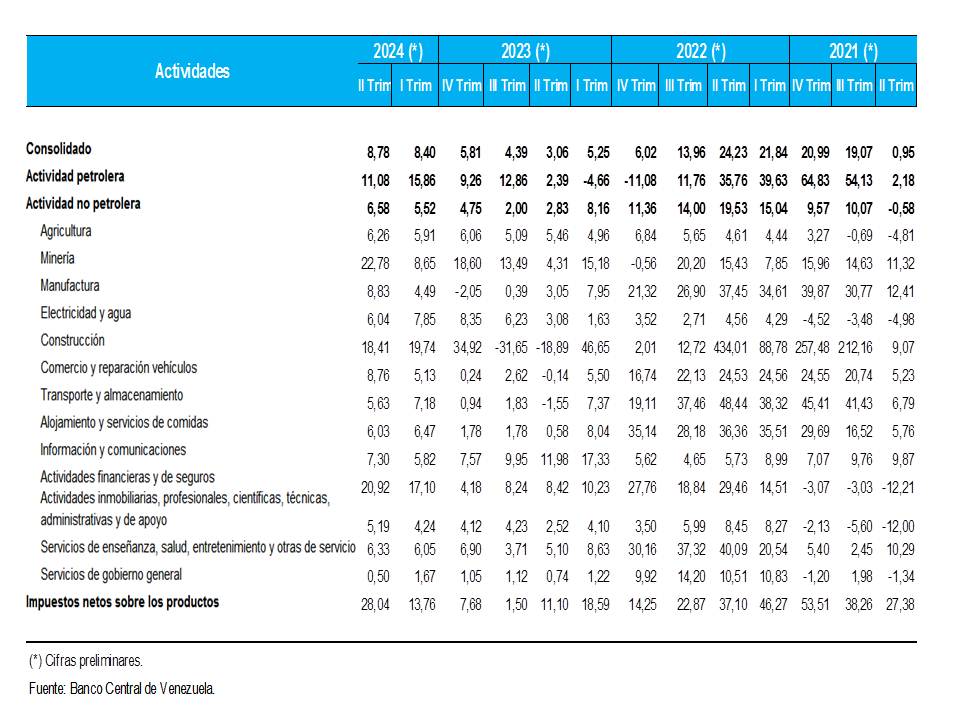
The GDP reported by the BCV shows signs of economic growth driven by the recovery of oil activity. In its update to the second quarter of this year, the United Nations Development Program (UNDP) report “Macroeconomic Performance of Venezuela” projects a GDP growth of 6.1% for the end of this year, and specifies that the variation will be driven by the recovery of oil activity (14.2%) and non-oil activity (4.7%).
Vice President Rodríguez, for her part, estimated that “the Venezuelan economy should be closing, as the president has said, above 9% in 2024. The projections made by the International Monetary Fund (IMF) are between 4 and 5%, but they are signs of an economy that is showing positive aspects for developing its productive capacities and the great potential that Venezuela has.”
The positive growth is attributed by the UNDP to higher oil revenues from crude oil exports, which rose by around 49% in the first half of the year.
This has also been influenced by lower discounts for marketing, the relaxation of sanctions via the US OFAC oil licenses, the improvement in the prices of the Venezuelan basket (17.5%) and a higher export volume (5.8%) in the period.
In addition, accumulated inflation at the end of June stood at 8.9%, lower than that recorded in the first six months of 2023 (108.4%). This greater price stability favored economic transactions, and also boosted investments and credit.
The exchange rate peg policy, facilitated by increased cash flow, stabilized the official exchange rate and reduced inflation levels. While the official exchange rate only increased 1.3% in the year, much lower than the 60.3% recorded in the same period of 2023, the accumulated inflation at the end of June was 8.9%, lower than that recorded in the first half of 2023 (108.4%).
2. Towards diversification: Oil and non-oil exports grow
The UNDP said in the cited report that average oil production in the second quarter was 903,000 barrels per day (b/d), 11.8% higher than in the same period in 2023. The price of Merey crude oil averaged $71.6 per barrel in the second quarter, 21.9% higher than last year.
In June, the country ranked fifth among the countries exporting crude oil to the United States, contributing 3.4% of its consumption. In September, there was a 49.2% increase in oil exports compared to the volume of August, both due to shipments to the Asian continent and to shipments made to the company Chevron.
In October, the highest level in four years was reached: an average of 947,387 b/d of crude oil and fuels, 21% more than the previous month. The Spanish company Repsol has also become a major exporter of Venezuelan crude oil shipments not only to its country and the European continent but also to the United States. PDVSA, for its part, increased its exports to India , a relevant market before the sanctions.
In addition, 314,500 metric tons of petroleum byproducts and petrochemicals were exported, 18% more than what was shipped in September. The increase is due to an increase in crude oil production associated with the stabilization of processing operations in the Orinoco Belt and a recovery of heavy crude oil inventories.
The revival of the oil industry is a goal that has been progressing efficiently, and so, in light of Donald Trump’s victory in the US elections, the Venezuelan government has accelerated the establishment of energy agreements with different countries that are within and outside the BRICS for the consolidation of said growth.
Non-oil exports are also showing significant growth. The Minister of Industry and National Production, Alex Saab, reported that Venezuela has managed to export around $8 billion in non-oil products, thanks to an import substitution plan that seeks to reduce the outflow of foreign currency.
The contribution of these exports to GDP remains a challenge to grow even in the midst of structural factors that still hinder the government’s efforts to diversify the economy and reduce dependence on oil.
However, various decisions have pointed to the creation of Special Economic Zones and the promotion of non-oil exports, the law of which was approved last July.
Based on the aforementioned law, President Maduro created the General Staff of Non-Oil Exports and APEX to reduce the average export period from 34 days to 10 days in the short term. He also created an oversight board for national ports and a special portfolio for facilitation and financing for Venezuelan exporters through the relaunch of the Foreign Trade Bank (Bancoex).
With these actions and the political will of the productive sector, the export matrix could be diversified and the capture of foreign currency from other economic activities in which the public and private sectors play a fundamental role could be stimulated.
3. More production for a full supply
Maduro has stated that “Venezuela has achieved 100% of food production and supply with respect to national production.” This is reflected in the elimination of queues in supermarkets and other commercial spaces; there is also a greater availability of medicines and drugs in the establishments.
According to the aforementioned UNDP report, in the first half of 2024, sales in supermarkets, warehouses and supply stores grew by 17.7% compared to the same period in 2023. The sectors that grew the most were home maintenance (42.6%), food (37.1%), proteins (23.3%), dairy products (22.6%), medicines (21.2%) and personal care (17.2%).
The document projects that, by the end of the year, domestic aggregate demand will grow by 8.0%, with increases in private consumption (5.9%), public spending (1.9%) and fixed capital formation (15.8%). This implies a greater dynamism of private capital, which has increased its investment in manufacturing, pharmaceuticals and food.
Data from Conindustria’s Statistical Information System (SIEC), corresponding to the second quarter of 2024, indicate that industrial production in the private sector grew by 23.1% compared to the same period in 2023. There was growth in sectors such as wood and paper (67.2%), plastic and rubber (41.8%), pharmaceuticals (38%), beverages (29.3%) and food (19%). In addition, the Venezuelan pharmaceutical industry supplies 70% of the national market and protein production aims for 100%.
It is worth noting that national supply increased from 3% to 97% in 9 years, which President Maduro attributes to “an economy that produces goods and services to supply the entire country. In addition, the domestic market, entrepreneurship and productive activity are growing.”
National production has supported the growing satisfaction of the population’s food needs with new brands and products . Economic actors, in constant dialogue with the government, have credits to promote the development of companies and national production, as the president has guaranteed in various speeches.
Amid efforts to counteract the effects of sanctions and the blockade, purchasing power and the quality of public services remain challenges and opportunities to move towards better living standards for the population. In retrospect, much has been achieved. A key marker has been the reduction in inflation levels, which stabilizes purchasing power.
Inflation, which reached a cumulative rate of 5,758% in October 2019, reached 43% in the same month of the current year, while the interannual variation reached 51%. UNDP projections for the end of the year were around 26% and average inflation around 46%, which would have allowed it to reach its lowest value in the last 11 years.
Growth increases the demand for foreign currency, the Vice President said, adding that the government “has to perform a surgical operation to reduce the gap because all kinds of distortions are generated.”
President Maduro has reiterated that the country’s economic strengthening is achieved through its own efforts, without the intervention of the IMF or the World Bank. This “own path” maintains dialogue, productivity and the defense of social income as premises, combining the efforts of various productive and financial sectors, and establishing agreements with global partners that promote multipolarity.
Venezuela is preparing for a complex geopolitical scenario in 2025 after having managed the recent critical situation. Many challenges remain in the economic sphere, however, progress has been fundamental to the consolidation of objectives in order to balance a productive and sovereign economy.
 Chicago ALBA Solidarity
One thought on “Three Facts that Tell of Venezuela’s Economic Takeoff”