
https://orinocotribune.com/vice-president-rodriguez-highlights-venezuelas-capacity-to-face-economic-warfare/
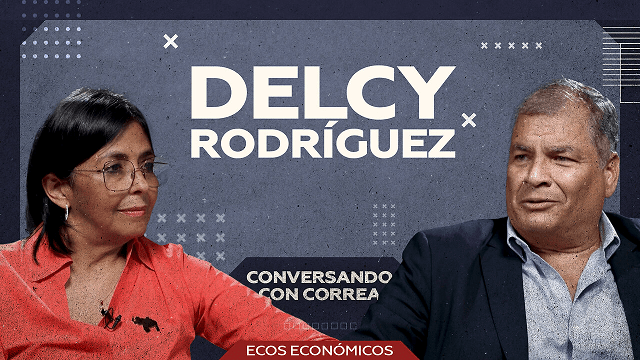
The Executive Vice President of the Republic, Delcy Rodríguez, described the resistance of the Venezuelan people to the difficulties created by the sanctions regime imposed on the country by the United States as a true miracle. She expressed this to the former Ecuadorian president in the program “Conversando con Correa”, broadcast by the international news network RT in Spanish.
Rodríguez pointed out that in terms of GDP, the impact of the measures meant the loss of more than $632 billion between 2015 and 2020, which created a dramatic negative impact not only on health, education and food but also on the income of the working class in general.
However, under the leadership of President Nicolás Maduro, strategies were designed that have allowed for a gradual recovery in the most affected areas, which has shown the world that “it is possible, basically, to be independent of Washington’s mandates, that sovereignty can be preserved, with dignity and historical morality.”
.
Venezuelan Vice President Delcy Rodríguez highlighted the historical capacity of the Venezuelan state in the face of the economic warfare suffered in recent years due to the imposition of illegal sanctions by the United States government.
During an interview on the television program Conversando con Correa (Talking with Correa), hosted by former Ecuadorian President Rafael Correa, Vice President Rodríguez said that Venezuela is setting a very important precedent in economic matters by registering one of the highest growth rates in Latin America.
“[It is] A real milestone to recover its economy, showing a capacity for resilience that has not been seen in any country in the region or the world. And this has been evident during the COVID-19 pandemic, where the economic crisis was global,” she said.
In this regard, Rodriguez said, “Venezuela is standing up, setting an example and showing that it is possible to be independent” from Washington’s authority. “It is possible to preserve the sovereignty of a country with dignity and historical morality,”
MIGRATION AND DIFFICULTIES
The Executive Vice President referred to the social wounds inflicted by the sanctions and what the deterioration of public services and social rights has meant for the daily life of the Venezuelan people. However, in contrast, she stressed that the Venezuelan government’s disposition has been to defend a model of social justice, which privileges universal access to rights and guarantees.
Addressing the issue of migration, Rodríguez pointed out the need to approach the problem with rigor because the evidence shows that “there was a very well-articulated plan” not only to encourage it but, as was later demonstrated, to exploit it against the Venezuelan state.
“The economic blockade created conditions of great hardship in our country, but it was also a very well-articulated plan. When we review the years of migration, the first phase was aimed at extracting Venezuelan talent in the area of public services, in the oil industry, in our electric company, the exodus of public talent, in the doctors of Venezuela. Then came a final stage that was a more massive migration of the popular sectors.” Rodríguez also said that all of this aimed at the declaration of a humanitarian crisis by the far right, which the United States could use as a pretext to invade Venezuela.
Statements by senior US officials anticipating intervention if a “humanitarian crisis” occurred reveal a calculation that is a double standard of foreign policy. Suffering has been used as a tool to promote regime change.
SANCTIONS AND CHANGE OF REGIME
Noting that in December 2024 Venezuela will complete a decade of sanctions and economic blockade, the Minister of Petroleum also commented that these types of measures, implemented against countries that are “inconvenient” for Washington, respond to a precisely designed system that incorporates the military industries and transnational communications companies, so it cannot be seen or analyzed in isolation.
There are two main reasons for regime change, she said. The first is associated with the vast natural resources that the country has, mainly oil and gas. The second is related to the “bad example” that the Bolivarian socialist model represents, which “speaks to the world” from its own place, “not from unilateral positions, nor from hegemony” but by claiming sovereignty, non-interference, and championing multipolarity.
Regarding the United States’ illegal sanctions policy, Vice President Rodríguez said that it is an anomalous behavior that represents an open violation of international laws and norms, including the United Nations Charter.
By ignoring the principles of sovereignty, territorial integrity and non-intervention, such measures undermine the foundations of international order and endanger global stability, peace and security. “Economic warfare has become the main instrument of US foreign policy.”
The clearest manifestation of this war is through sanctions, confiscation of assets and the recognition of illegitimate figures that hijack the essential formality of the State and its institutions.
Venezuela, under the figure of Juan Guaidó, is a clear example of such a strategy. There were no real political changes, but the nation was stripped of “more than $22 billion in accounts abroad and allowed the United States to appropriate and steal Citgo from us.” Starting in 2024, “US transnationals, mainly Exxon Mobil, are stealing Venezuela’s oil and gas from a territory that is under a territorial dispute.”
“The warning is for the countries of the world: Can you be sure that your assets in the United States will not be seized? No. Can you be sure that your international gold reserves, which are in the Bank of England, will not be illegitimately appropriated? You cannot be, because it will depend on the political and geopolitical vision of those governments to determine whether they will be able to respect those assets or not. So it is a call to the countries of the world: Attention! Danger! Your assets are in danger, your money in the West is in danger, that is why a new world is being built.”
Rodríguez called on the peoples of the world to observe the scenario being created. “That is why we must pay attention to what is happening, because their assets are in danger, as is their money. They should not suffer the same fate as is happening in Venezuela with the theft of their assets and their wealth. That is why we must be careful with what is happening in the West.”
“There is a world beyond them, beyond their borders. There is a world that wants to change. There is a world in Africa, Asia, and the Middle East that wants a world where we all participate as an independent community of sovereign nations,”
There has been no change in the US administration, she said, and the sanctions policy remains intact despite certain “licenses” granted. The imposition of this system of exemptions seeks to replicate the colonial model of economic control, similar to that exercised by the Guipuzcoan Company.
A WORLD BEYOND THE UNITED STATES
On the other hand, she stressed that the United States must recognize that there is a world beyond its borders, a diverse world that aspires to a fair and equitable international order, where all countries have a voice and a vote. This new order should not be dictated by a single power but by a community of sovereign and independent nations.
Taking stock of the state of integration in the region, the Vice President pointed out the levels of political and ideological dependence that characterize it, which means that in the 21st century we continue to be the most unequal, most disconnected region with the least interdependence between our countries.
The goal, she says, is to strengthen the region’s own economic and political capabilities in order to advance the consolidation of a project of integration and, beyond that, of regional unity. “How can we do it? By strengthening our sovereignty, our own economic and financial channels, where foreign trade is correlated with the use of national currencies. One strategic aspect is to defeat the hegemony of the dollar. We have seen it, we have shown numbers in which the dollar still has a lot of strength as a reserve currency, where it still has strength in financial transactions; but as new financial channels emerge in the world, we will be able to be freer.”
Rodríguez concluded by pointing out the need to promote a new regional geopolitical concept that presents us to other areas of the planet as a cohesive area, with clear and specific objectives, that responds to our own interests and is not just a simple piece in the international geopolitical chess game.
Thus, the possibility of building an alternative international order to the declining hegemony of the United States is no longer just a necessity for the countries that are currently under illegal sanctions, but also implies an urgent sense for the integration processes of Latin America and the Caribbean, which must be accelerated under their own geopolitical impulse so that the region can maneuver with effective independence in a scenario of decisive geopolitical readjustment. This remains the geopolitical priority and the vision of Venezuela on the international level.
“That is why we must pay attention to what is happening, because their assets are in danger, as is their money. They should not suffer the same fate as is happening in Venezuela with the theft of their assets and their wealth. That is why we must be careful with what is happening in the West.”
“There is a world beyond them, beyond their borders. There is a world that wants to change. There is a world in Africa, Asia, and the Middle East that wants a world where we all participate as an independent community of sovereign nations.”
 Chicago ALBA Solidarity
One thought on “Rafael Correa interviews Venezuela Vice President Delcy Rodriguez: Venezuela’s Capacity to Face Economic Warfare”