
https://misionverdad.com/venezuela/los-logros-indiscutibles-de-nicolas-maduro-en-el-ambito-economico
Venezuela has traveled a tortuous economic path in recent years, marked by the imposition of economic sanctions by the United States and its European satellites. These measures have meant great losses for the country, estimated at $232 billion.
In this context, the achievements and economic advances obtained under the leadership of President Nicolás Maduro acquire even greater value, since they have been achieved in a minefield of adversity.
Below we will examine the government’s most notable strategies to mitigate the impact of sanctions and lay the foundations for economic recovery, which constitute its calling card for the re-election of President Nicolás Maduro.
A DECADE OF LOW INFLATION
Hyperinflation has been the threatening shadow that has stalked the Venezuelan economy during the last decade. However, since the end of 2023, a marked slowdown in the inflation rate has been observed – which began in 2018 – a sign of the effectiveness of the economic policies implemented by the Maduro government.
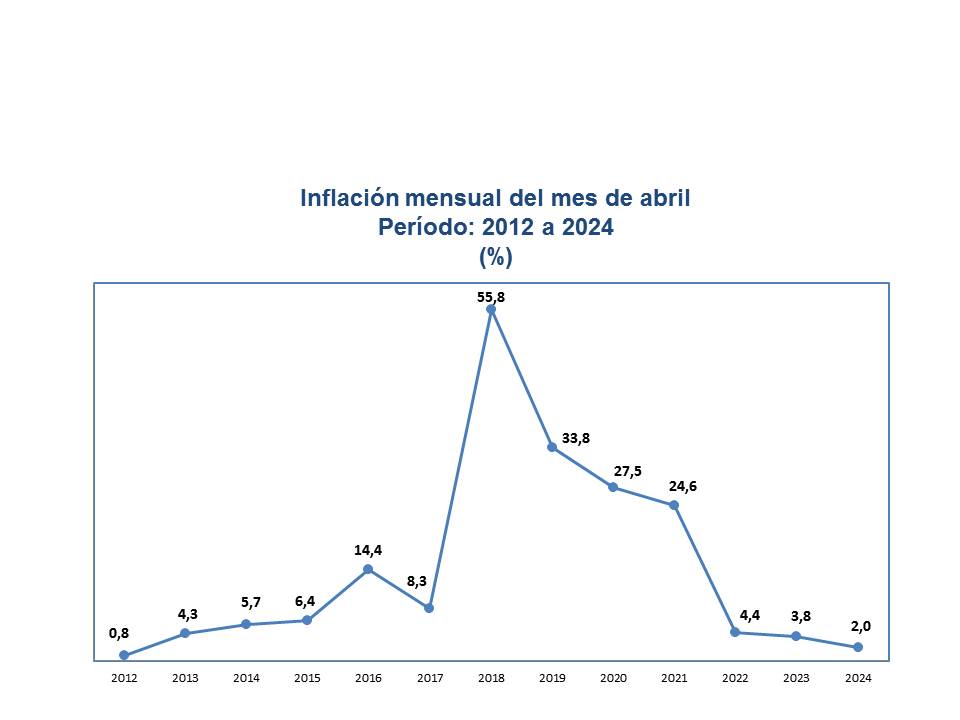
Monthly inflation for the month of April, period 2012 to 2024 (%)
The inflationary escalation that Venezuela experienced starting in 2014 was the result of a confluence of adverse factors. The fall in international oil prices, the fundamental engine of the Venezuelan economy, together with the economic war characterized by speculation, hoarding and exchange manipulation, created a favorable scenario for the acceleration of inflation. The imposition of economic sanctions by the Donald Trump government starting in 2017 aggravated the situation by restricting access to international markets and limiting the Venezuelan government’s ability to maneuver.
Against this backdrop, the Maduro government implemented a set of economic measures characterized by its heterodoxy, creativity and gradual approach. The exchange rate policy, initially anchored to a rigid exchange control, has transitioned towards a managed floating system, which has sought a balance between the supply and demand of foreign currency. Measures have been implemented to restrict monetary liquidity in order to contain inflationary pressure, which is leaving compelling results:
- Falling inflation : By December 2023, annualized inflation fell to 2.4%, the lowest figure since 2013, marking a turning point in the fight against hyperinflation.
- Constant deceleration : In 2024 the downward trend has been consolidated. In April 2024, the month-on-month variation of the National Consumer Price Index (INPC) was only 2%, the lowest in 12 years.
- Accumulated inflation under control : Accumulated inflation so far in 2024 is 6.3%, the lowest level recorded in the January-April period in the last 12 years.
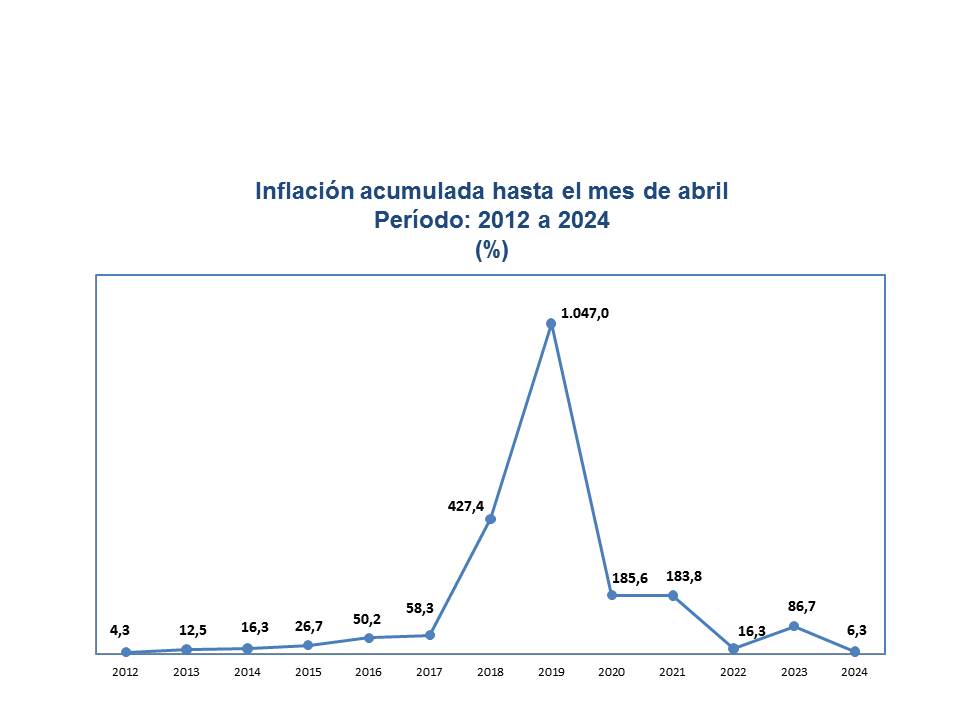
Accumulated inflation until the month of April, period 2012 to 2024 (%)
REDESIGNING THE EXCHANGE SYSTEM
The government of President Nicolás Maduro has managed to advance significantly in the exchange system in Venezuela through a successful strategy that has guaranteed stability in this area. Since October 2023, the BCV [Central Bank of Venezuela] reference exchange rate has remained at 36.5 Bolivars/USD. This situation has allowed the gap with the parallel dollar to be reduced, and thus distortions in the exchange market have been avoided and has contributed to containing the escalation of prices and, therefore, inflation.
A notable aspect of the exchange rate policy implemented by the Maduro government is the active participation of the private sector in the foreign exchange market. Projections suggest that the total volume of foreign currency traded in 2024 could exceed $18 billion, of which 78% would come from this sector. This change in model promotes the abandonment of oil rentism and promotes a more diversified and solid economy.
Likewise, the management of monetary liquidity has been crucial to maintaining macroeconomic stability. Containing liquidity through high levels of Bank Legal Reserve has been a sound strategy, but the government has also demonstrated flexibility by relaxing monetary policy to stimulate economic growth. And although this has led to an increase in credit and monetary liquidity, the supply of foreign currency has managed to maintain the stability of the bolivar against the dollar.
We see then how the stimulation of private sector participation and the responsible management of monetary liquidity have become fundamental pillars of this new paradigm in the exchange system, which has demonstrated its ability to facilitate growth despite the continuity of American economic pressures through sanctions.
FROM DEPENDENCE TO AGRI-FOOD SOVEREIGNTY
Venezuela has also experienced a profound transformation in its agricultural sector by managing to reverse its historical dependence on imports, which has led to guaranteeing internal supply in the context of the blockade.
The Venezuelan government has promoted the relaunch of the Great AgroVenezuela Mission, the flagship program of Commander Hugo Chávez. This effort has been the key to boosting the agricultural sector, a foundation that has allowed Venezuela to go from 85% dependence on food imports to producing 97% of the food consumed by its population.
In February of this year, the country recorded 14 consecutive quarters of growth in agricultural production. Meat production has increased 5% in the last five quarters and the livestock population has grown 3.9%, reaching almost 30 million heads of cattle, sheep, goats and buffalo. This growth, driven by local production, has allowed internal consumption of red meat to increase and diversify the food supply.
The new economic dynamic, with a strengthened agricultural sector, has opened the doors to the export of agri-food products. Venezuela is projected as a potential meat exporter. Aquaculture production has also recorded important figures, with a 25% growth in white shrimp production and a 78% increase in sardine production, both with potential for export.
The success of the Great AgroVenezuela Mission is not limited to the economic sphere. The increase in agri-food production has had a direct social impact, and thus the food security of the population has been guaranteed. The Local Supply and Production Committees (CLAP) program, which distributes food to 7,600,000 Venezuelan families, is 97% nourished by national products. This achievement is especially significant in the context of economic sanctions, which have sought to suffocate the economy and generate social unrest.
The transformation of the Venezuelan agri-food sector under the leadership of Nicolás Maduro is an example of resilience. The nation has shown that it is possible to overcome dependence on imports and guarantee the food security of its population, even in an adverse context.
 Chicago ALBA Solidarity
2 thoughts on “The Indisputable Achievements of Nicolas Maduro in the Economic Field”