
Sputnik: Nicaragua fortalece su posición bioceánica con la expansión de su infraestructura vial
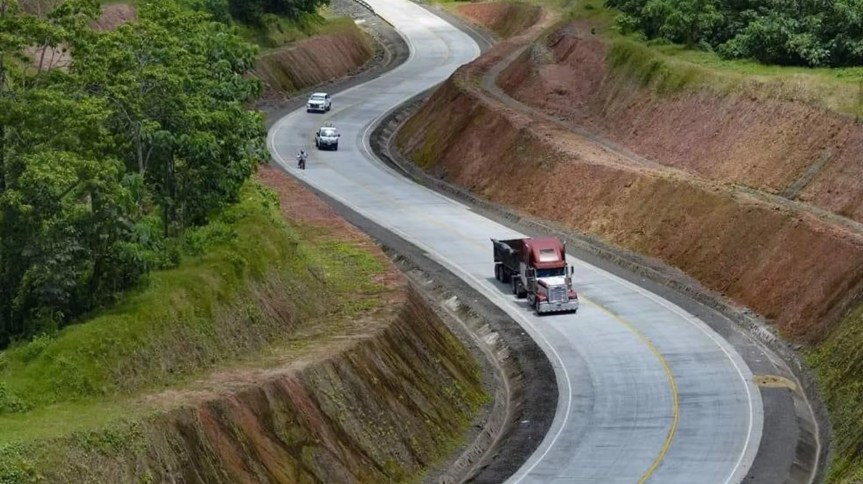
Nicaragua was positioned as the country with the best roads in Central America and the fifth in Latin America with the highest quality road infrastructure, according to estimates by the World Economic Forum in its 2019 report.
The country’s road expansion constitutes one of the main growth strategies that lead it to develop as a regional connectivity platform, with the construction of land, water and air routes, Oscar Mojica, the head of the Ministry of Transportation and Infrastructure, told Sputnik.
“Nicaragua, within the framework of Latin American countries, is in fifth place with the best roads. Nicaragua has not only been making great progress, but has put itself at the forefront of more advanced countries with modern roads and land communication routes in the region,” the official said.
Since 2007, the Government of Nicaragua has prioritized the development of road infrastructure and the interconnection with the strategic corridors of the territory, with a growth of 870%, which is materialized in 5,335 kilometers of concrete roads. “It has been a titanic effort,” he said.
Poverty reduction
According to Mojica, promoting the construction of roads to strengthen the logistics chain of industries, construction and electricity generation has had an impact on the fight against poverty.
“This expansion of land roads has contributed to reducing poverty from 48% to 24% and has been the main factor in reducing extreme poverty from 17% to 6% in our country; now people have better conditions to work, to produce, to to receive food, to supply inputs, to remove production from agricultural areas,” the official said.
“We really feel the effort that the Sandinista government has made, with an impact in 146 of the 153 municipalities of Nicaragua, 95% of the municipalities of Nicaragua are connected to the trunk road network, when before it was only connected in 48% of the municipality, today 95% are connected to the network,” Mojica explained.
Investment in roads for transportation and commerce is not only a factor of economic growth, it also impacts the social development of rural communities located in mountainous areas of the Central American country, he noted.
“It means medical care, educational care, the solution to the big problems demanded by different social sectors, education programs in the countryside, school snacks, school backpacks, universities that are expanding throughout Nicaragua: Today we find ourselves at universities in remote areas of Nicaragua, now there are graduations in the depths of the mountains,” he added.
coastal road
In 2023, Nicaragua began the construction of the coastal highway, which will cross 437 kilometers of the Pacific coast, from El Naranjo beach, in the south of the department of Rivas, to the coasts of Potosí, in the west of Chinandega.
“This promise of the coastal highway was made by neoliberal governments for decades without fulfilling, the Sandinista Government recently raised it as a project that we offered to the population, which President Daniel Ortega promised to do among the population, today it is being carried out in practice, let’s say, in an extraordinary way,” said the Nicaraguan minister.
The “costanera,” as Nicaraguans call it, is seen as a circuit for the tourist, productive and fishing industry, because it will allow access to 74 communities and 53 beaches on the Pacific.
The first phase of the construction of 58 kilometers of the highway began in July 2023 on the coast of the department of Rivas, bordering the Pacific of Costa Rica, where the beaches most visited by international tourism are located due to their scenic beauty and your preference for surfing.
Tourism impact
“There are the best beaches in Central America, without a doubt, and we feel very proud because we are advancing very quickly, we are working day and night taking advantage of the summer conditions to advance as much as possible,” said Mojica.
“It is a road that has its complexities, it has to go through tourist centers, it has to go through properties, we have received a wonderful response from the land owners, they have supported us, they have supported us, they have made it easier for us to pass through their properties and the legalization of these properties in favor of the State for the construction of the highway in 99.5% of the cases,” said the head of the agency.
By 2024, Nicaragua plans to consolidate the construction project of a deep-water port in Bluefields, located 360 kilometers east of Managua, whose estimated value is $600 million.
The Government of President Daniel Ortega signed with the Central American Bank for Economic Integration (CABEI) the memorandum of the collaboration framework for the project of the main port city of the southern Caribbean, which achieved land connectivity with Managua until 2019.
Bi-oceanic position
“We are culminating the efforts of Nicaragua’s interoceanic communication with the construction of the future port of Bluefields, it is a wonderful work, dreamed of, but that is becoming a reality. This management on the Caribbean coast will strengthen Nicaragua’s position as a bi-oceanic country, to facilitate international trade, to also facilitate the exports and imports of our products,” he described.
Nicaragua’s road expansion strategy profiles this country as a large-scale regional connectivity platform, after signing a series of agreements for the financing and construction of air, land, and energy infrastructure promoted by China, through its Belt and Road Initiative.
In December 2023, Nicaragua obtained credit for the construction of its first 4F [first tier hub] airport, led by the Chinese company CAMC Engineering Co. Ltd., for a value of $491.5 million, according to the Asian company.
The terminal will be built at the Punta Huete airport, 70 kilometers from Managua, where a military base operated in the 1980s, when the Central American country faced a war financed by the United States.
“This airport, Punta Huete, is being built at a time when the expansion of airport activity in our country is at a high level, there are conditions for a new airport, it is a vital need because it is also another of the fundamental pillars of development of the national economy,” concluded the Minister of Transportation and Infrastructure.
.
Nicaragua consolidates: “Three consecutive years that the economy has been expanding”
Nicaragua se consolida: “Tres años consecutivos que la economía se viene expandiendo”
Nicaragua’s economy is experiencing a stage of moderate but sustained expansion: with growth in the Gross Domestic Product estimated above 4%, despite the regional forecast of low progression by the Economic Commission for Latin America and the Caribbean (ECLAC).
To find out the elements that came together in the recovery of this country, which went through a fluctuation after the failed coup d’état of 2018 and the impact of the COVID-19 pandemic, Sputnik spoke with the president of the Central Bank of Nicaragua (BCN), Ovidio Reyes, and with the deputy of the National Assembly Wálmaro Gutiérrez.
“We had a cyclical moment of recession when there was a shock to the economy for internal socio-political reasons, and then there was an international shock, which was the COVID pandemic, that caused the economy to decrease and have negative rates, but then came a moment of recovery and a moment of expansion,” stated Reyes.
“We are in a moment of expansion, three consecutive years that the economy has been expanding with economic growth, it is a moment that can be felt in commerce, in vehicular circulation, in the movement of people,” added the president of the financial institution.
Resilient economy
The final statement of the technical mission of the International Monetary Fund that visited Nicaragua from November 6-17 to evaluate the macroeconomy and the outlook for 2024, indicates that the country has maintained “its resilience in the face of multiple shocks thanks to appropriate economic policies, considerable buffers and multilateral support (…) with favorable economic prospects and balanced risks.”
The organization considered that, given the record level of remittances and the increase in exports, Nicaragua’s economy will continue to rise by 4% at the end of 2023.
“We believe that the economy is going to have a higher projection than that of the IMF, the economy is going to be exactly at 4.5% and that is good because what we are observing is a positive economic dynamism with a commercial sector, hotel, restaurant, but also economic activities such as finance, the manufacturing industry, which are bidding. That is, we already have consolidated economic growth and the engine is very well on,” Reyes said.
For the senior official of the issuing bank, one of the keys to Nicaragua’s economic strengthening is the reduction in inflation, recorded at 5.65% last November, when at the end of 2022 it stood at 11%. “We believe that in December this will end in a specific estimate of 5%,” said the Nicaraguan official.
Other indicators that present the country with financial strength is the historical record in the accumulation of international reserves, which will total around $5.3 billion in 2023, as well as the rising tourism industry.
Financial adjustment
The increase in the fiscal deficit in world economies as a consequence of geopolitical phenomena, as well as global inflation resulting from the COVID-19 pandemic, forced the Government of Nicaragua to take measures to prevent capital flight, which resulted in a high financial profitability in 2023.
“Just as the rise in prices was transferred to Nicaragua, the drop in inflation in the world is also translating into price drops in Nicaragua, which implemented actions. The BCN increased its interest rates, that is, we also gave a signal of adjustment, we increased the cost of financing, if we did not do so, we could have capital flight,” he explained.
“In order to maintain capital in the country we have to make it as attractive as outside, and we believe that the rate that the BCN set at 7% is an acceptable rate for the economy,” said the president of the bank. The positive behavior of the different economic agents of this Latin American nation comes from a “prudent” macroeconomic policy, according to the IMF.
In this sense, Congressman Gutiérrez, member of the Nicaraguan Economic Cabinet, highlighted that the set of budgetary, tax and monetary policies has fostered macroeconomic conditions with clear rules of the game, which have increased foreign direct investments, exports, remittances, collections and international reserves, indicators of an expanding economy.
“We closed the year 2022 with $1.8 billion in foreign direct investment, and according to the Central Bank, the projection is that in 2023 we are closing with no less than $2 billion in foreign direct investments. That is a revealing fact, because when we talk about investment this is like a thermometer, they measure the health of the economy in real time,” said the parliamentarian.
“No investor with a brain is going to risk in a country where they are not offered the conditions for their investment to prosper with clear and pre-established rules of the game,” he added.
Income on the rise
Nicaragua also registered a budget surplus due to the increase in direct and indirect tax collection in 2023, which will allow spending next year to be guaranteed with its own resources, said the legislator, who chairs the Economic and Finance Commission of the National Assembly.
“As all economic agents have been reacting very positively with fiscal, tax, budgetary and monetary measures, and all indicators have been on the rise, this means that there is greater generation of wealth that will guarantee the financing of spending and a supply for any eventuality, such as the rise in oil prices,” he said.
“In the face of a hurricane, an epidemic, in the face of rising food prices, you have financial support that will allow you to face those eventualities,” Gutiérrez confirmed.
The budget surplus will allow the Central American country to guarantee the subsidy policy for fuel, energy and drinking water services, public transportation in Managua and the Caribbean, retirees and universities, a dynamic that also allowed the Central American nation to contain the effects of global inflation during 2023.
“One cannot give what one does not have. When we say that we have financed the chain of subsidies in the budget it is because we have the resources to cover them and they do not come from loans or donations, they come from the fiscal effort of Nicaraguans,” confirmed the representative of Parliament.
Challenges
According to the president of the Central Bank, Nicaragua declares that it is better prepared to face the challenges of global geopolitical “swings”, the inflationary crisis and the consequences of climate change, after the experience left by the failed coup of 2018, the of hurricanes Eta and Iota in 2020 and the impact of the pandemic in subsequent years.
“These vicissitudes and these shocks have been well managed even with a lower financial position, and now that we are in a much better financial position we believe that we are with better strength and greater capacity to confront them,” said Reyes.
“So in 2024 we would expect lower inflation, we would expect foreign direct investment to continue, the boost to exports, which are the fundamental pillar by which the Nicaraguan economy moves,” he added. “So we see a positive 2024, with expansion, with optimism, with a low unemployment rate that is oscillating between 3% and 3.5% and with businesses and entrepreneurs growing,” he said. The Central Bank of Nicaragua recorded a 3% growth in exports valued at $3.449 billion as of October 2023, while family remittances reached more than $3.8 billion as of October.
 Chicago ALBA Solidarity
2 thoughts on “Nicaragua strengthens its bi-oceanic position with the expansion of its road infrastructure; Nicaragua consolidates: “Three consecutive years that the economy has been expanding””