
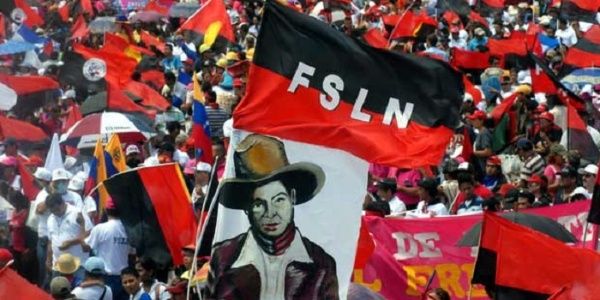
17 de Revolución. ¿Y qué? by Fabrizio Casari
(edited version in English)
Nicaragua The 17th year of Sandinista Government
On January 10, 2007 Daniel Ortega became President of Nicaragua again. 17 years have passed since the return of Sandinismo to the government, during which time the greatest process of modernization in Nicaragua has occurred. It would be long to list the achievements both in social policies and at the macroeconomic level, but the general and detailed figures confirm extraordinary results for a small country of just over 6 million inhabitants, which had inherited debts and misery and was constantly attacked by the giant from North.
Sandinismo raised hopes, and now those who wait no longer look to the heavens but to the ground, witnesses that it was fulfilled. The complex of modernization of the country, transformation after transformation, has had an unwavering course, with a clear and non-negotiable direction: the expansion of social rights in concrete terms, with concrete tools to enjoy them.
M&R Consultores has just published its latest survey on the satisfaction of Nicaraguans with the government and its leader. The figures are overwhelming and they are understandable everywhere, North and South. Asking why after 17 years popular credit towards the government and its president is so high may seem like a rhetorical question: when a people sees a government handing over land and houses, that is, returning Nicaragua to the Nicaraguans, they understand that since January 2007 has come to change everything that needed to be changed. The Nicaragua of today is different and distant from that of 17 years ago.
In these seventeen years of victories, the end of an illusion has also been recognized, which believed that businessmen, the right, and the ecclesiastical hierarchies were honest participants in the democratic game. But the greatest defeat was for the doctrine of the vendetta, for those who see Nicaragua as an exclusively North American colony, perhaps the most beloved, but a colony nonetheless. National sovereignty was the only dish that Sandinismo had the followers of this sect swallow. They had thought only of a government that they administered and they found one that revolutionized and continues to do so.
A Revolution Governing
In many ways, in fact, this 17th anniversary speaks of a Revolution. Not only because it carries the meaning and historical proposal of Sandinismo elaborated in the mountains, attempted in the 1980s and achieved in these 17 years. It is a Revolution because just as from 1979 to 1990, in these 17 years it has continued to displace the traditional social, economic and political order of the country.
Not only is there the extraordinary continuity, year after year, of virtuous economic policies, but the transformation of Nicaragua from a country succumbed to adverse economic cycles into a country that generates a different and winning economy within.
Along with a new socio-economic dimension, the political structure of the country has also changed, the balance of power has changed (which, in itself, is already Revolution). Nicaragua is no longer the scene of an internal armed conflict. The coup has been crushed and the institutionalization of the country has reduced the irreconcilable conflict with the right to a political confrontation that is decided on the electoral and parliamentary level.
Today Sandinismo, using the words of Daniel in 1990, no longer governs only “from below” but also from above; It not only defends but plans, it is the lever and the fulcrum of balance, the only guarantor of the new social and political order on which the new Nicaragua is based.
The power relations between classes, the power structures, the role of the intermediate classes, the level of power and interference that religious institutions represent have changed. The identity card of the economy has changed, which also has repercussions on the social organization, now endowed with a middle class previously absent in the history of a division between oligarchs and peasants. The power of Nicaraguan capitalism has disappeared: now 70% of the country’s wealth is produced thanks to public intervention and a family-type economy, with a small and medium-sized business model. Private companies contribute to 30% of the GDP, and there do not seem to be conditions in the short and medium term to reverse these proportions, also because Nicaragua depends on foreign investment capital and not national investment.
In its inability to participate in the country’s growth, COSEP lost a war, not a battle. What it instigated in 2018 [with an attempted coup] has produced the end of a master caste and a coup-mongering right. The FSLN is in its place and Commander Ortega wears the presidential sash with justified pride, by virtue of the political consensus and even the personal trust that his people have once again ratified in him, making him one of the presidents with the highest approval rating in the world. The right, cornered and defeated, continues from the outside with a litany about dictatorship, a cacophonous rite useful to gather money for the bank accounts of parasitic families.
The dimension of the spiritual connective tissue of the country is also completely different today. Although widespread religiosity continues to be a strong element in society, the role of Catholic hierarchies in the country’s political life is profoundly reduced, if not completely absent. A role that has been, throughout the centuries, the crutch of the oligarchy, the consenting machine of Somocismo and the shameless opponent of Sandinismo.
Today, however, Nicaragua is a different world from the one in which the ecclesiastical hierarchies affirmed their primacy, playing a role of overlord between economic and political power, establishing themselves as moral rulers. Their decision to lead the coup d’état forever undermined their credibility and reliability. There is no religious persecution and dialogue with the Vatican has never ceased, as witnessed by the repeated series of returns to the Vatican of priests investigated for subversive activity, the most recent today with Monsignor Álvarez and others. So the dialogue with the Catholic Church continues, respectful, careful and discreet. For Sandinismo, theirs is an exclusively pastoral function and can never become political, and even less a party one. A solution will be found to a confrontation that should not even exist. But without clerical recognition of the clear division of roles, as corresponds to a secular State, it is difficult to hypothesize a synthesis.
In these times, when the word “freedom” is being degraded, it is advisable to continue working each one where we belong, in the sole interest of a just, free, sovereign and Sandinista country.
 Chicago ALBA Solidarity
One thought on “Nicaragua: The 17th year of Sandinista Government”